
In 3 Months, Our AI Agent Increased reply rates from under 5% to 34%, raise close rate from 12% to 67%, and cut CPA from $2,800 to $475 in just 3 months
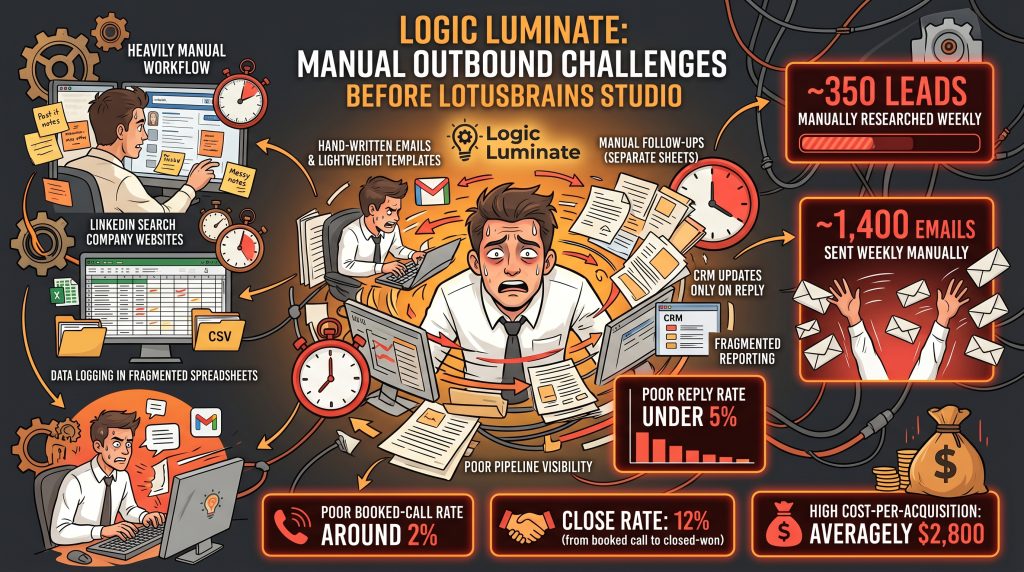
Logic Luminate, a digital marketing agency serving mid-market B2B companies, had a strong offer but a painfully manual outbound process.
We implemented an AI-driven prospecting and outbound system that helped them identify stronger-fit leads, personalise outreach at scale, and operate with far greater consistency.
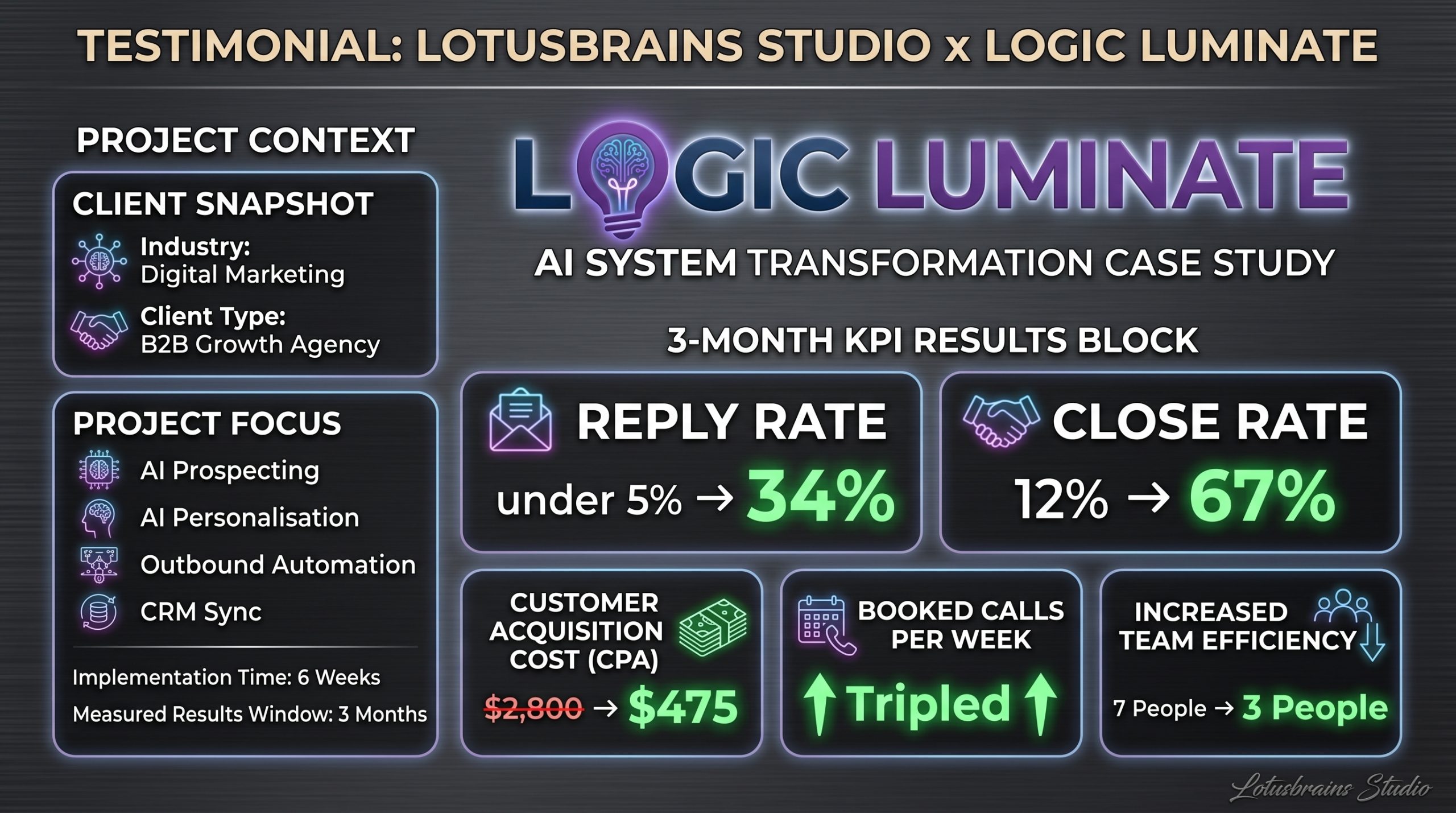
Reply rate
under 5% → 34%
More relevant outreach created stronger first conversations.
Close rate
12% → 67%
Better-fit prospects improved the quality of booked calls.
Booked calls
Tripled
Outbound execution became more consistent and easier to scale.
Customer acquisition cost
$2,800 → $475
The team generated pipeline with far less manual effort.
About Logic Luminate
A B2B growth agency with a strong offer, but an outbound engine that was not built for scale.
Logic Luminate helps businesses grow through strategic marketing, lead generation, and campaign delivery. Their core offer is designed for mid-market B2B companies that want more than generic agency support.
Their ideal buyers are typically seven-figure business owners, heads of growth, or marketing directors looking for a more intelligence-led, results-driven marketing partner.
AI agent solution
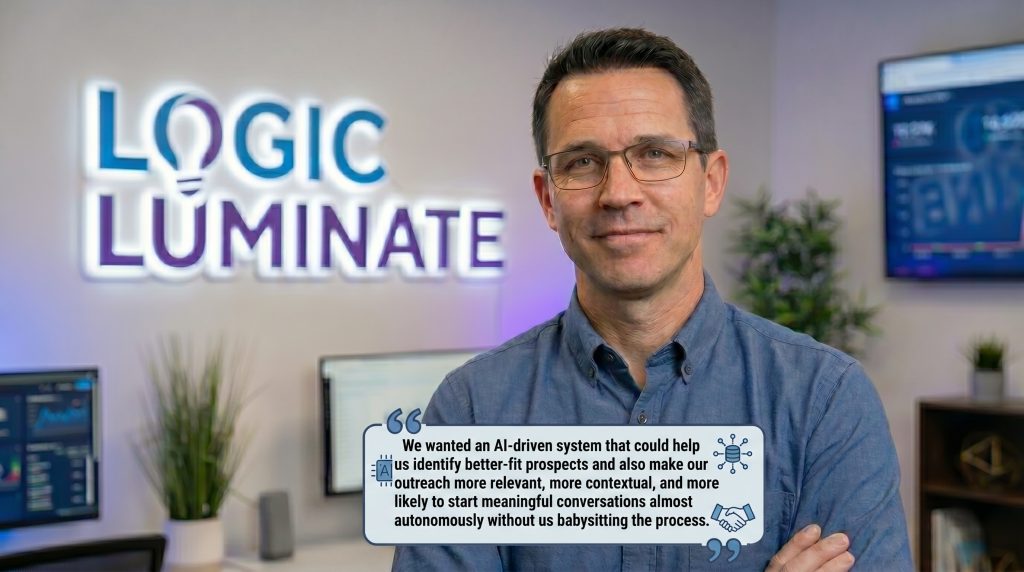
An AI-driven outbound system built around relevance, prioritisation, and scale.
We designed and implemented a multi-layer AI outbound system to help Logic Luminate move from manual prospecting and inconsistent outreach to a more intelligent, scalable growth engine.
The goal was not to create a giant volume machine. It was to help Logic Luminate focus on companies that were more commercially relevant from the start, then give the sales team the context, prioritisation, and workflow consistency needed to convert those opportunities more effectively.
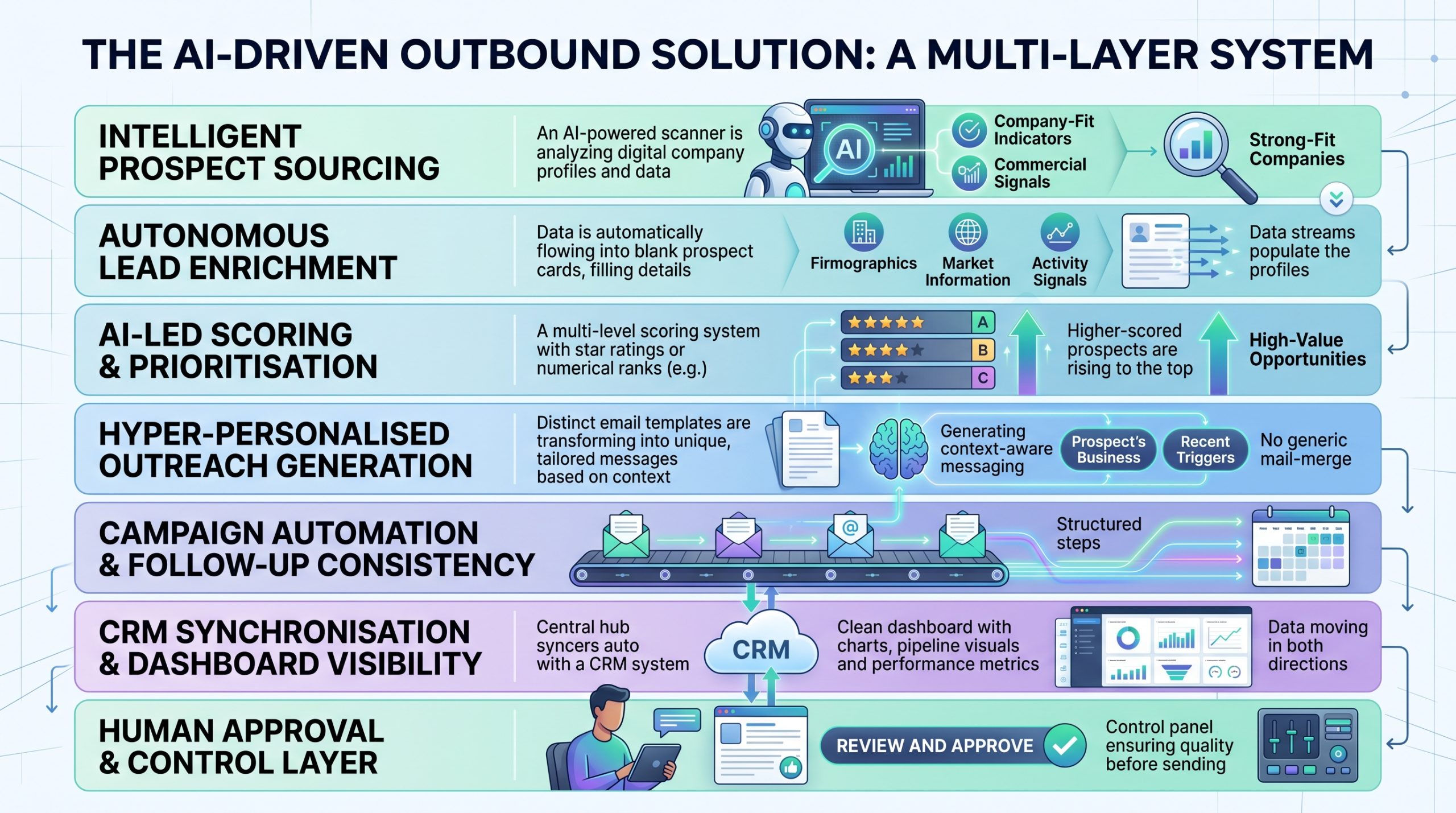
Without revealing proprietary implementation details, the AI agent combined prospect sourcing, enrichment, scoring, message generation, campaign automation, CRM synchronisation, dashboard visibility, and human approval into one controlled outbound engine.
Intelligent prospect sourcing
The AI automation helped identify stronger-fit companies using company-fit indicators and commercial signals, reducing reliance on manual lead hunting.
Autonomous lead enrichment
The system added firmographic, market, and activity context so prospects became commercially useful records rather than names in a spreadsheet.
AI-led scoring and prioritisation
Leads were classified by fit and engagement potential so the team could focus on higher-value opportunities first.
Hyper-personalised outreach generation
Outreach moved beyond cosmetic mail-merge personalisation into context-aware messaging shaped around the prospect's business and likely needs.
Campaign automation and follow-up consistency
Outbound sequences became more structured and dependable, removing reliance on rep memory or spreadsheet tracking.
CRM synchronisation and dashboard visibility
Two-way CRM sync and dashboard visibility created cleaner feedback across lead status, outreach activity, and pipeline performance.
Human approval and control layer
Quality assurance remained built into the workflow, preserving trust, commercial judgment, and brand protection as the system scaled.
Implementation
How the AI outbound system was rolled out in 6 weeks.
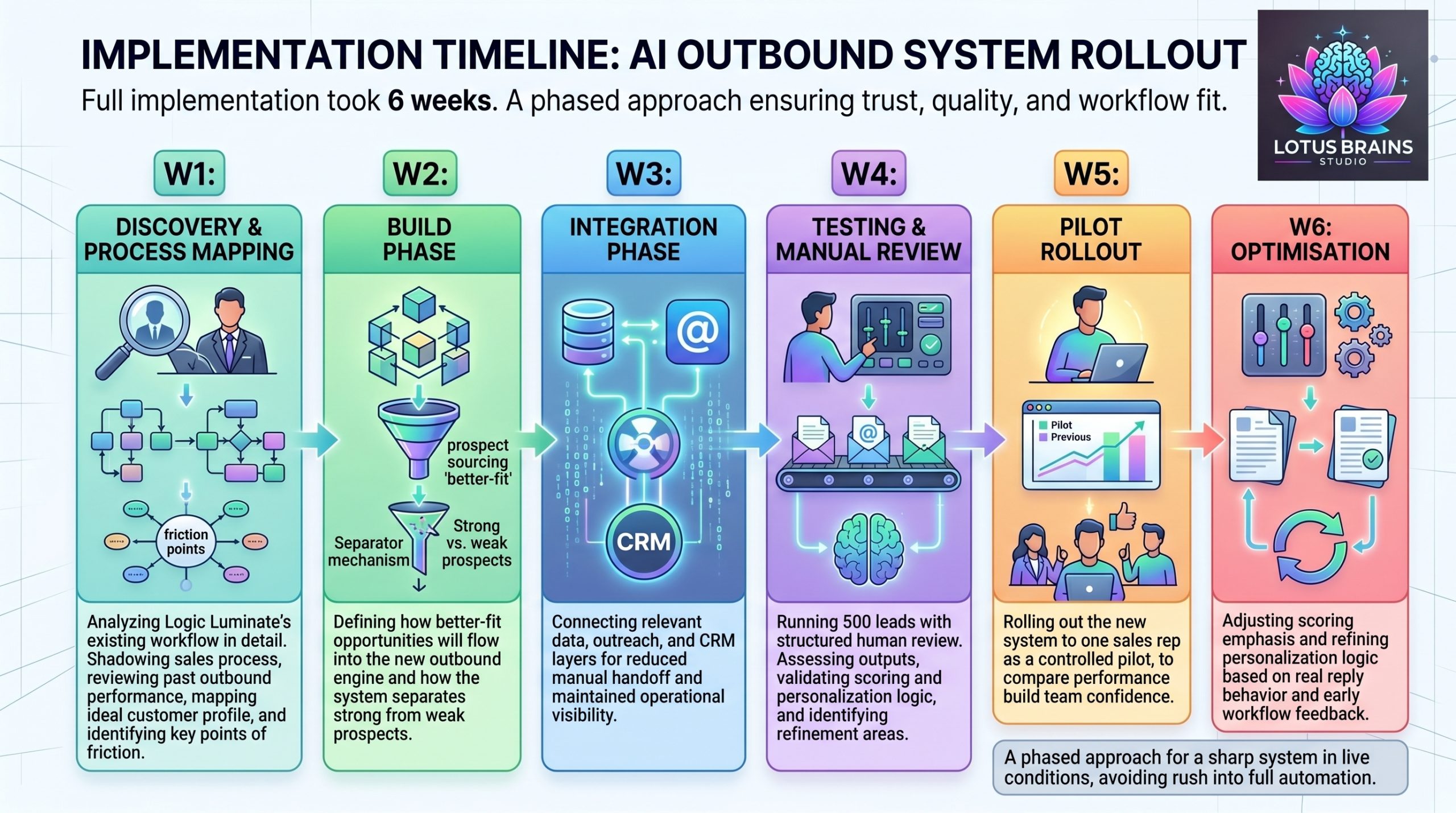
The full implementation took 6 weeks. We used a phased rollout so Logic Luminate could build trust in the AI automaton, validate output quality, and refine the workflow before scaling it across the sales motion.
Discovery and process mapping
We analysed the existing workflow, shadowed the sales process, reviewed past outbound performance, mapped the ideal customer profile, and identified key friction points.
Build phase
We built the prospect sourcing, enrichment, and scoring framework that would become the foundation of the new outbound engine.
Integration phase
We connected the relevant data, outreach, and CRM layers so the workflow could operate with far less manual handoff.
Testing and manual review
We ran 500 leads through the system with structured human review, validating scoring quality, personalisation logic, and commercial fit.
Pilot rollout
The new workflow was rolled out to one sales rep first, creating a controlled comparison point before wider adoption.
Optimisation
Using real reply behaviour and early workflow feedback, we adjusted scoring emphasis and refined personalisation logic for live conditions.
Human oversight and safeguards
Scaling AI without sacrificing control, quality, or brand protection.
One reason why automations from AI agencies fail is that businesses either over-trust them too quickly or force them into workflows with no guardrails. We avoided both mistakes by keeping humans in the loop at the right moments.
Logic Luminate did not want reckless automation, and neither did we. The outbound engine needed to scale responsibly while preserving commercial judgment, message quality, and trust.
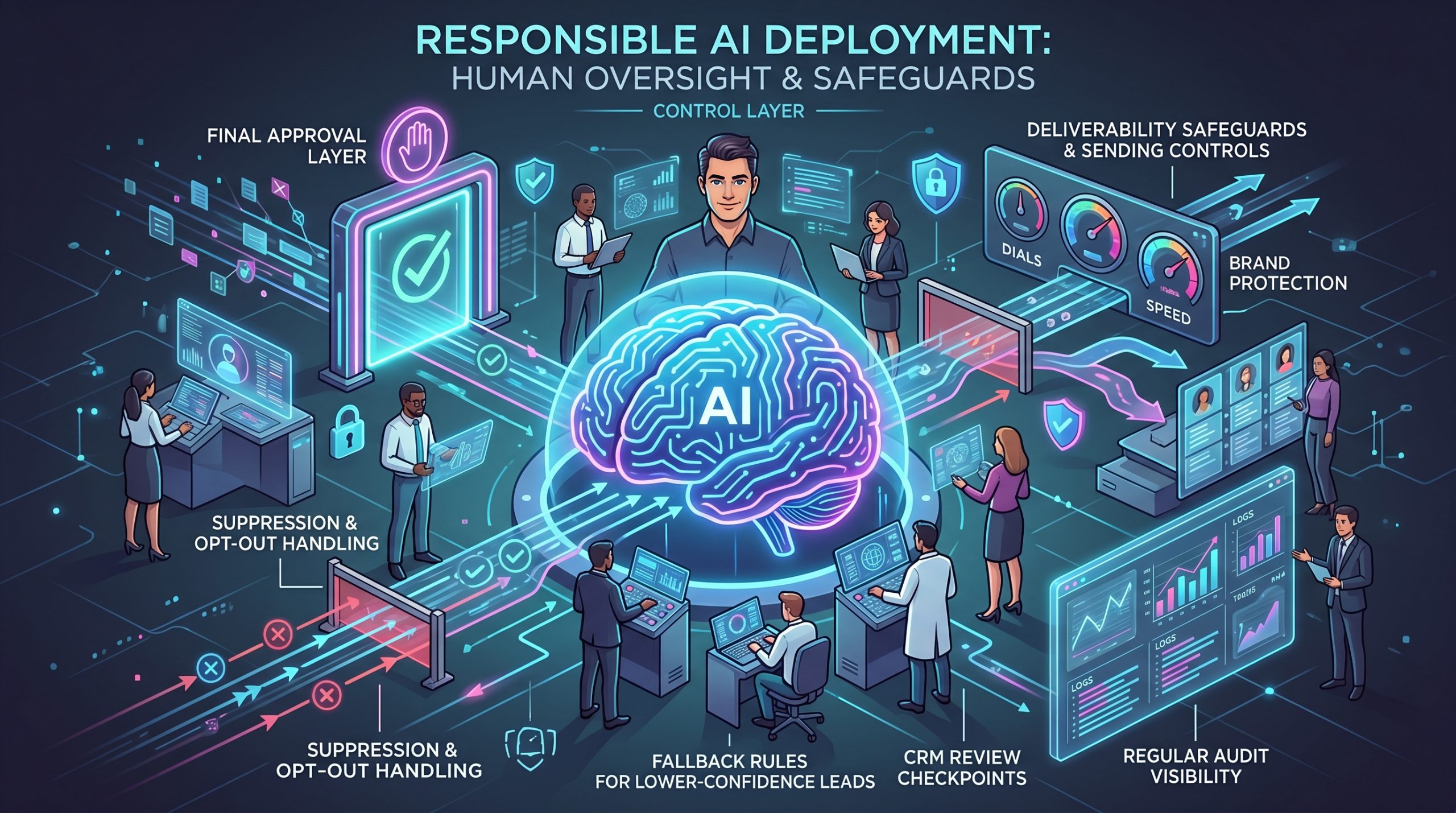
That meant the system was designed with control points around approval, suppression, deliverability, fallback handling, CRM review, and audit visibility.
Final approval layer
Human review remained in the workflow so quality control was preserved before high-impact outbound activity went live.
Suppression and opt-out handling
The AI system respected suppression rules and opt-out signals so the outbound engine did not create unnecessary risk.
Deliverability safeguards
Sending controls helped protect domain health, campaign reliability, and the long-term quality of outbound execution.
Fallback rules for lower-confidence leads
Lower-confidence prospects followed safer workflows, preventing weak-fit leads from receiving the same treatment as high-confidence opportunities.
CRM review checkpoints
Review points were built in before direct sales rep action, improving operational clarity and reducing messy handoffs.
Regular audit visibility
The team could review campaign behaviour, system decisions, and workflow performance instead of operating from a black box.
Results
The outcome after 3 months.
The impact was transformational. Within three months of implementation, Logic Luminate had a far more efficient outbound engine capable of producing stronger results with fewer people and far less manual effort.
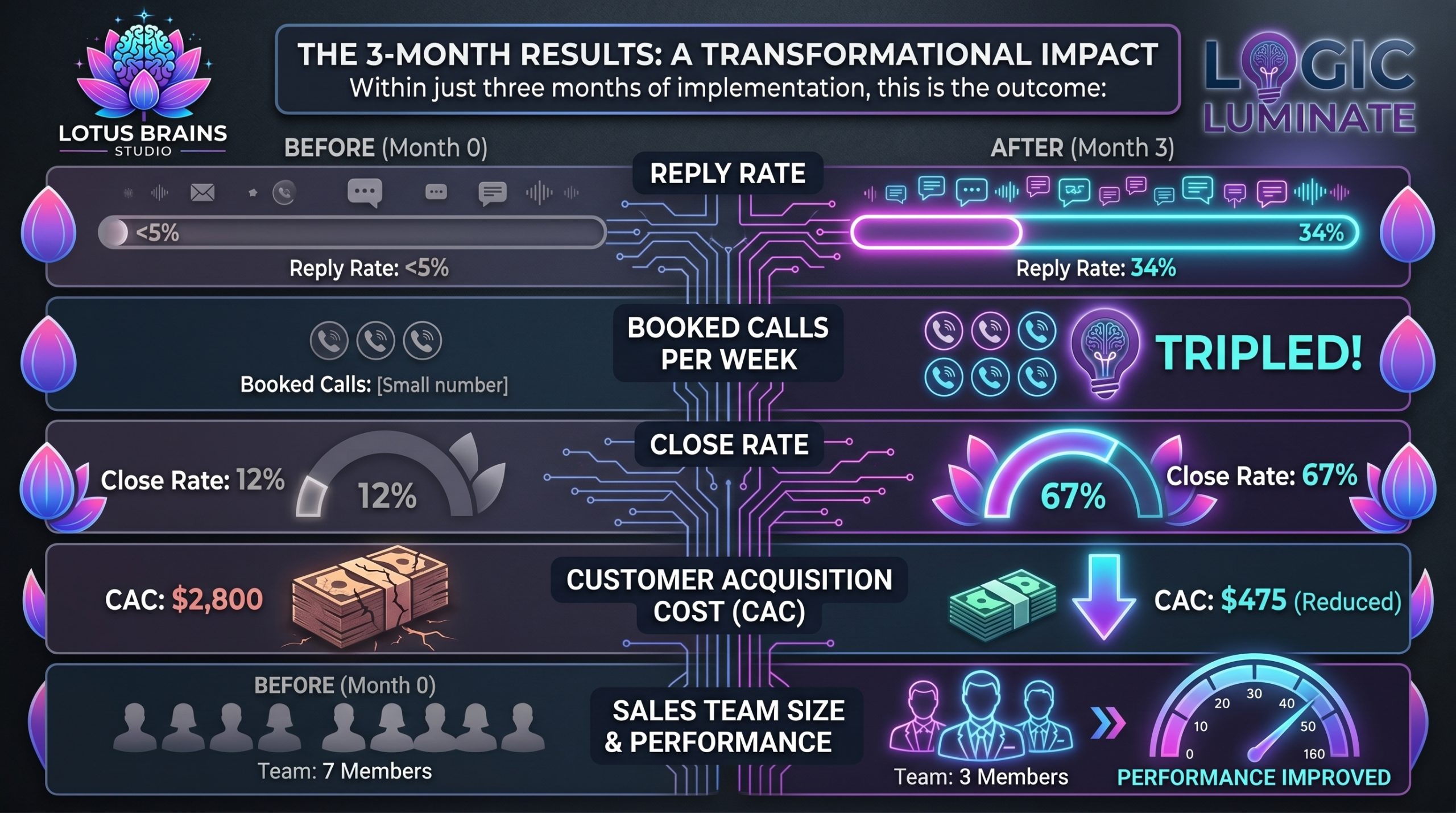
Reply rate
under 5% → 34%
More relevant outreach created stronger response rates.Booked calls
Tripled
More consistent outbound execution created more sales conversations.Close rate
12% → 67%
Better-fit calls improved conversion from booked call to closed-won.Customer acquisition cost
$2,800 → $475
Pipeline became less dependent on heavy manual effort.Sales team size
7 people → 3 people
The team became smaller while performance improved.These results represent more than marginal optimisation. Before the implementation, Logic Luminate was relying on a labour-heavy outbound process to create pipeline.
After implementation, they had a far more efficient system capable of producing stronger results with fewer people and far less manual effort.