
Research shows that 78% of organisations now use AI in at least one function, and the global AI market is estimated to cross £3 trillion by 2033.
One of the fastest-growing verticals in AI is voice agents. Given that these agents can reduce the cost of handling calls for businesses by 95%, it is no surprise that over 85% of businesses are eagerly looking to adopt them.
AI voice agents UK are particularly on the rise. 30% of British businesses, rising to 45% in London, say they would switch AI voice agent providers within a year or two.
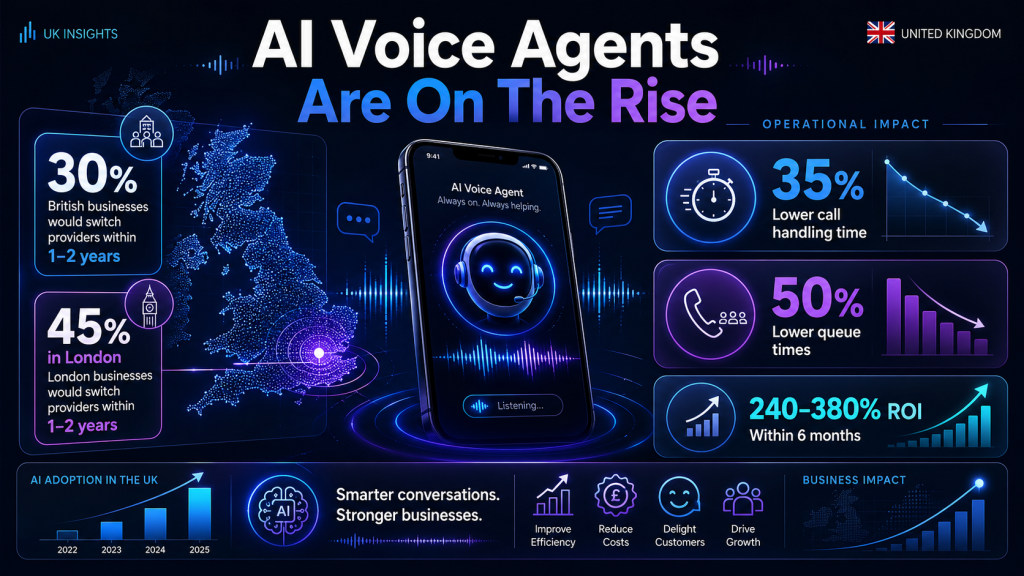
When done well, integrating an AI voice agent can cut down your call handling time by 35%, lowering queue times by 50% and overall lavishing you with 240–380% ROI within six months.
On the flip side, when done wrong, the consequences can be catastrophic. This is why choosing the right AI voice agents for your business demands meticulousness and saviness.
Luckily, we have saved you that risk by painstakingly testing hundreds of AI voice agents in the UK today and diligently handpicked the best 20 AI voice agents you can get in 2026.
This report analyses ten leading UK done-for-you providers and ten DIY AI voice agent platforms, offering a granular assessment of their stacks, delivery models, and commercial fit.#
Ready?
AI Voice Agents UK: Top 10 Providers (Done For You)
1. Lotusbrains Studio: Best Value AI Voice Agent Overall For SMBs
Overview + Best for (Use Cases and Industries)
At Lotusbrains Studio, we do not simply build voice bots; we build AI voice systems designed to function as autonomous extensions of your business’s core workforce. We specialise in high-complexity environments where nuance, accuracy, and dependable call handling matter.
Our primary focus is on done-for-you, full-stack AI voice agents designed for SMEs across real estate, construction, medical, dental, and financial services, as well as high-end professional services.
Our clients have been awed by how we replace rigid scripts with dynamic, context-aware agents capable of managing:
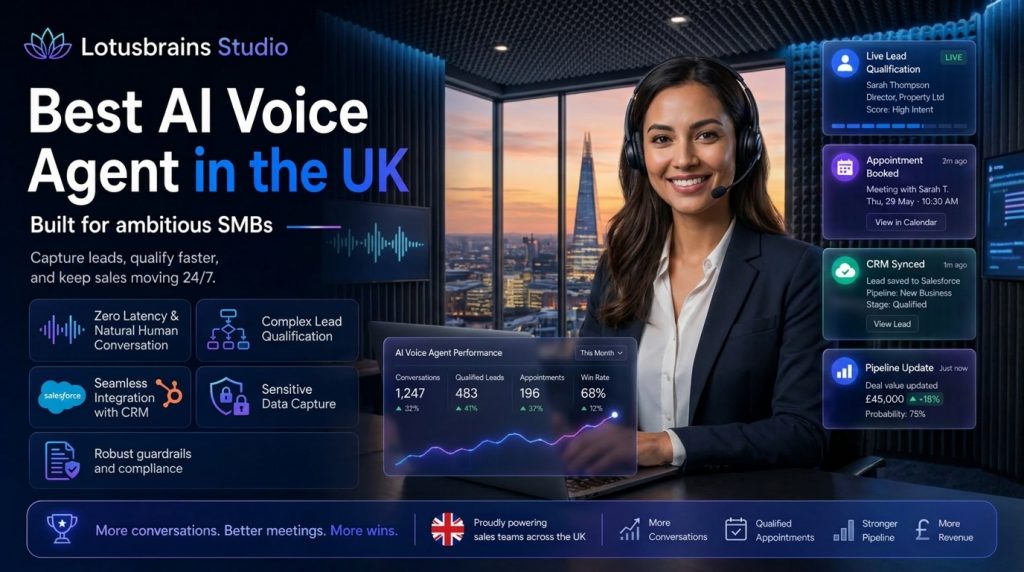
Complex Lead Qualification: Navigating non-linear conversations to assess leads based on implicit intent, not just keyword matches.
Intelligent Appointment Orchestration: Seamlessly managing diary conflicts and booking directly into calendars with time-zone awareness.
Sensitive Data Capture: Handling PII securely during client intake workflows.
We are best suited to businesses that need an ai voice agent to think before it speaks, ensuring that every interaction, whether inbound support or outbound reactivation, advances a commercial objective.
Voice/AI Stack + Integrations (What it’s Built With)
We do not rely on monolithic, black-box platforms. Instead, we use a modular, best-of-breed composition designed to deliver sub-500 ms latency, so our agents can be interrupted naturally without the robotic lag that affects many competitors.
The Core Engine
Telephony & Transport: We utilise ultra-low-latency VoIP backbones, leveraging infrastructure similar to Twilio and Vapi, optimised for UK carrier networks to support clear audio fidelity.
Brain (LLM): Our agents are powered by fine-tuned combinations of GPT-4o and Claude 3.5 Sonnet, selected for their reasoning ability and emotional intelligence.
Ears (ASR) & Voice (TTS): We integrate Deepgram Nova-2 for fast speech recognition and ElevenLabs Turbo v2.5 for hyper-realistic voice synthesis. This combination allows our agents to detect emotion, match the caller’s energy, and handle interruptions gracefully.
Deep Integrations
We do not just pass data; we perform actions. Our agents have read/write access to business systems via robust APIs:
CRM: Salesforce, HubSpot, and Pipedrive, including real-time deal-stage updates.
Calendar: Calendly, Outlook, and Google Calendar, including dynamic availability checks.
Orchestration: We leverage n8n and LangChain to execute multi-step workflows. If a client asks for a brochure during a call, our agent can trigger the email instantly while continuing the conversation.
Delivery and Safety (Implementation and Compliance)
We treat safety as a feature, not an afterthought. Our human-in-the-loop delivery model ensures that every agent is battle-tested before it ever speaks to a customer.
Semantic Discovery: We map your business logic into a knowledge graph rather than a linear script.
Adversarial Red-Teaming: We simulate hostile, confused, and quiet callers to stress-test the agent’s recovery protocols.
Phased Rollout: We deploy initially to a low-risk traffic segment, monitoring sentiment analytics to tune performance.
Compliance and Guardrails
We enforce strict UK GDPR compliance. Our architecture includes:
PII Redaction: Automatically scrubbing credit card numbers and other sensitive data from logs before storage.
Hallucination Control: We use RAG (Retrieval-Augmented Generation) to ground answers in verified documentation. Our agents are legally constrained; they cannot invent policies or prices.
Data Sovereignty: All voice data processing and storage can be pinned to UK/EU server regions to satisfy data residency requirements.
Pricing
We operate on a custom pricing model because every AI voice agent deployment we build is scoped around the client’s call flows, integrations, use case complexity, and compliance requirements.
Rather than forcing businesses into a one-size-fits-all package, we typically structure engagements around a bespoke setup fee, followed by ongoing support and usage costs depending on scope, call volume, and the depth of automation required.
This makes us best suited to businesses that care more about conversion, operational efficiency, and long-term ROI than simply finding a low-cost message-taking solution.
AI Voice Agent Case Study: How Our Neon Luxuries Doubled Closing Rates with AI Voice Agent
We worked with Neon Luxuries, a real estate company focused on property sales, lettings, and investment opportunities, where fast response times, clear communication, and a smooth client journey matter from the very first enquiry.
Before working with us, Neon Luxuries faced a familiar challenge: handling inbound enquiries quickly and effectively while manually sorting interest from buyers, sellers, landlords, and investors. In real estate, speed matters, but so does understanding who the serious prospects are, what they are looking for, how urgent their need is, and how best to route each opportunity. Managing that process manually created pressure on the team and increased the risk of missed opportunities.
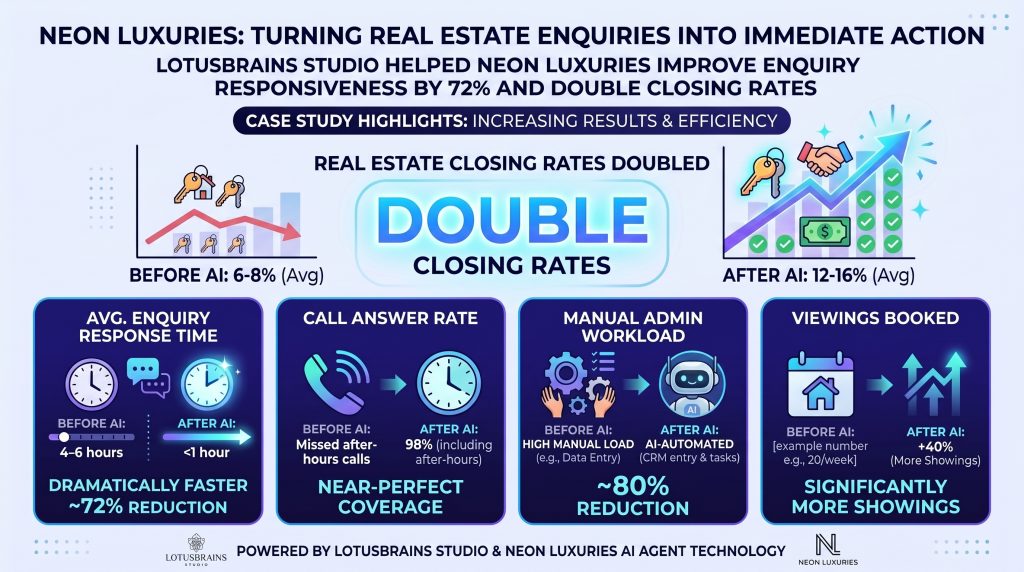
We implemented a bespoke AI voice agent system tailored to Neon Luxuries’ enquiry flow. Our solution engaged leads faster, qualified them more intelligently, and captured the right information early, including intent, urgency, and suitability, with almost no human intervention.
That gave the business a more structured, responsive, and consistent way to handle enquiries from the outset. This was gamechanging, to say the least.
Neon Luxuries reports that enquiry responsiveness improved by 72%, despite operating with only half the team size previously managing that process. The effective output of a single employee also tripled, as repetitive administration and initial lead qualification were handled automatically.
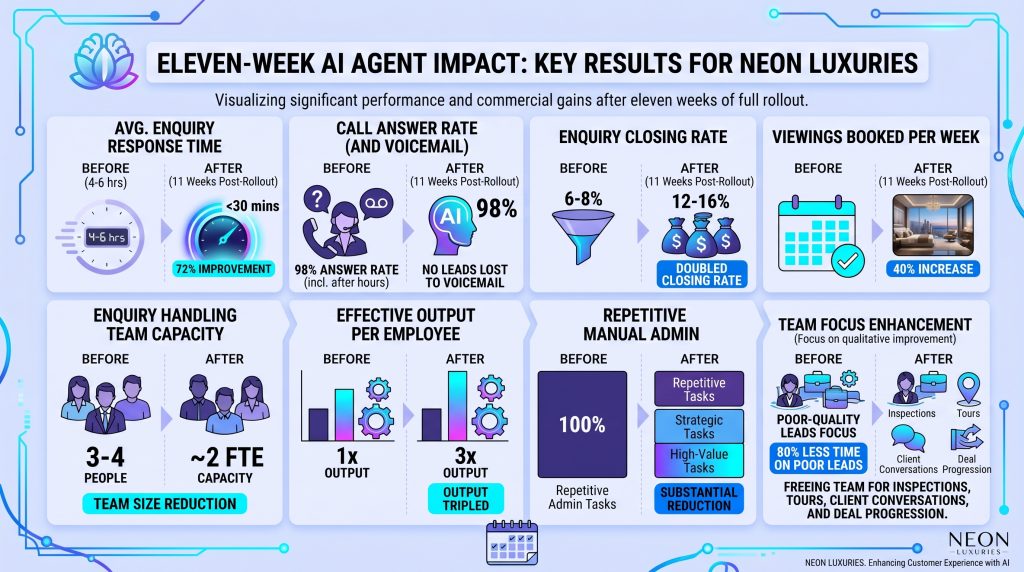
Most importantly, the business no longer had to spend as much time filtering poor-quality leads, with our system helping surface higher-value opportunities and contributing to doubled closing rates over a three-month period.
For a business where every missed call can mean a missed instruction, the result was a more efficient, scalable operation and a stronger client experience.
2. Ancast Intelligence
Overview + Best for (Use Cases and Industries)
Ancast Intelligence builds custom AI voice agents and provides consultancy for UK businesses looking to automate inbound customer interactions and workflows. Their custom voice agents handle FAQs, lead qualification, caller routing, and client onboarding with 24/7 availability.
Best suited to companies that need conversational AI without in-house development resources, Ancast serves organisations across customer service and lead-capture use cases. Beyond voice agents, Ancast also offers consulting services spanning roadmap planning to product delivery, helping businesses align AI adoption with operational goals.
The company designs agents that sound like and represent each brand authentically.
Voice/AI Stack and Integrations (What It’s Built With)
Ancast’s voice agent stack includes ElevenLabs for brand-matched voice synthesis, OpenAI, Claude, and Gemini for natural language processing, and a custom retrieval-augmented generation (RAG) knowledge base for context-aware responses.
The platform features persona and tone controls, guardrails to reduce hallucinations, and embedded widgets for website deployment. With this architecture, Ancast voice AI agents can summarise conversations and avoid generic AI responses through real-time voice synthesis.
However, Ancast does not publicly disclose its telephony infrastructure, such as SIP or VoIP providers, call routing mechanisms, human handoff protocols, or specific CRM, helpdesk, or calendar integrations. Analytics capabilities and hosting arrangements, whether cloud or on-premises, are also not detailed on their website. The available information focuses more on the AI and voice synthesis layer than the full telephony stack.
Delivery and Safety (Implementation Process, Guardrails, Compliance)
Ancast Intelligence does not publicly publish a detailed, step-by-step delivery framework for implementing AI voice agents. However, based on its service descriptions and case studies, its delivery approach involves understanding the client’s workflow, designing a tailored AI agent aligned with the brand voice and use case, and integrating it into the required touchpoints.
Following successful testing, these AI voice agents are then moved from pilot deployment into live production.
In its AI voice agent use case study, Ancast references the use of guardrails to reduce hallucinations and persona and tone controls to keep responses brand-appropriate. That said, the company does not publicly disclose specific policies on PII handling, GDPR compliance, data retention, escalation logic, or monitoring practices, and these details are not outlined on its website.
Proof of Outcomes + Commercials (Case Study, Pricing Model, Support)
A notable Ancast AI voice agent case study documents a solution built for a client facing time-consuming manual responses, multi-region enquiries, and the need for professional voice experiences without live support.
Post-deployment, the voice agent handled 92 inbound calls autonomously, offloading 92 real-world interactions from human workflows and increasing overall inbound message volume.
A separate case study on AI agent workflows for newsletter generation shows how automation saved a client 5–8 hours per newsletter cycle. These examples demonstrate Ancast’s ability to deliver time savings and operational efficiency, though results will vary by use case.
We could not find publicly available information on Ancast pricing. Similarly, there is no standard engagement model or tiered plan on the website. This is not unusual, as most AI voice agent solutions vary depending on customer needs. You can expect a tailored quote for your project after a discovery call with the Ancast team.
3. PolyAI
Overview + Best for (Use Cases and Industries)
PolyAI is one of the best AI voice agents in the UK. It is a London-based conversational AI firm that provides enterprise-grade, fully managed AI voice agent solutions for the UK and other regions.
Founded in 2017 by researchers at the University of Cambridge, PolyAI is dedicated to creating human-like conversational AI voice agents that can take part in genuine customer service interactions.
PolyAI’s voice agents can perform numerous tasks, including routing calls, making bookings, verifying customer identity, and responding to billing enquiries, while also being intelligent enough to provide general assistance when needed.
PolyAI primarily serves mid-sized and larger companies in the retail, hospitality, banking, insurance, and utility sectors that face extremely high volumes of inbound calls.
With multilingual capabilities built into PolyAI products, these AI voice agents can communicate with customers in multiple languages, allowing customer-facing teams to focus on higher-value service interactions.
Voice Agent AI Stack and Integrations
PolyAI’s voice agent technology platform is engineered for use in large corporate environments, enabling unscripted voice interactions in real time. Voice recognition, natural language understanding, reasoning through large language models, and intelligent orchestration are all built into PolyAI’s voice agent stack to support realistic customer engagement.
With SIP and PSTN telephony connections to existing call centre systems, PolyAI’s platform can integrate with backend services such as billing, reservation, and CRM systems via APIs.
The foundation of PolyAI’s technology platform is Advanced Spoken Language Understanding (ASLU), which enables its agents to accurately interpret free-form spoken language during live interactions.
This is augmented by generative and retrieval-based models that generate natural-sounding responses during calls, enabling PolyAI’s voice agents to handle interruptions, topic changes, and multi-turn conversations without being constrained by scripted responses.
The platform supports more than 45 languages and routes incoming calls to human agents with full conversation context, ensuring customers receive help from the right person. PolyAI’s technology also supports scalable deployment through integrations with cloud and telco providers, while built-in monitoring and analytics support ongoing post-launch optimisation.
Implementation, Safety Guardrails, and Compliance
Moving voice AI assistants from proof of concept to live production requires a structured delivery process that can support enterprise-grade reliability, security, and operational control.
PolyAI’s delivery process appears standardised, covering exploration and discovery, call-flow design, integrations with CRM systems, telephony platforms and APIs, and rigorous testing.
Through continuous monitoring and AI agent tuning, PolyAI aims to deliver increasingly intelligent, reliable, and natural-sounding agents.
PolyAI also appears to embed safety controls throughout the voice-agent lifecycle. Its handling of uncertainty, such as mishearings, vague replies, and low-confidence intents, is a core part of its delivery approach.
The company also implements safeguards designed to minimise hallucinations. Its AI voice agents are supported by comprehensive logging and high-fidelity observability for continuous monitoring and improvement.
By using a context-orchestration approach, PolyAI reduces the risk of the agent producing incompatible responses and provides a mechanism for escalation when necessary. While PolyAI does not publicly disclose UK-specific implementation details for GDPR and the Data Protection Act, its deployment on Microsoft Azure supports enterprise-level data residency, access control, and regulatory requirements.
Case Studies, Outcomes, and Commercial Engagement Model
PolyAI’s case study with The Big Table Group demonstrates the impact of its voice AI agent solution in addressing challenges caused by missed calls and reservations.
By deploying PolyAI’s AI voice agent solution to manage inbound bookings and answer customer queries, The Big Table Group achieved approximately 3,800 reservations managed each month with little to no human intervention.
These results contributed more than £140,000 in monthly revenue for the restaurant business, while also freeing up time for in-house staff to focus on delivering excellent service.
PolyAI does not publicly offer standard pricing. Enterprise engagements are modularly scoped and typically include implementation, integration, ongoing optimisation, and account management. Specific SLAs or pricing tiers are available only through direct consultation with PolyAI.
4. AI Voice Solutions
Overview + Best for (Use Cases and Industries)
AI Voice Solutions is a UK-based service provider that builds and implements AI voice agents for businesses. The company focuses on deploying voice-based agents that handle phone interactions, positioning its offering as a managed service rather than a self-serve software platform.
AI Voice Solutions is suited to businesses seeking AI voice agents for inbound and outbound call handling, helping them automate routine phone conversations. The company does not specify a particular industry vertical. The offering may be less suitable for teams seeking do-it-yourself voice automation tools or deeper internal system control.
Voice/AI Stack and Integrations (What It’s Built With)
While the service clearly relies on core components such as speech recognition, conversational processing, and voice synthesis, AI Voice Solutions does not disclose the specific technologies used for ASR, TTS, large language models, or orchestration.
Likewise, details about integration with external systems such as CRMs, scheduling tools, or internal business software are not clearly outlined in public documentation.
As a result, the solution is best understood as a managed AI voice agent service in which technical integrations are handled internally by the provider. This setup is likely to appeal to businesses looking for AI voice agents delivered as a managed service rather than a self-configured platform.
Delivery, Support, and Guardrails
AI Voice Solutions’ voice agents integrate with existing phone systems and workflows. We understand that most clients can be set up within 3–5 working days, with the AI integrating into the existing phone number and system without requiring an extensive infrastructure overhaul.
However, detailed documentation outlining a formal implementation process is not publicly available. Likewise, specific guardrails are not documented on the website.
As a UK-based provider, they operate under GDPR-regulated data protection expectations, but there are no clear public references to data processing agreements, data retention policies, or compliance statements.
Proof of Outcomes and Commercial Fit
Lanier South West is a notable example of how AI Voice Solutions is applied in practice. It is a family-run provider of printers, photocopiers, and phone systems across the South West.
Over time, Lanier South West’s growing reputation brought heavier inbound call volume and more administrative pressure. This created a risk of missed enquiries that could quietly damage customer experience and revenue.
AI Voice Solutions deployed voice agents to answer inbound calls 24/7, so customers could always reach someone, even during peak periods. The agent captures key details up front, such as who is calling, what is needed, and the urgency, and then routes calls with context rather than bouncing customers around.
More importantly, these voice agents could autonomously schedule service appointments directly into the team’s calendar, removing the back-and-forth that slows operations.
The impact of the AI system was fewer missed calls, faster response times, and significantly less manual administrative work for the team. With more time saved, Lanier South West was better positioned to focus human effort on higher-value work such as service delivery, customer care, and proactive support.
5. ScotsphereAI
Overview + Best for (Use Cases and Industries)
ScotsphereAI offers AI voice agents designed for more complex workflows where customer requests are often ambiguous and require structured interpretation rather than simple scripted responses.
Its solutions appear best suited to industries where requests involve complexity and specialist logic, such as logistics and complex quoting. The company positions its AI voice agents to understand vague requirements and convert them into structured data that supports more accurate quoting and scheduling.
Voice/AI Stack and Integrations (What It’s Built With)
Its core stack is Flowsight, a proprietary multi-agent orchestration layer. ScotsphereAI uses Synthflow as the Extractor Agent to manage the natural flow of conversation with low latency.
The more complex reasoning is then offloaded to a secondary Estimator Agent, powered by GPT-nano or a similar lightweight reasoning model, to process the data underneath the interaction.
This split architecture allows one model to manage the conversational flow while another handles the heavier reasoning workload, translating vague customer requests into structured JSON payloads for accurate pricing via custom webhooks.
Delivery, Support, and Guardrails
Its delivery model appears focused on making agentic AI more accessible to SMEs. The support model is also shaped by close involvement with the developer communities behind its underlying technologies, with the team contributing within the Synthflow ecosystem so clients can benefit from newer features as they become available.
Safety is built into the Flowsight architecture through deterministic artefacts, which provide traceable logs showing how decisions or prices were reached. This is intended to reduce hallucination risk and improve auditability.
The architecture also avoids allowing the LLM to make business decisions directly. If the Estimator Agent cannot resolve the input into a valid schema, Flowsight Core triggers a fallback and introduces a human-in-the-loop rather than allowing the system to guess.
Proof of Outcomes and Commercial Fit
Its effectiveness appears strongest in high-variability AI voice use cases, particularly complex data resolution in the moving and logistics sector. A key proof point is Flowsight’s ability to convert vague conversational inputs into precise volumetric data.
This type of automation can reduce administrative overhead and help capture revenue that might otherwise be lost through missed calls. The system’s deterministic artefacts also help minimise disputes because, where a customer’s request is misquoted, logs of what the AI understood can be retrieved, providing an additional layer of commercial accountability.
6. Summit AI
Overview + Best for (Use Cases and Industries)
Summit AI is a specialist boutique AI voice agency focused on the healthcare and allied health sectors. They build empathetic AI receptionists to reduce missed calls for physiotherapists, chiropractors, and dental practices.
Their agents are tailored to navigate core constraints around patient data privacy, appointment scheduling, and clinical empathy. This allows medical staff to focus more on patient care than on the ringing phone, making Summit AI a strong fit for clinics already using practice management software.

Voice/AI Stack and Integrations (What It’s Built With)
Their technology stack does not appear to rely on a single proprietary black-box component. Instead, it uses a layered system architecture intended to support reliability.
For conversational AI infrastructure, they leverage Retell AI and Vapi to deliver ultra-low-latency telephony. Voice synthesis is handled through ElevenLabs, with the aim of creating a warmer and more realistic patient-facing experience.
The operational logic runs through n8n and Make.com workflows, which execute two-way API integrations with Cliniko, Dentally, and Cal.com. This allows the agent to check availability and write appointments directly into practice management software.
Delivery, Support, and Guardrails
Their delivery model appears consultative, which is especially important in healthcare settings where deployment risk must be carefully managed.
A critical safety guardrail is transparency: the agent is programmed to identify itself as AI immediately. This helps manage patient expectations and build trust from the start of the call.
The system is also tightly scoped to administrative tasks such as scheduling, cancellations, and FAQs. For complex clinical queries or emergencies, it supports intelligent call transfers. If a patient asks a question outside the system’s training scope, the call is routed to a human staff member instead.
The company also appears to customise system prompts so the AI agents ask the right preliminary questions before offering an appointment slot.
Proof of Outcomes and Commercial Fit
Summit AI reports that their systems can automate over 80% of calls, resulting in a 99% reduction in voicemails. Clients have also seen a 30%+ increase in lead conversion by answering calls instantly.
More specifically, Summit customers such as Ben Hampson from Optee and Steve from Conexys describe Summit’s voice agents and overall delivery as exceptional and ahead of schedule.
Pricing appears to be engagement-based and positioned as an alternative to the cost of a full-time receptionist while offering 24/7 coverage. This makes Summit AI a notable specialist option for healthcare-focused AI voice agent deployments.
7. AI Agency Plus
Overview + Best for (Use Cases and Industries)
AI Agency Plus delivers custom-built voice AI assistants specialising in appointments, recruitment, customer service automation, and sales qualification for UK SMEs.
Its primary focus appears to be recruitment, dental practices, beauty salons, home services, and local professional services that need straightforward inbound call handling with calendar integration and basic customer data capture for high-frequency, lower-complexity interactions.
Voice/AI Stack and Integrations (What It’s Built With)
The backbone is built on n8n and Make.com, which allow the team to map business logic visually and connect different apps without relying heavily on custom code.
The platform connects to Google Calendar, Acuity Scheduling, Calendly, and basic CRM systems, including HubSpot Free and Zoho. Technical specifications indicate sub-one-second response latency for typical queries, alongside webhook-based integrations for custom systems.
Their use of n8n also gives them connectivity to a wide range of other apps. Key integrations include WhatsApp for hybrid voice/text agents and TaskMagic for robotic process automation tasks.
Delivery, Support, and Guardrails
Implementation appears to follow a three-stage process: initial consultation and use-case definition, agent configuration and voice testing, and then live deployment with ongoing monitoring.
Their service also includes script development and conversational flow mapping tailored to the client’s requirements.
On compliance, AI Agency Plus signals support for self-hosted n8n instances on Microsoft Azure, which may be useful for UK businesses that need data to remain within specific UK or EU jurisdictions.
The company also includes standard disclaimers around AI limitations. Its white-label partners, such as Retell and Vapi, provide a baseline level of infrastructure security for voice data transmission.
Proof of Outcomes and Commercial Fit
AI Agency Plus provides examples to demonstrate operational efficiency across sectors.
In one recruitment use case, TeloAI used an automated screening AI agent to pre-qualify more than 100 candidates in minutes, a task that had previously taken weeks of manual calling.
In another example, LaylaAI for travel reduced the time needed for complex travel planning from 10 hours to just 10 minutes through conversational automation.
Pricing appears accessible relative to some agency-led implementations, with automation solutions starting from $1,000, approximately £800. The commercial model likely includes an initial setup fee alongside a monthly retainer for maintenance and optimisation. The company also offers a white-label option, suggesting added flexibility for partners or higher-volume users.
8. Intouch Now AI
Overview + Best for (Use Cases and Industries)
Intouch Now AI is a vertical specialist focused on the UK healthcare and NHS general practice market. Its value proposition is centred on solving one critical operational pain point: the 8 am rush of patient calls that overwhelms GP surgeries each day.
Best For
GP Practices and NHS: Appointment-management solutions tailored to the needs of UK primary care.
Dental and Private Clinics: Managing bookings and enquiries for private health providers.
Senior Care: A companion product designed to help reduce loneliness among older people through empathetic AI conversation, highlighting the company’s experience with vulnerable user groups.

Voice/AI Stack and Integrations (What It’s Built With)
The platform is distinguished by its clinical interoperability and linguistic breadth, both of which are especially important in public-sector healthcare settings.
Technical composition
Clinical Integrations: The company appears to have deep, often proprietary integrations with core NHS systems such as EMIS, SystmOne, and Accurx. This allows the AI to read from and write to the patient record, a capability that more generic agents usually lack.
Voice and Language: Its agents support 33 languages with real-time language detection, helping improve accessibility for non-English-speaking patients.
Hybrid Logic: The platform uses a computer-use agent in the backend. While the voice agent manages the call, the computer-use layer navigates the clinical software to complete triage forms and book slots, effectively mimicking a human receptionist’s desktop actions.
Delivery, Support, and Guardrails
Safety is the central delivery requirement for Intouch Now AI, given its deployment in clinical settings where mistakes can have health implications.
Medical Device Certification: Intouch is one of the few providers to certify its platform as a Class I Medical Device, aligning with stricter risk-management expectations.
Clinical Guardrails: The agents are built around zero-clinical-decision protocols. Any mention of red-flag symptoms, such as chest pain, triggers immediate escalation to emergency pathways.
Data Sovereignty: Intouch adheres to NHS Digital standards and the Information Governance toolkit. It does not retain patient data long term, instead processing it directly into the practice’s secure systems.
Proof of Outcomes and Commercial Fit
Operational Efficiency: A deployed clinic saw a 60% reduction in wait times and a 50% drop in call volumes routed to front-desk staff during peak periods.
Testimonials: Armada Family Practice cited a notable reduction in pressure and improved staff morale following implementation.
Pricing
Standard: £100/month for 50 calls
Growth: £1,200/month for 1,000 calls
Scale: £5,000/month for 5,000 calls
Engagement: The company offers a two-week free trial to demonstrate efficacy before commitment, lowering adoption risk for public-sector bodies.
9. Moneypenny
Overview + Best for (Use Cases and Industries)
Originally known as a premium human telephone answering service, Moneypenny has moved into a hybrid model that blends human PAs with enterprise-grade AI.
Best for:
Moneypenny appears best suited to mid-market and enterprise clients where brand reputation is highly sensitive, and reliability matters more than using a pure AI-only service.
Hospitality: Managing table reservations and room bookings for hotels and restaurants.
Legal and Finance: Acting as a 24/7 switchboard for law firms and financial consultancies, where missing high-value client calls can be costly.
Property: Handling viewing enquiries for estate agents that need dependable coverage and message capture.
Its clearest differentiator is the human fallback layer.

Voice/AI Stack and Integrations (What It’s Built With)
Moneypenny has partnered with PolyAI (a global leader in conversational AI infrastructure) to power its voice capabilities. This gives MoneyPenny access to an advanced enterprise conversational AI stack while keeping the service wrapped in its managed operating model.
Technical composition
The Engine: MoneyPenny’s stack advanced spoken-language understanding with fast transcription, natural response generation, and realistic voice delivery. The emphasis is less on a self-serve builder stack and more on dependable enterprise conversation handling, especially in noisy or accent-heavy environments.
Integrations: The system integrates with Microsoft Teams, Salesforce, and hospitality tools such as OpenTable.
Latency: The platform delivers latency optimised for natural turn-taking, which is important in high-touch service environments.
Delivery, Support, and Guardrails
Moneypenny offers a managed-service model rather than a SaaS product.
Process: Deployment appears to involve a solution architect who maps the call flows and builds a bespoke knowledge base using the client’s FAQs and policies.
Guardrails: The company uses guardrails to reduce hallucinations and keep the AI on brand.
Compliance: As a long-standing UK business, Moneypenny positions itself as GDPR-compliant. Its human fallback is also a practical safety mechanism: if the AI detects caller frustration or low confidence, the interaction can be handed to a human, reducing the operational risk of AI error.
Proof of Outcomes and Commercial Fit
Llanerch Vineyard Hotel: The AI Agent implementation allowed the hotel to manage bookings around the clock without increasing night staff. The managing director cited 2025 as its busiest year yet, attributing part of that success to the AI’s ability to capture leads that might otherwise have gone to voicemail.
Pricing
Pricing structure: The AI service is positioned as an add-on to Moneypenny’s core telephone-answering subscription.
Cost: Setup fees start at approximately £250. Monthly pricing is volume-based, with £99 for 50 calls, £399 for 250 calls, and £1,150 for 1,000 calls.
Engagement: This pricing reflects the premium positioning of a hybrid AI-plus-human service, placing Moneypenny toward the higher end of the market compared with pure-play AI agencies.
10. Convex AI
Overview + Best for (Use Cases and Industries)
Convex AI operates as a premium managed-service AI voice agency specialising in high-volume outbound sales and lead qualification. It acts as a digital extension of the sales team, building agents that proactively contact prospects.
It is best suited to marketing agencies, home-service providers, and financial firms that need to scale outreach without building their own voice infrastructure in-house.
Voice/AI Stack and Integrations (What It’s Built With)
Its technology stack is built for outbound velocity and inbound reliability, with a clear emphasis on speed and conversational quality.
Convex AI uses Vapi for the conversational layer, giving its agents low latency, which is critical for maintaining engagement in live sales calls.
This is paired with ElevenLabs for more emotionally aware voice delivery. Its backend also integrates with a wide range of third-party tools, including CRM systems such as HubSpot and Salesforce, allowing agents to update lead statuses and book meetings in real time during the call.
Convex’s voice infrastructure can scale from 100 to 10,000 calls per day. That elasticity allows businesses to increase campaign volume during peak periods without committing to long-term staffing costs.
Delivery, Support, and Guardrails
Convex AI operates on a done-for-you model, so the client is buying an outcome rather than a toolset.
Its implementation follows a three-step structure: Discovery, Creation, and Optimisation. Unlike DIY platforms, Convex AI uses a 2–4 week development and testing phase to sandbox the agent against objections before going live.
As a fully managed service, it handles prompt engineering, deployment, and ongoing maintenance. This reduces technical risk for the client and gives the business a more controlled path to rollout.
Proof of Outcomes and Commercial Fit
Convex AI offers one of the clearest ROI-led commercial cases in this section of the article.
A featured case study is RenoWeb, a UK social media marketing agency. By deploying a Convex AI agent to handle outbound calls for plumbing businesses, RenoWeb recorded $24,000 in labour savings.
The owner also noted that the AI sounded natural enough that clients did not realise they were speaking to a machine, while still successfully booking real demos.
Commercially, Convex AI offers a Launch Plan with a one-time €2,500 setup fee and a Growth Plan at €1,500 per month. This retainer covers up to 1,000 calls and includes full management, positioning Convex AI as a scalable alternative to hiring a human sales team.
How To Choose AI Voice Agents 2026
Choose Lotusbrains Studio if you require a bespoke, ost-effective, brain-like agent capable of negotiating, qualifying, and managing complex, non-linear conversations in high-value verticals. It is the strongest fit if you value ownership of the intelligence and deep integration with custom workflows over generic scripts.
Choose AI Agency Plus if you are an SME looking for rapid deployment to automate repetitive tasks such as candidate screening or simple bookings. It is a strong fit for businesses that need a partner who can move quickly and use low-code tools to keep costs down.
Choose Intouch Now AI if you operate in the healthcare sector. Its Medical Device certification and deep NHS system integrations, including EMIS and SystmOne, make it the strongest fit for clinical environments where safety and compliance are paramount.
Choose Moneypenny if you are an established brand where reliability and human backup are critical. If you cannot afford even a single poor AI interaction, its hybrid model of AI plus human PA support offers the strongest safety net, albeit at a premium price point.
AI Voice Agents UK: Best 10 Do-It-Yourself Providers
In the previous section, we extensively reviewed the best AI voice agencies. These were providers in the UK that provided end-to-end AI voice agents as services, saving you the rigors of building it out yourself.
But of course, you may want to build your custom AI voice agent yourself. For that, you would need the right infrastructure to build with. This section reassures that you can build with AI voice agent tools or software by expansively reviewing them.
A) Best AI Voice Agent: The Orchestrators (Best Overall)
When building a voice agent, the hardest part isn’t generating the voice; it’s managing the conversation. These platforms excel at orchestration, i.e, stitching together the best transcribers, brain models (LLMs), and synthesizers into a seamless experience.
1. Vapi
Vapi is one of the strongest AI voice agent platforms available for engineering teams. It is especially well-suited to high-stakes environments such as healthcare triage, banking support, and complex logistics coordination, where granular control over conversational state, interruptions, and silence handling matters.
Why does it count among overall best?
Vapi has established itself as the best choice for engineering-led teams by acting as a powerful middleware layer. Think of it as a universal adapter that connects the best ears, brains, and mouths into one cohesive workflow.
Build Experience (Docs, Debugging, Tools): The dashboard offers one of the best debugging experiences in the DIY market. Every call log includes a visual timeline of the conversation, separating user and agent audio tracks. This makes it far easier for developers to pinpoint where a tool call failed.
DIY setup snapshot
Architecture: SIP/Twilio -> Vapi Orchestrator -> Custom Node.js server -> Tools/Actions
Telephony Integration: Purchase a phone number inside the Vapi dashboard or import an existing Twilio number. If you use Twilio, configure the voice webhook to point to Vapi’s SIP URL.
Assistant Configuration: Define the assistant object in the Vapi dashboard. Select Deepgram Nova-2 for transcription speed and ElevenLabs Turbo v2.5 for voice quality.
Server Setup: Deploy a simple Node.js or Python server using FastAPI or Express.
Payload Handling: When Vapi sends a request to your server, it includes the messages array. Your server processes that payload and returns the text channel.
Tool Execution: Define a tool in Vapi’s UI, such as book_appointment. In your server code, handle the specific function-call logic when Vapi requests it, execute the booking logic, and return a success message to the agent.
Real-World Constraints
Configuration Complexity: Vapi is not a no-code solution. The intelligence of the final voice agent depends heavily on the rest of your stack. A poorly configured Vapi agent can feel erratic, interrupt users too often, or wait too long to respond.
Cost Stacking: Because Vapi acts as a middleware layer, you pay a platform fee on top of speech-to-text, LLM, text-to-speech, and telephony costs. That four-layer cost stack can become expensive.
Cost Drivers
Platform fee: Vapi charges an orchestration fee of around $0.05 per minute for managing call state.
Synthesis costs: High-quality TTS voices add roughly $0.03 to $0.06 per minute.
Telephony/SIP: Carrying the call via providers such as Twilio or Vonage adds roughly $0.01 to $0.015 per minute.Convex AI offers one of the clearest ROI-led commercial cases in this section of the article.
A featured case study is RenoWeb, a UK social media marketing agency. By deploying a Convex AI agent to handle outbound calls for plumbing businesses, RenoWeb recorded $24,000 in labour savings.
The owner also noted that the AI sounded natural enough that clients did not realise they were speaking to a machine, while still successfully booking real demos.
Commercially, Convex AI offers a Launch Plan with a one-time €2,500 setup fee and a Growth Plan at €1,500 per month. This retainer covers up to 1,000 calls and includes full management, positioning Convex AI as a scalable alternative to hiring a human sales team.
2. Retell
Retell AI is an excellent option for teams that want to build strong AI voice agents without heavy engineering overhead. It removes much of the configuration paralysis that comes with more technical tools.
Retell AI voice agents are widely used for automated sales outreach, lead qualification, and receptionist automation, especially in use cases where emotional intelligence in the voice matters.
Why does it count among overall best?
DIY setup snapshot
Architecture: Retell Cloud -> Retell LLM (Prompts) -> Native Integrations
Agent Creation: In the dashboard, select Create Agent and choose Retell LLM to host the logic on Retell’s servers, which simplifies setup.
Prompt Engineering: Input a system prompt that defines the persona, for example: “You are Maya, a dental receptionist.” Use variable syntax to inject dynamic context.
Tool Connection: In the tools section, authenticate with Cal.com and map the function directly to your calendar API key.
Phone Provisioning: Purchase a number directly from Retell’s inventory to avoid external SIP configuration.
Testing: Click Test Audio in the browser, speak to the agent, and watch the live call log to see transcription and tool execution in real time.
Real-World Constraints
Opaque Cost Scaling: While the entry point is accessible, the all-in-one model gives users less visibility into the breakdown of token usage versus audio generation compared with a bring-your-own-key model. You pay a bundled rate that includes Retell’s margin.
Cost Drivers
Bundled Usage Rate: Retell charges a bundled rate, typically starting at around $0.07 per minute, covering the platform and standard voice and LLM features.
3. Bland AI
Bland AI is built for hyper-scale outbound operations. It is a strong fit for political polling, large-scale logistics coordination, and mass lead qualification.
In essence, Bland AI performs best where API-driven dispatch of thousands of simultaneous calls is the primary requirement.
Why does it count among overall best?
Bland AI functions less like a tool for crafting one perfect assistant and more like end-to-end phone-call infrastructure built for dispatching calls at scale with high reliability.
Call Quality: Its proprietary model stack is optimised specifically for the Public Switched Telephone Network (PSTN). That specialisation helps it handle low-fidelity 8 kHz telephony audio, accents, and background noise better than more general-purpose models.
Build Experience (Docs, Debugging, Tools): Its conversational pathways feature is a graph-based state machine that ensures the agent follows a strict script when necessary. This blends LLM flexibility with IVR-style rigidity, which is especially useful in enterprise compliance environments.
DIY setup snapshot
Architecture: cURL/Python script -> Bland API -> PSTN network
API Key Generation: Generate a secret key from the Bland developer portal.
Script Construction: Write a Python script using the requests library to construct the call payload.
Dispatch: Post the payload to the API.
Webhook Handling: Set up a webhook receiver to ingest the call_analyzed event, which contains the recording, transcript, and extracted JSON.
Real-World Constraints
Reliability/Uptime: At very high volumes, reliability becomes part of the trade-off. Large-scale calling infrastructure can face periods where audio quality drops or call initiation becomes less consistent during peak loads.
Cost Drivers
Per-minute Rate: Bland charges a flat rate, typically around $0.09 per connected call minute.
Outbound Connection Fees: Fees for attempted but unconnected calls, such as voicemail or busy signals, can accumulate rapidly in large campaigns, at roughly $0.015 per attempt.
Transfer Time: If the agent transfers the call to a human, Bland continues billing for the duration of the transfer, often at a different rate.
4. Synthflow
Synthflow is best suited to non-technical agencies and SMEs, particularly those using GoHighLevel (GHL), that need to deploy sophisticated AI voice agents without writing code.
Why does it count among overall best?
Call Quality: Synthflow uses standard high-quality voice providers on the backend, likely including ElevenLabs and OpenAI. It adds value through out-of-the-box prompt templates for specific verticals such as real estate and dental. These templates are pre-tuned for stability, helping reduce the likelihood of hallucinations.
Build Experience: Its visual builder makes conversations flow more easily to inspect than code-only systems, especially when you need to spot dead ends or broken logic. The test button launches an in-browser simulator that closely mirrors the phone experience.
DIY setup snapshot
Architecture: Synthflow UI -> Visual Builder -> One-click deploy
Template Section: Choose a template, such as dental appointment booking, from the library to load a pre-configured flow.
Knowledge Base: Upload a PDF of the clinic’s FAQ and Synthflow indexes it automatically for retrieval-augmented generation (RAG).
Tool Configuration: Drag a calendar node into the canvas and connect Google Calendar through OAuth to link the schedule.
Testing: Use the preview button to speak to the browser-based phone simulator and verify the flow logic.
Deploy: Click Assign Number to purchase a local area-code number and map it to the active flow.
Real-World Constraints
Flexibility Ceiling: The no-code abstraction is a double-edged sword. You are limited to the integrations Synthflow supports directly, plus basic webhook extensions.
Cost Mark-up: You are paying for convenience. The cost per minute is typically higher than building directly on tools such as Vapi and Twilio, and pricing is often packaged per agent or in bundles that expire.
Cost Drivers
Subscription Tier: A monthly SaaS fee, for example, around $29 per month, often limits the number of agents or concurrent calls.
Usage Overages: Minutes beyond the plan are charged at a premium rate.
Whitelabelling: Agencies that want to remove Synthflow branding face higher-tier costs.
B) Best AI voice agents for call quality + low latency
This category prioritises the Time-to-First-Byte (TTFB) of audio. In human conversation, a gap of more than 500 ms feels robotic. A gap of more than 1,000 ms often leads to a collision, where the user assumes the agent did not hear them and starts speaking again.
The following platforms use streaming architectures or native speech-to-speech models to reduce latency aggressively.
5. Ultravox
Ultravox is a genuine break from conventional AI voice-agent architecture. It uses a speech-to-speech (S2S) model, which means the system listens to raw audio, interprets tone and words directly, and generates audio in response.
Traditional stacks typically follow this path: Audio -> Text -> LLM -> Text -> Audio. Ultravox compresses that path into Audio -> Audio Embeddings -> Audio.
Latency Proof
Average feel: ~300 ms–500 ms.
Worst moment: Latency remains highly consistent and does not spike sharply because the model is not waiting for a transcription service to finish a sentence.
Barge-in behaviour: Ultravox processes audio tokens directly, so it detects semantic interruption more effectively than VAD-based systems. It stops generating almost instantly when it detects user intent to speak.
What enables low latency
Elimination of transcoding: Skipping the audio-to-text conversion removes roughly 200 ms–500 ms of delay.
Token streaming: The model begins generating audio tokens as soon as it has enough context to respond.
Stability on real calls
Mishearing/Hallucination: Ultravox handles paralinguistic cues well, including the subtle non-verbal signals that text-based models often ignore or misinterpret. It also maintains voice consistency effectively over longer interactions.
Monitoring: Ultravox gives developers tools to inspect audio-token behaviour, making it easier to understand why the model interpreted a sound as a word, a cough, or something else.
Recommended low-latency stack
Stack: Ultravox Cloud (Model + Telephony). No external STT or TTS is required. Use WebRTC for browser-based calls to avoid the added latency of SIP trunking.
6. Deepgram Voice Agent API
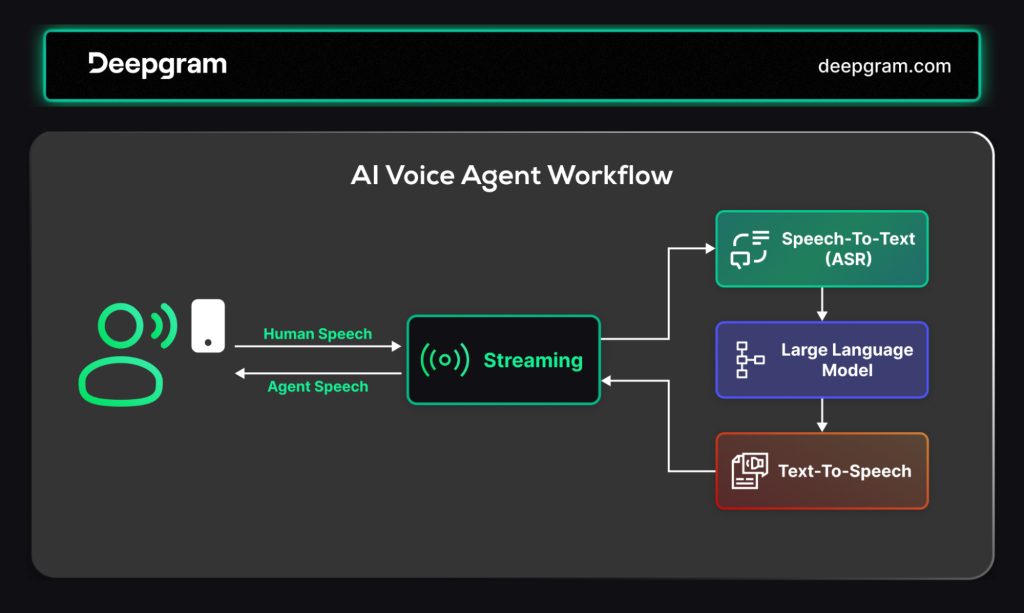
Deepgram began as a transcription company, and that origin shaped its approach to voice AI. It recognised that one of the biggest sources of latency in AI voice is the network overhead created by moving audio between separate STT, LLM, and TTS providers.
To reduce that delay, Deepgram built a unified agentic API where those layers operate within the same platform. It combines Nova speech recognition with Aura text-to-speech, which removes much of the vendor-to-vendor handoff delay that slows assembled stacks.
Latency Proof
Average feel: ~400 ms–600 ms.
Worst moment: ~900 ms during more complex reasoning tasks, though latency generally stays below that because orchestration remains internal.
Barge-in behaviour: Deepgram’s Nova-2 and Nova-3 STT models are exceptionally fast, and their voice activity detection is tuned to detect end-of-speech in under 10 ms. That allows near-instant interruption handling.
What enables low latency
Optimised STT (Nova-3): Deepgram’s transcription engine is built on Rust and optimised CUDA kernels, delivering transcripts in under 300 ms.
Unified infrastructure: By keeping STT, LLM orchestration, and TTS on a single platform, Deepgram eliminates the repeated HTTP handshakes that typically slow multi-vendor stacks.
Stability on real calls
Stack: Deepgram Voice Agent API (Nova-3 STT + Llama 370B via Groq + Aura TTS). Using Groq for inference within the orchestration layer is a major contributor to the speed advantage.
Recommended low-latency stack
Stack: Ultravox Cloud (Model + Telephony). No external STT or TTS is required. Use WebRTC for browser-based calls to avoid the added latency of SIP trunking.
7. OpenAI Realtime API
OpenAI Realtime API is one of the most compelling options for teams building browser-based or phone-based voice systems where low latency and strong instruction-following matter.
Its biggest strength is that it is designed around real-time audio interaction rather than being adapted from a text-first workflow.
Latency Proof
Average feel: ~300 ms–400 ms with native WebRTC.
Worst moment: ~1.5 seconds if rate limits are hit or more complex function-calling is invoked.
Barge-in behaviour: Native and seamless. The model supports server-side VAD, allowing it to stop generation immediately when it hears the user, without relying on external interruption logic.
What enables low latency
WebRTC integration: Unlike the WebSocket approach used by many other platforms, OpenAI pushes WebRTC (Web Real-Time Communication), which uses UDP rather than TCP. That means lost packets do not stall the stream, reducing jitter-buffer delay significantly.
End-to-end design: Because the platform is built for live audio interaction, it reduces much of the orchestration overhead that usually slows down assembled voice stacks.
Stability on real calls
Beta constraint: The API is stable but expensive. Crashes are uncommon, but connection timeouts can still occur on the WebRTC layer if the client network fluctuates.
Instruction adherence: It follows more complex behavioural instructions, such as speaking slowly when the user sounds confused, better than many assembled pipelines.
Recommended low-latency stack
Stack: OpenAI Realtime API via WebRTC for browser calls or Twilio Media Streams for phone calls. No external components are required.
C) Best AI voice agent (Pricing and cost)
Many platforms advertise a low platform fee while hiding the cost of the underlying models. The following choices offer the best value for money among the AI voice agents in this guide.
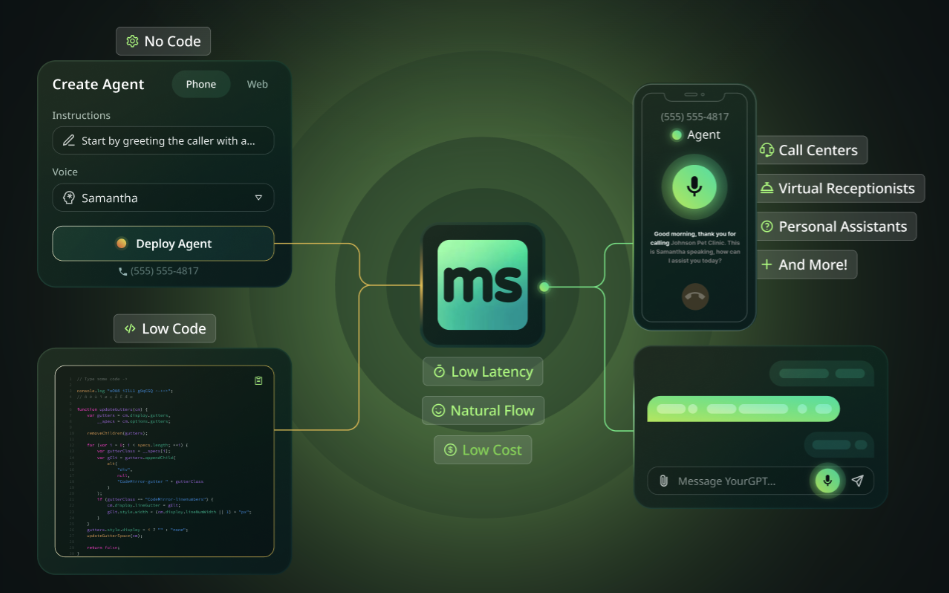
8. Millis AI
Millis AI builds on the bring-your-own-key philosophy. It offers a slimmer, developer-focused orchestration layer with a micro-fee.
It is a strong fit for developers who want a Vapi-like experience, including webhooks, function calling, and flexible provider switching, but at a lower cost.
Pricing model
Millis charges a low platform fee of approximately £0.016 per minute, plus at-cost or bring-your-own-key pricing for the LLM and TTS layers. This separates the infrastructure cost from the intelligence cost.
True per-minute cost breakdown
Total cost per minute: ~£0.016 (platform) + £0.0035 (STT) + £0.012 (TTS) + £0.001 (LLM) + £0.008 (telephony)
Estimated total: ~£0.0405 per minute
Why does it stay cheap?
Microservice architecture: Millis focuses narrowly on WebSocket connection management. It does not significantly mark up LLM or TTS token usage.
Routing optimisation: Millis Choice Optimisation dynamically selects the cheapest model that still meets the latency requirement.
Hidden cost warning
Premium voices: TTS is billed per character. If you select high-end voice clones in the dashboard, your cost can rise sharply regardless of Millis’s low platform fee.
Recording storage: While the call itself is inexpensive, storing thousands of hours of audio logs can create separate storage costs if not actively managed.
9. Bolna
While many tools focus on providing dedicated AI voice agent APIs for developers, Bolna is closer to a tailored app layer for setting up phone agents.
It bridges the gap between the flexibility of open source and the convenience of hosting. Because it targets SMEs, such as clinics and estate agents, rather than tech startups, its pricing is structured around bundles rather than complex API computations.
Pricing model
Bolna uses a bundle subscription system. Instead of calculating tokens, you pay a flat monthly fee. It offers fixed-price bundles, roughly £0.04-£0.06 per minute, as well as a BYOK model where the platform fee is negligible. It also positions itself as an open-source framework with a hosted option.
True per-minute cost breakdown
Total cost per minute: ~£0.016 (platform) + £0.04 (telephony/voice bundle)
Estimated total: ~£0.056 per minute for lower tiers.
Note: Self-hosting the open-source version removes the platform fee, reducing cost closer to raw API usage, around £0.03 per minute.
Why does it stay cheap?
Open-source root: The Bolna framework is open source. Technical teams can host the orchestration layer on a low-cost DigitalOcean droplet, eliminating the middleman tax.
Low overhead: As a developer-centric tool, it operates with leaner margins than an enterprise sales-led organisation.
Hidden cost warning
DevOps cost: The hidden cost is engineering time. Maintaining a WebSocket server that handles 100 concurrent calls requires meaningful DevOps expertise.
Telephony mark-up: On hosted starter plans, the per-minute telephony rate can be higher than direct Twilio pricing, effectively creating a convenience tax.
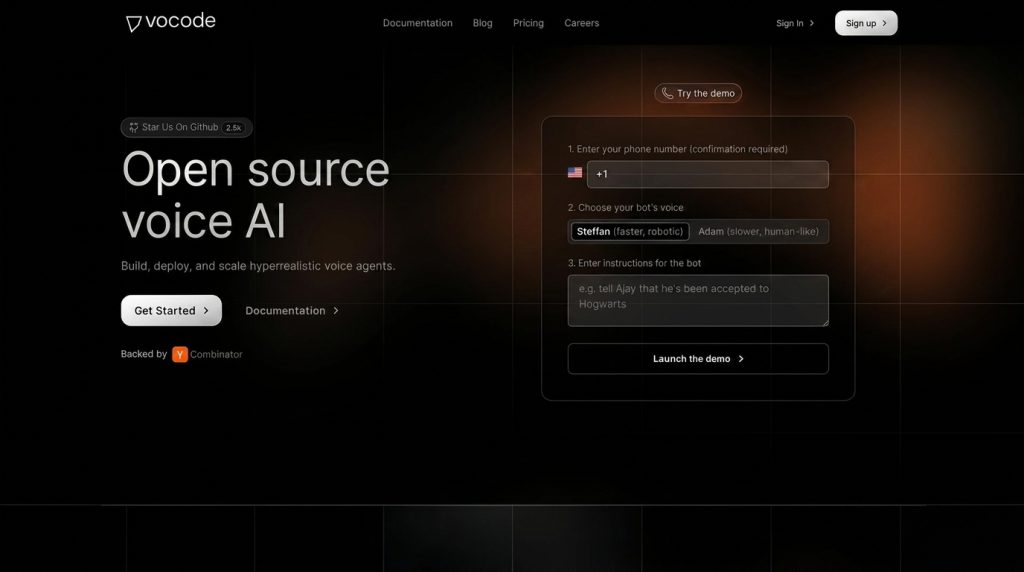
10. Vocode (Hosted/Open Source)
Vocode is an open-source library that lets you build and host the agent yourself. There is no middleman charging a mark-up on every minute of conversation; you pay only the raw cost of the APIs you use and the server you run it on.
Pricing model
Why does it stay cheap?
Zero platform tax: You pay £0 to Vocode itself. You pay only for the compute you use on AWS or GCP and the API tokens for speech services.
Component swapping: You can swap expensive providers, such as ElevenLabs, for cheaper alternatives, such as Azure TTS or local Piper TTS, to further reduce costs.
Hidden cost warning
Scale failures: The open-source version lacks an SLA. If your server crashes during a critical campaign, the cost of lost business can outweigh any savings on per-minute fees.
How to Choose an AI Voice Agent Software: Quick Checklist
Latency tolerance: If your use case requires rapid-fire negotiation, such as auctions, choose Category B (Ultravox/Deepgram). For standard support, Category A (Retell/Vapi) is sufficient.
Development resources: If you have Python or Node.js engineers, choose Vapi or Vocode. If not, Synthflow is the strongest no-code option.
Telephony requirement: If you need to port existing numbers, make sure the platform supports SIP trunking or BYOC, as with Vapi and Bland.
Compliance: If HIPAA or PCI-DSS matters, Retell and Bland Enterprise are stronger fits than open-source tools.
Observability: If debuggability matters, Retell and Vapi provide strong call traces. End-to-end models such as Ultravox are harder to debug because they are more black-box in nature.
Here we come to the end of our extensive review of the best AI voice agents in the UK across both done-for-you and DIY categories. Often, we get asked if one should go for DIY AI agent software and build it out yourself or go for AI voice agent providers for an end-to-end delivery.
The right answer depends less on hype and more on the level of control, speed, and operational responsibility your business can realistically handle. DIY platforms such as Retell AI and Vapi are strong options for teams with technical capability.
Retell is the better fit for businesses that want faster deployment and smoother conversational quality, while Vapi suits engineering-led teams that want deeper control over the stack.
That said, for most businesses, building and maintaining a reliable voice agent in-house comes with unnecessary complexity, integration work, and ongoing optimisation headaches.
For companies that want a true end-to-end solution for their AI voice agent needs, Lotusbrains Studio stands out as the strongest recommendation.
We offer bespoke AI voice agents built around your workflows, goals, and customer journeys, giving you the commercial benefits of AI voice without the operational burden of DIY assembly.
Across the UK, we have helped businesses use AI voice agents to capture missed-call revenue, qualify enquiries faster, automate bookings, and deliver more consistent customer service without adding headcount.
If you want an AI voice agent built around how your business actually operates, contact Lotusbrains Studio today and let us show you what a bespoke deployment could do for you.