
Real estate AI case study
AI Agent For Real Estate: How we helped Neon Luxuries qualify better prospects and double closing rates within 11 weeks of full rollout
Neon Luxuries, a real estate company operating across property sales, lettings, investment sourcing, and managed property opportunities, had a strong client offer but a fragmented enquiry-handling process.
Their team was receiving leads from website forms, calls, WhatsApp, Instagram, Facebook, email, and referrals. But without a centralised system, every enquiry depended on whoever was available to respond, qualify the lead, and pass it to the right person.
We helped Neon Luxuries implement a multi-agent AI enquiry system that could answer inbound calls, qualify prospects, capture structured lead data, route enquiries, support viewing bookings, and update their CRM with minimal human intervention.
Results at a glance
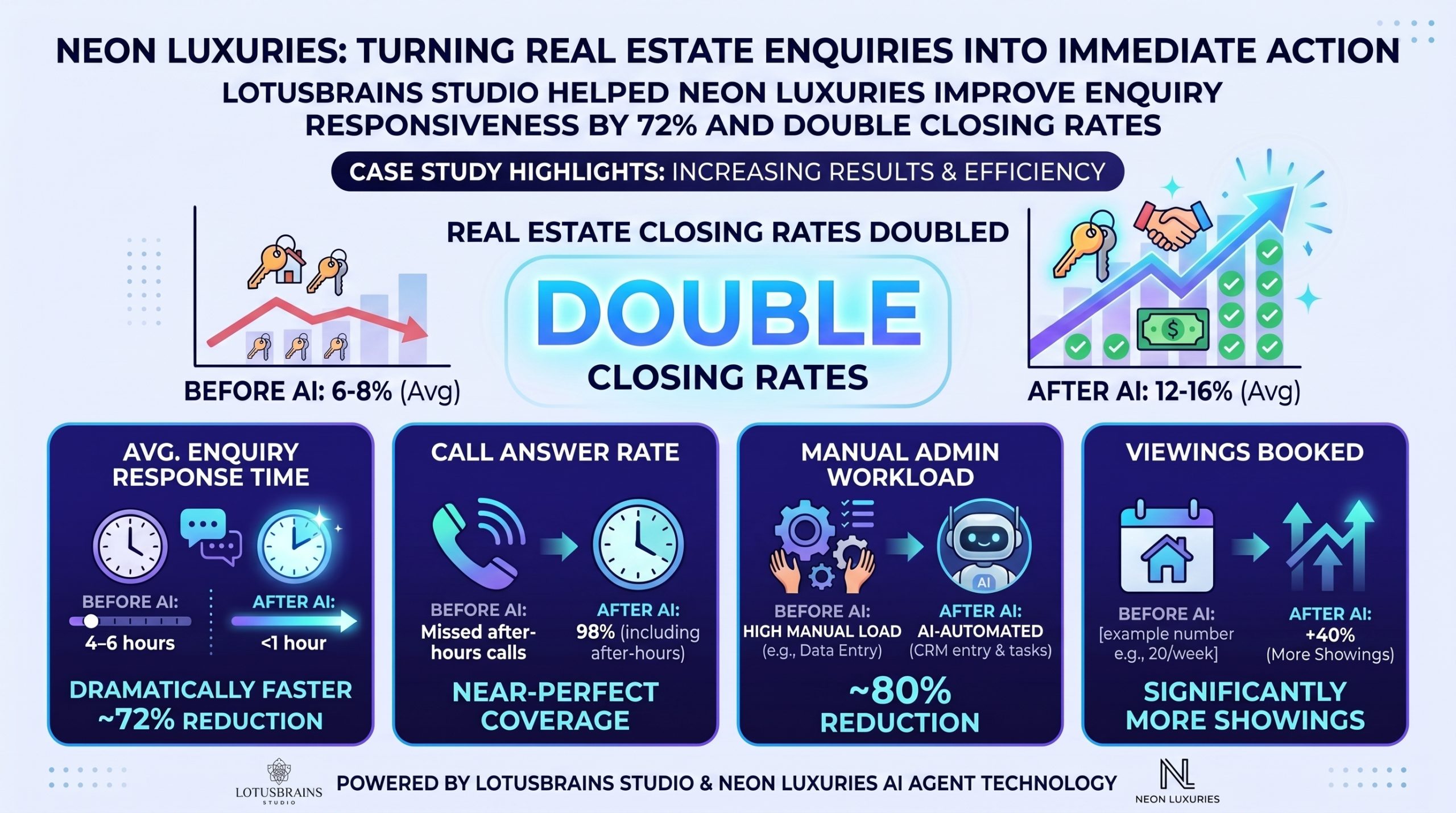
The enquiry engine became faster, cleaner, and more commercially useful.
Average response time moved from 4-6 hours to under 30 minutes.
Closing rates doubled after the AI enquiry system was fully rolled out.
Inbound calls were answered consistently, including after-hours calls.
Repetitive qualification, notes, CRM updates, and routing were automated.
The same enquiry volume could be handled with roughly half the previous team size.
More qualified prospects moved toward property viewings.
Effective output per employee tripled because repetitive manual work dropped.
Lost voicemail leads were reduced to zero after go-live.
Staff spent more time on inspections, tours, client conversations, and deal progression.
About Neon Luxuries
Neon Luxuries sells convenience, speed, confidence, and operational relief.
Neon Luxuries is a real estate company working across property sales, lettings, investment sourcing, and managed property opportunities.
Their work spans several client types, including homeowners, landlords, investors, corporate relocation clients, and people looking for short- or long-term property solutions.
A major part of their value proposition is helping clients move faster without losing quality. For time-pressed sellers and investors, Neon Luxuries offers a more streamlined property experience built around speed, communication, and due diligence.
For landlords and investors, their strongest offer is a hands-off, high-return property management package that combines dynamic pricing, guest screening, cleaning coordination, and 24/7 guest support.
Before working with Lotusbrains Studio, the company's enquiry-handling process was not keeping pace with the quality of the service they wanted to deliver.
Brand context
A premium real estate operator needed a premium enquiry experience.
The automation had to support speed and qualification without making the customer journey feel generic or disconnected from the trust-led nature of real estate decisions.
The challenge
The problem: too many enquiry channels, too little structure
Before the AI implementation, Neon Luxuries had a common but costly real estate problem: they were not short of enquiries, but those enquiries were arriving in too many places with no central system to manage them properly.
Enquiries were scattered across multiple channels, response times varied, and admin work pulled the team away from higher-value real estate activity.
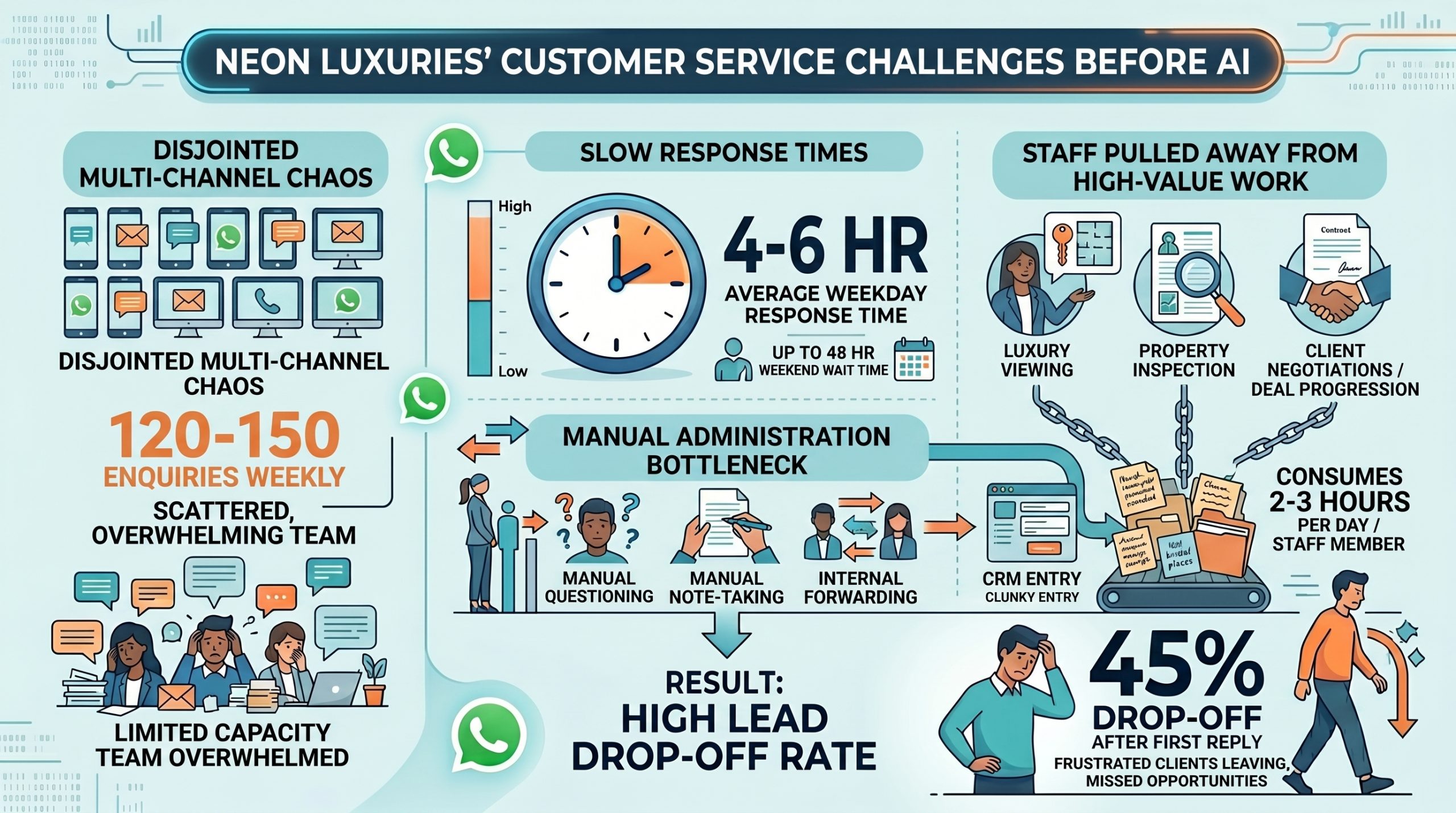
They were receiving around 120-150 enquiries per week across website contact forms, direct phone calls, property portal calls, WhatsApp messages, Instagram DMs, Facebook messages, email enquiries, and referrals by text or voice note.
That meant one high-intent investor might call directly, another landlord might send a WhatsApp voice note after hours, while a buyer might submit a website form at 2am.
There was no single operational view of all enquiries. The team had to constantly switch between tabs, inboxes, apps, messages, and call logs.
Important context was easy to lose. Follow-ups depended heavily on memory. Response quality varied depending on who happened to pick up the enquiry first.
For a real estate business, that is a serious issue. A buyer ready to view, a landlord considering a new agency, or an investor looking for a fast-moving opportunity will not wait forever.
Slow first response
Average response time was around 4-6 hours during business hours, and weekend enquiries could wait up to 48 hours.
Poor lead prioritisation
Casual browsing enquiries could receive the same attention as cash buyers, serious landlords, or investors ready to move.
Manual administration
Questioning, note-taking, internal forwarding, CRM entry, reminders, and clarification consumed 2-3 hours per day.
Missed visibility
The business could not easily see which leads were new, qualified, urgent, low quality, booked, followed up, or owned.
Why Neon Luxuries chose us
They needed an AI system that understood the realities of real estate enquiries.
Neon Luxuries chose Lotusbrains Studio because they did not want a generic AI chatbot or a basic automation layer.
A buyer, seller, landlord, investor, relocation client, and short-stay guest do not all need the same conversation. Each enquiry type requires different questions, routing, urgency handling, and follow-up actions.
From the start, our work focused on understanding how Neon Luxuries actually operated.
Enquiry source mapping
We mapped where enquiries came from, how the team responded, and what information they needed from each prospect.
Lead quality logic
We clarified what made a lead high quality, what made a lead low priority, and which enquiries required fast escalation.
Operational control
We mapped how viewings were arranged, how leads should appear in the CRM, where a robust AI automation would help, and where human judgment still mattered.
The solution
A multi-agent AI enquiry system for real estate
We delivered a complete enquiry-to-viewing AI system designed to help Neon Luxuries respond faster, qualify leads more intelligently, reduce manual admin, and give the team a cleaner view of every opportunity.
The system connected AI call handling, WhatsApp and web chat qualification, lead scoring, CRM updates, scheduling, and reporting into one enquiry workflow.
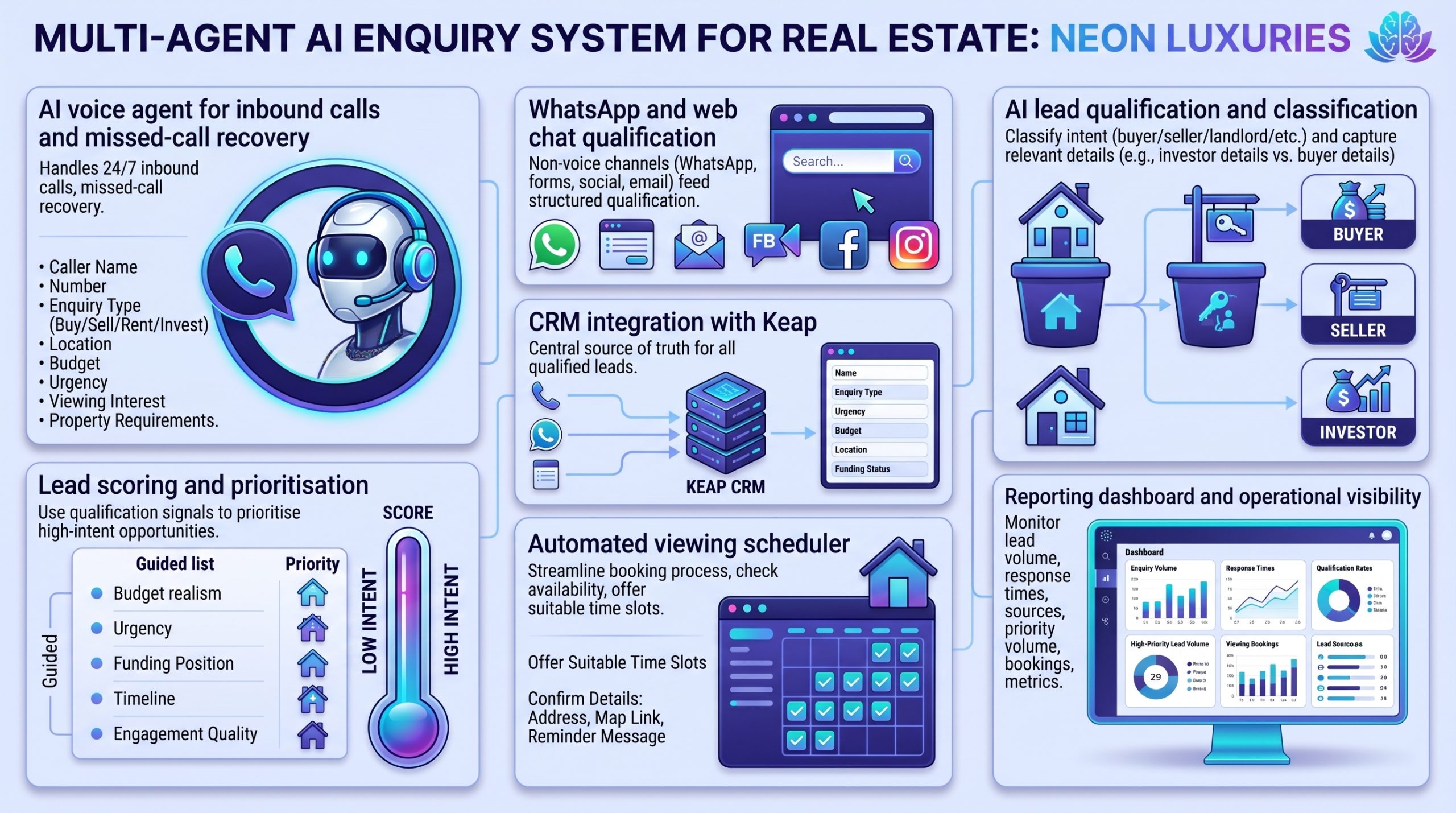
AI voice agent for inbound calls and missed-call recovery
The first layer was an AI voice agent designed to handle inbound calls 24/7, including evenings, weekends, after-hours periods, and busy moments.
It captured caller name, contact number, enquiry type, buying or selling intent, preferred location, budget range, urgency, viewing interest, and key property requirements.
WhatsApp and web chat qualification
The second layer extended the same qualification logic into WhatsApp, web forms, Instagram, Facebook, and email.
A WhatsApp enquiry, website form, and phone call could all feed into the same qualification and routing process.
AI lead qualification and classification
The system classified leads as buyers, sellers, landlords, tenants, investors, relocation clients, or short-stay and event-based stay prospects.
Investor leads could be asked about yield, capital growth, refurbishment appetite, funding position, and preferred location. Buyer leads could be asked about budget, property type, bedrooms, location, timeline, and viewing availability.
Lead scoring and prioritisation
The AI system used qualification signals such as budget realism, urgency, funding position, timeline, engagement quality, enquiry type, property fit, investment intent, and whether the prospect was already speaking with competing agents.
The point was not to ignore lower-quality leads. The point was to make sure the team's best time went to the best opportunities first.
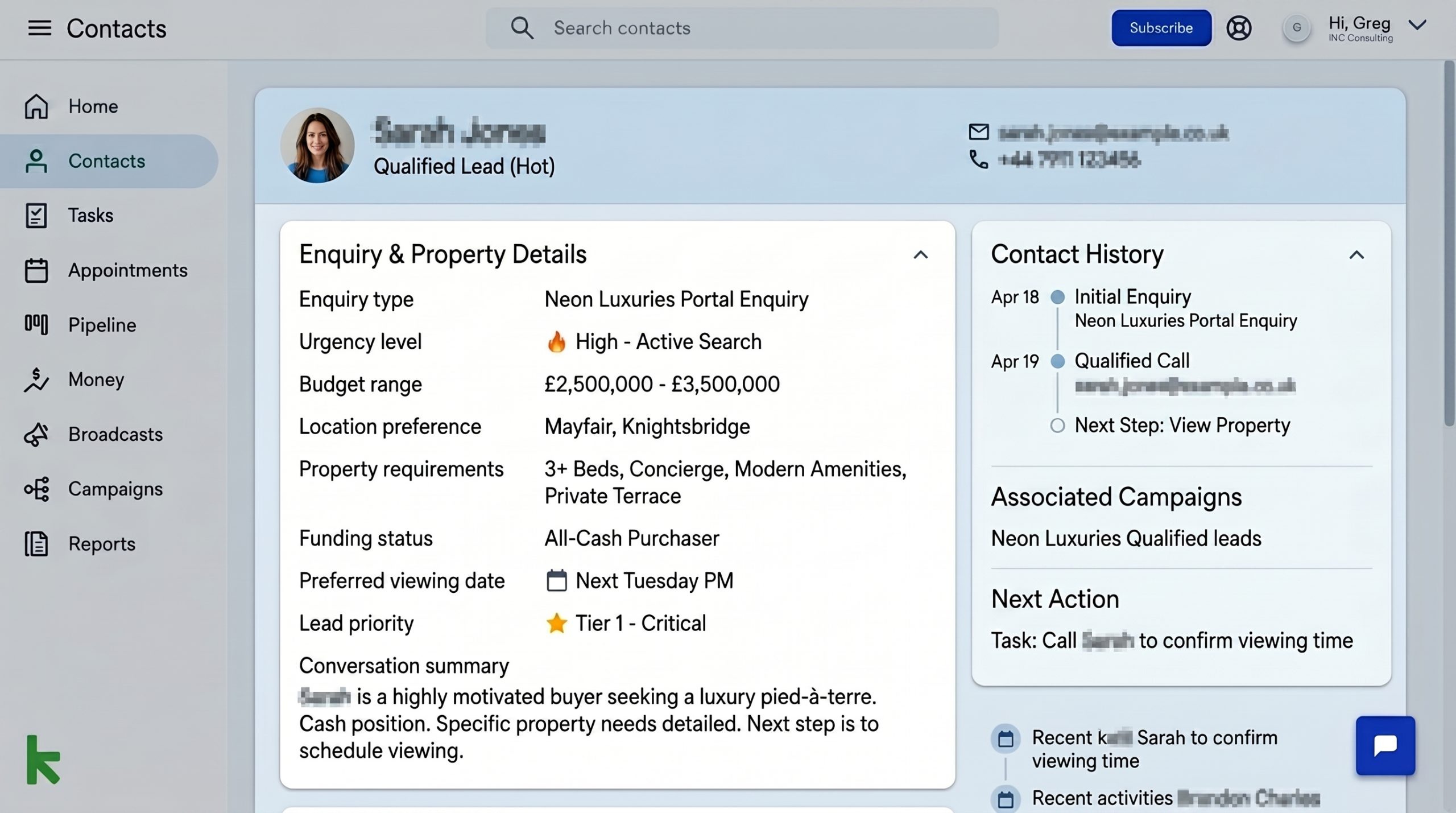
5. CRM integration with Keap. Keap became the central source of truth for qualified leads.
Once an enquiry was captured and qualified, the system automatically created or updated the CRM record with enquiry type, urgency level, budget range, location preference, property requirements, funding status, preferred viewing date, lead priority, and conversation summary.
This removed a large amount of manual CRM entry and gave the team cleaner records to work from.
Qualified leads were pushed into Keap with structured fields and clear follow-up context.
Automated viewing scheduler
The AI system helped streamline viewing bookings by checking team availability and offering suitable time slots.
Once a slot was confirmed, the prospect could receive appointment details, including address, map link, and reminder message.
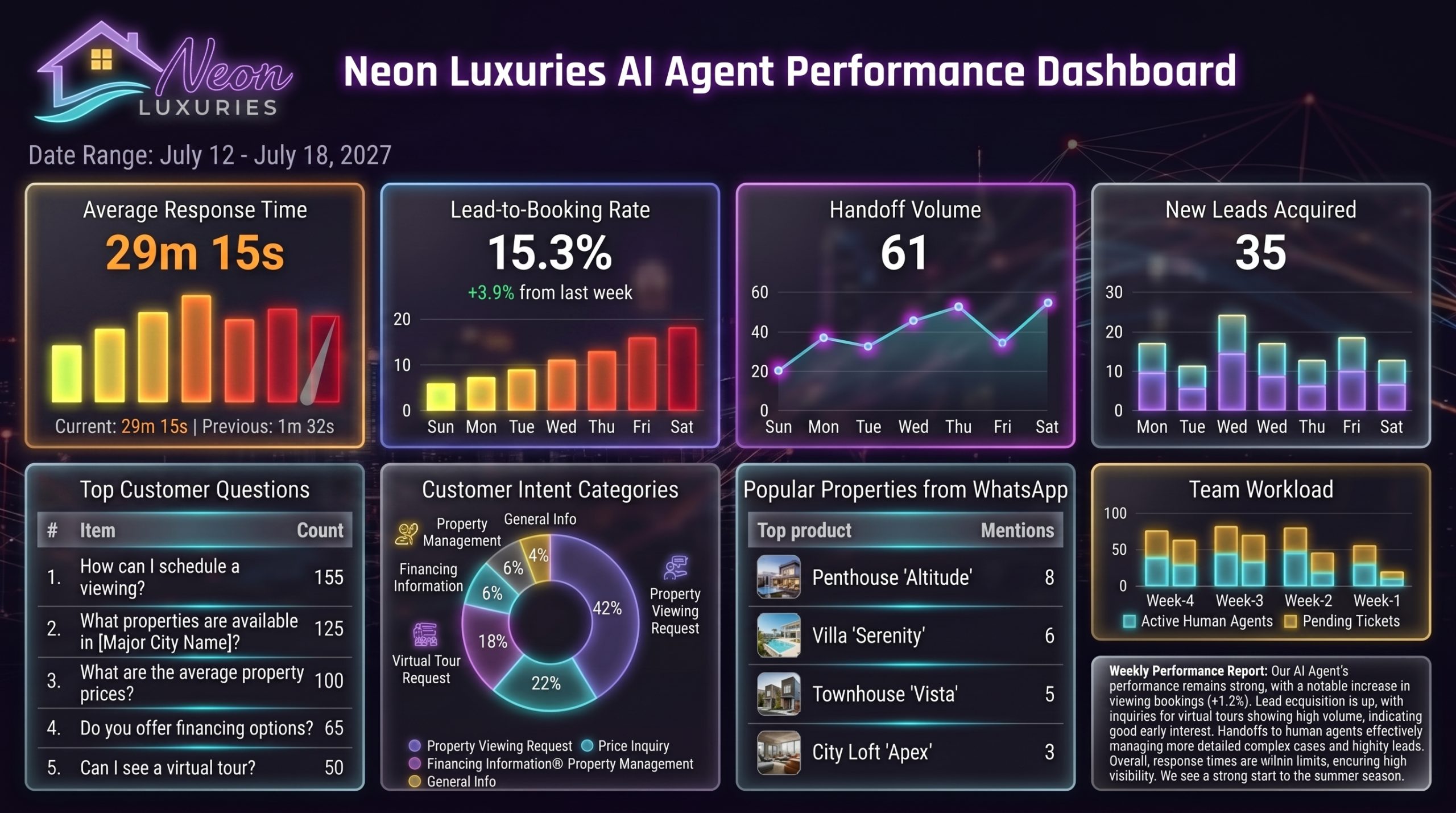
Reporting dashboard and operational visibility
The final layer helped the team monitor enquiry volume, response times, qualification rates, lead source performance, high-priority lead volume, viewing bookings, conversion metrics, and call answer performance.
For a growing real estate company, that visibility matters. You cannot improve what you cannot see.
Leadership could see where opportunities were coming from and how effectively the business was handling them.
From scattered messages to structured opportunity flow
The system was not just built to capture enquiries. It was built to move serious prospects toward the next step.
Implementation timeline
How the implementation unfolded
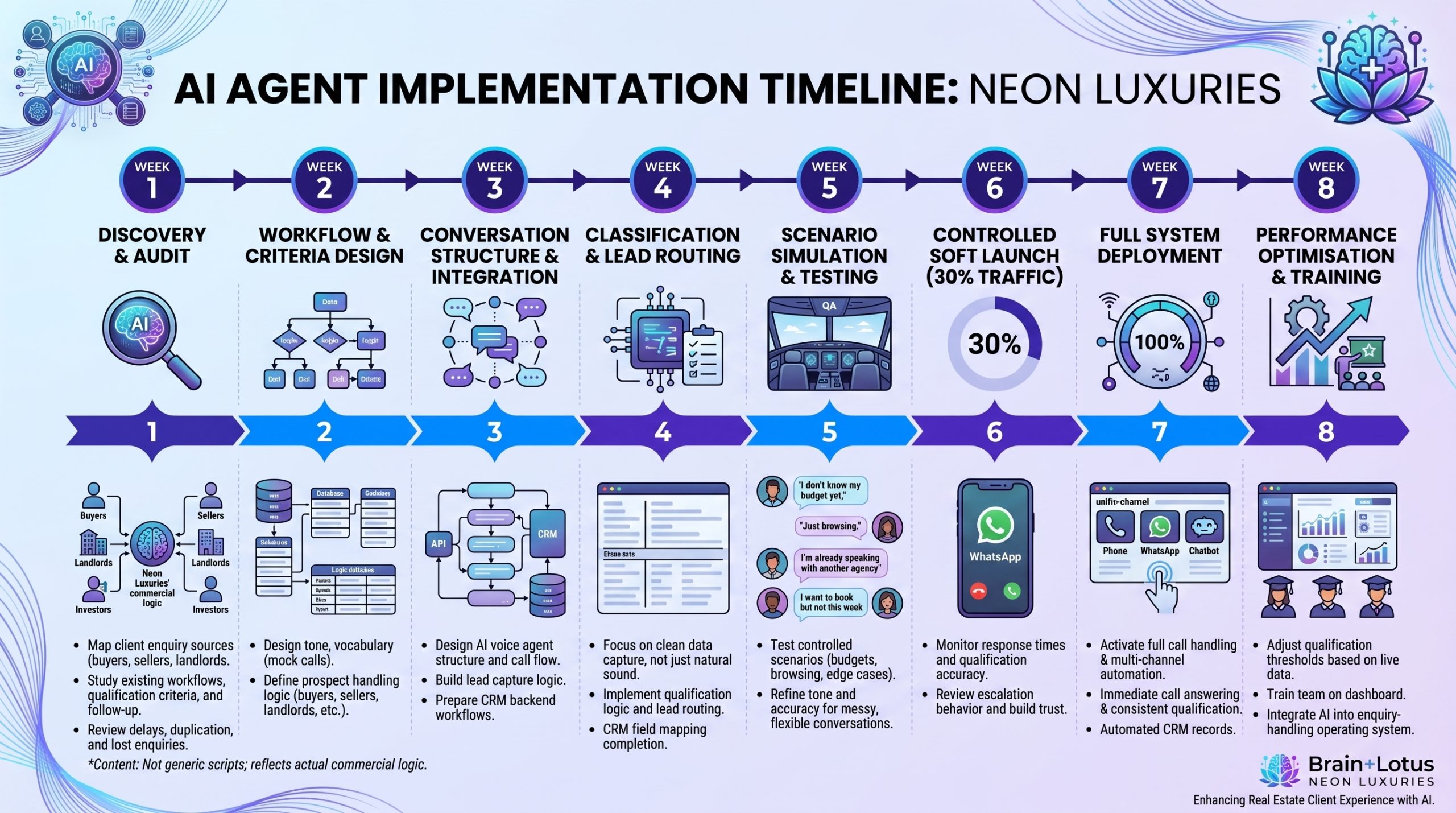
The full implementation took 8 weeks, moving from discovery and workflow mapping through build, testing, soft launch, full rollout, optimisation, and team training.
The implementation was staged so the team could test real estate conversation logic, monitor escalation behaviour, and build confidence before full deployment.
Discovery and workflow mapping
We mapped enquiry sources, team workflows, qualification criteria, follow-up processes, delays, duplication, lost enquiries, mock call tone, and vocabulary.
Build phase
We designed the AI voice agent conversation structure, call-handling flow, lead capture logic, backend CRM workflows, routing, and field mapping.
Testing
The team simulated messy real prospect conversations, including uncertain budgets, browsing intent, urgent moves, investor flexibility, competing agencies, and viewing availability constraints.
Soft launch
The AI went live for around 30% of inbound calls while we reviewed response times, qualification accuracy, call handling quality, and escalation behaviour.
Full rollout
The system moved to full call handling and WhatsApp/chat automation, creating a more unified enquiry process across key channels.
Optimisation and training
We adjusted qualification thresholds based on live data and trained the team to use the dashboard for better operational decisions.
Operating system
The AI was not treated as a separate tool outside the business. It became part of the operating system for enquiry handling.
Clean lead records
The team no longer had to rely on scattered notes, delayed callbacks, or manual triage to understand what should happen next.
Why the system worked
The implementation solved the real operational problem.
The problem was not simply that the team needed a chatbot. The problem was that enquiry handling had become too fragmented, too manual, and too dependent on human availability.
Before implementation
- Enquiries arrived in too many places
- Response times varied widely
- Notes were scattered
- Follow-up was inconsistent
- All leads were treated too similarly
- Manual admin consumed too much staff time
- High-intent prospects were sometimes delayed or missed
After implementation
- Calls were answered 24/7
- Enquiries were qualified consistently
- Serious leads were prioritised faster
- CRM records were updated automatically
- Viewing workflows became more structured
- Reporting improved
- Staff could focus on inspections, tours, and serious client conversations
That is the real value of AI automation in a real estate business.
It does not just make replies faster. It improves the quality of the entire enquiry-to-conversion process.
Escalation rules
Urgent or high-value enquiries could be moved to human review quickly.
CRM review visibility
The team could inspect lead records, summaries, priorities, and context.
Fallback handling
Uncertain answers were handled with fallback rules instead of risky assumptions.
Dashboard oversight
Management could monitor call quality, completion rates, and rollout behaviour.
The outcome after 11 weeks
Enquiry handling became structured, responsive, and scalable.
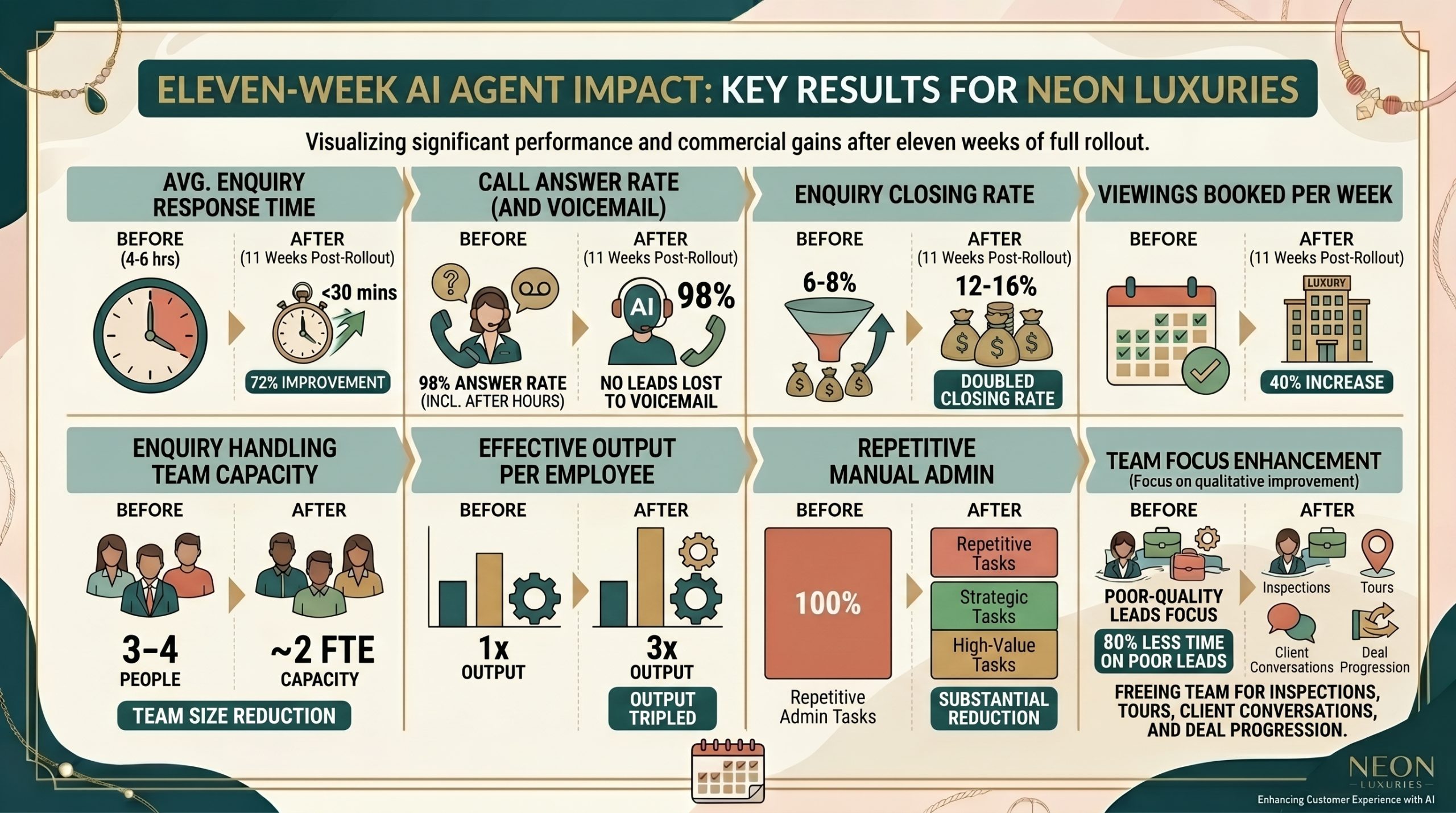
Within 11 weeks of full rollout, Neon Luxuries saw a significant improvement in operational and commercial performance.
The full rollout improved response speed, call coverage, closing rate, viewing activity, team capacity, employee output, and admin workload.
Responsiveness improved
Average response time moved from 4-6 hours to under 30 minutes.
Call answer rate
The AI maintained a 98% call answer rate, including after-hours calls.
Closing rates doubled
Close rates moved from approximately 6-8% to 12-16%.
More viewings
Viewings booked per week increased by 40%.
Lean enquiry capacity
The same enquiry volume could be handled with around half the previous team size.
Employee output
Effective output per employee tripled because repetitive manual administration was significantly reduced.
Less poor-fit lead time
The team spent 80% less time on poor-quality leads.
No voicemail loss
No leads were lost to voicemail after go-live.
Before the system, enquiry handling was reactive. After the system, it became structured, responsive, and scalable.
Closing insight
Why the numbers improved
The numbers improved because the business stopped treating enquiry handling as a manual admin function and started treating it as a structured conversion system.
Speed improved because the AI automation could respond immediately. Lead quality improved because every prospect was qualified using a consistent process.
Team productivity improved because staff no longer had to spend hours manually collecting information, entering CRM notes, chasing basic details, and filtering poor-quality leads.
Business-first implementation
For Neon Luxuries, the experience of working with us was not just technical. They valued that the system was built around their actual business process.
Practical fit
We took time to understand how enquiries came in, how prospects needed to be qualified, how viewings were arranged, and where the team was losing time.
Built for day-to-day reality
The system was not designed to impress on a demo call. It was designed to work inside a busy real estate operation.
Final takeaway
Neon Luxuries did not need another disconnected tool.
They needed a smarter way to handle enquiries, qualify prospects, prioritise serious opportunities, and reduce the manual workload on their team.
By working with us, they transformed a fragmented enquiry process into an AI-powered real estate response and qualification system.
The result was faster response times, fewer missed opportunities, better-qualified leads, higher viewing activity, stronger close rates, less manual admin, more productive staff, and a better client experience.
For real estate businesses, this case study shows what becomes possible when AI is implemented properly: not as a generic chatbot, not as a gimmick, but as a practical operational system designed around how enquiries actually turn into revenue.
CTA
Want to build a smarter enquiry system for your real estate business?
If your team is losing time to missed calls, scattered messages, manual qualification, and poor-quality leads, we can help you design an AI enquiry system built around your actual workflow.
At Lotusbrains Studio, we build tailored AI automation systems for businesses that want faster response times, better lead qualification, cleaner operations, and more scalable growth.
Whether you need AI call handling, WhatsApp automation, CRM updates, viewing scheduling, or end-to-end enquiry qualification, we can help you turn fragmented enquiry handling into a structured growth engine.
Let's explore how AI could help your business respond faster, qualify better prospects, and convert more opportunities without increasing headcount.