
In real estate, a missed call is rarely just a task for tomorrow. It is often the moment a high-intent seller, buyer, landlord, or tenant – who could have been your next customer – moves on. This explains why real estate answering services are critical.
Let us face it. In today’s real estate space, customers want a larger touch of “royalty”. Essentially, they want you to answer them VERY FAST.
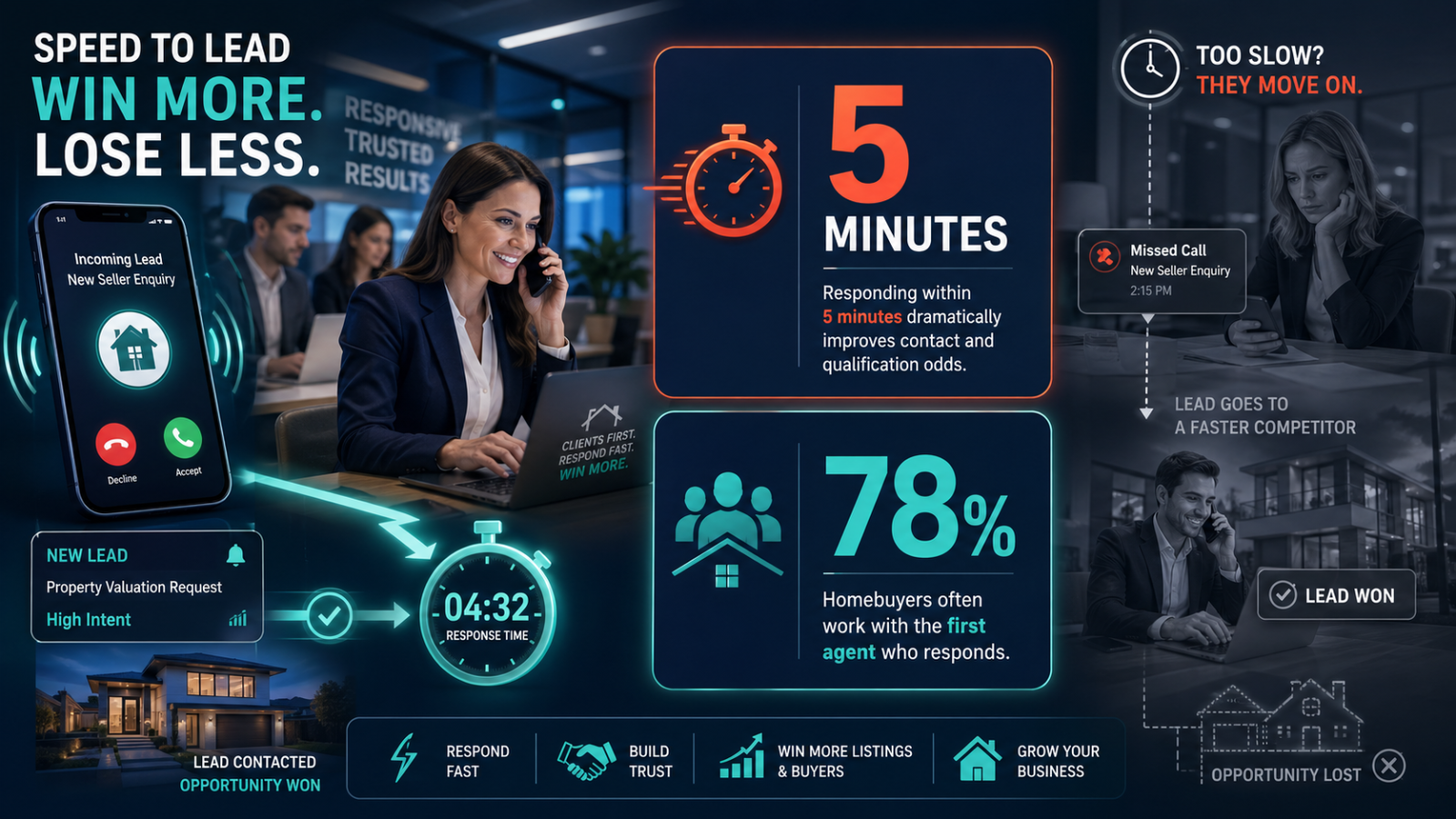
The numbers agree with this. Reputable studies found that contacting an inbound lead within five minutes rather than 30 minutes dramatically improves both contact and qualification odds.
As a real estate business, if you don’t handle calls fervently, you are in for a whopping!
Would it surprise you to learn that 78% of homebuyers eventually work with the first agent who responds to their enquiry?
The operational pressure also tends to peak when staff are offline. Many agencies still use outsourced answering to cover overflow and out-of-hours. This has endless bottlenecks as often these outsourced real estate answering services answering services are one-size-fits-all call centers that are not extensively aligned with the peculiarities of your real estate business.
Enter AI phone agents. It is no secret that more real estate businesses are successfully replacing traditional human real estate answering services with AI phone agents.
As a premier provider of AI real estate answering services, we have delivered remarkable outcomes for real estate businesses, satiating their needs with a tailored AI real estate answering service that furnishes them with more structured lead capture, more accurate routing, and a call-handling experience that is shaped around the agency’s own workflow rather than a generic script.
With that said, this guide compares the best real estate answering service providers by their ability to handle emergency triage, booking workflows, multi-branch routing, and proven property-sector case studies.
Real estate answering service: What must your vendor handle
In real estate, a general message-taking service can become an operational liability. To be effective, a provider—human or AI—must treat every call as a specific workflow with distinct data requirements and urgency rules.
Here are six non-negotiable requirements your real estate answering service must have
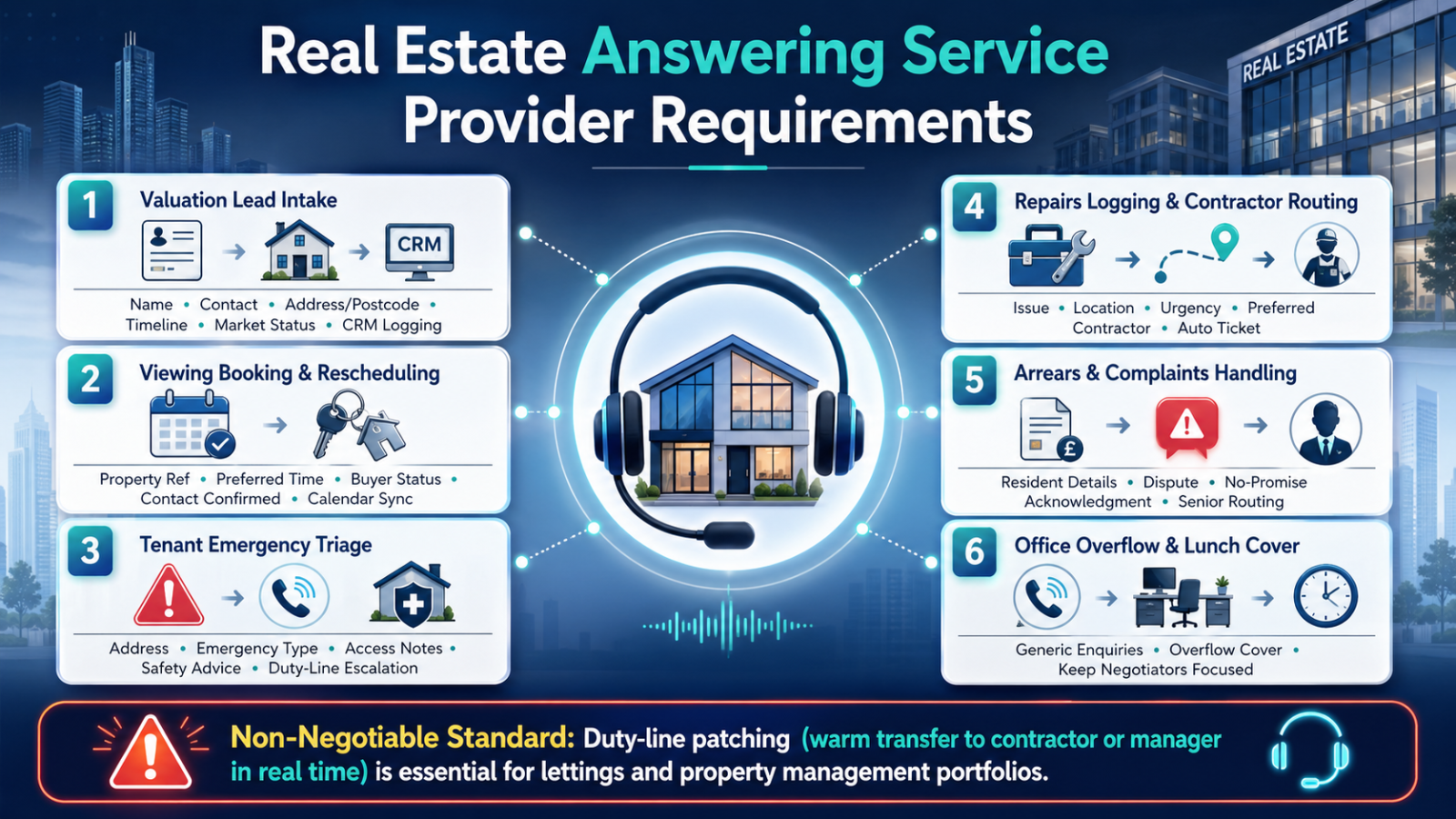
1. Valuation lead intake and qualification
Minimum data: name, contact details, complete property address/postcode, timeline to sell, current market status
AI-friendly: structured lead capture and instant CRM logging
2. Viewing booking and rescheduling
Minimum data: property reference, preferred date/time, buyer status, contact confirmation
AI-friendly: real-time booking/rescheduling and calendar integration
3. Tenant emergency triage (life, limb, or property)
Minimum data: address, nature of emergency, access notes, immediate safety advice given, escalation to duty line
AI-friendly: consistent emergency playbooks and immediate automated escalation
4. Repairs logging and contractor routing
Minimum data: issue description, location within property, urgency level, routing to preferred contractor
AI-friendly: categorisation and auto-ticket creation in property software
5. Arrears and complaints handling
Minimum data: resident details, nature of dispute, “no-promise” acknowledgment before senior manager routing
6. Office overflow and lunch cover
Requirement: handling generic enquiries to keep internal negotiators focused on closing deals
Operational standard: If a provider does not offer duty-line patching (warm transfer to a contractor or manager in real time), they should not be considered for lettings or property management portfolios.
Real Estate Answering Service Provider: Protecting your number and your data
Handing over your calls is a major operational decision. In practice, you are trusting an outside provider with two sensitive assets: your main business number and the personal data shared by callers.
That is why due diligence matters. The goal is not just to buy a pleasant voice on the phone; it is to make sure the service cannot disrupt your call flow, mishandle customer data, or leave you without a clear audit trail when something goes wrong.
Here is what you need to ask before signing the contract.
Number continuity: don’t port until you’re sure
As a real estate business, your phone number is one of your most valuable operational assets. If callers cannot reliably reach it, you risk missed leads, tenant frustration, and avoidable revenue loss.
We have seen businesses struggle to regain control of numbers that became too tightly tied to a previous provider’s phone setup.
In many markets, number portability exists, but the process depends on the country, carrier, number type, and how complex your setup is. Treat it as a transition project, not an admin form.
The strategy: the “soft trial”
We recommend testing the service before committing to a full port. Start with call forwarding or overflow routing so you can assess pickup speed, script quality, and handover accuracy without risking downtime on your main number.
Why? Because this lets you verify operational performance before you hand over the line your customers already know.
AI/hybrid advantage: AI phone agents are particularly well-suited to this model. They can sit behind forwarding rules quickly, giving you a low-risk way to test pickup, structured capture, and escalation before you trust them with your primary number.
Data governance: you are still accountable
When an answering service takes a message from a tenant, buyer, seller, landlord, or contractor, it is processing personal data on your behalf. Across modern privacy regimes, that usually means your business still carries accountability for choosing and instructing the provider properly, while the provider acts under contract as a processor or equivalent service provider.
You should therefore treat your answering service — whether human or AI — as an extension of your own governance workflow. You need clarity on the following:
Access controls: Who can see the call logs, recordings, and transcripts? Is access restricted to the delivery team, or can wider support staff view them too?
Retention: How long are recordings and transcripts kept? Can they delete or return data promptly when required?
The paperwork: Do they provide a DPA or equivalent processing agreement setting out your instructions, confidentiality obligations, security measures, deletion/return terms, and any sub-processors they rely on?
Buyer test: If they cannot explain these controls clearly in writing, treat that as a major operational risk.
The AI privacy question
If you choose a hybrid or AI solution, the governance question goes a step further. AI usually requires transcription, classification, or structured analysis. So you need to ask: where do the audio files and transcripts go, what security safeguards apply, whether data crosses borders, and whether your customer data is used to train public or shared models.
The broader benchmark here is simple: purpose limitation, use limitation, security safeguards, openness, and accountability. Those principles appear across established privacy frameworks, and they matter even more when AI is involved.
NIST’s AI risk framework (the AI Risk Management Framework released by the National Institute of Standards and Technology in January 2023) makes the same point in operational terms: AI deployment should be treated as a risk-management exercise, not a blind trust exercise.
Use your local privacy rules and the provider’s written commitments as your baseline. If they cannot answer these questions clearly, move on.
How To Choose Real Estate Answering Services
Finding the right real estate answering service can be strenuous, especially when so many generic providers present themselves as property-ready. That is why we built this review around operational fit rather than marketing polish.
But how did we arrive at this?
We did not rank these services based on who sounded the politest. We ranked them on who could reliably handle property-critical tasks without needing your intervention.
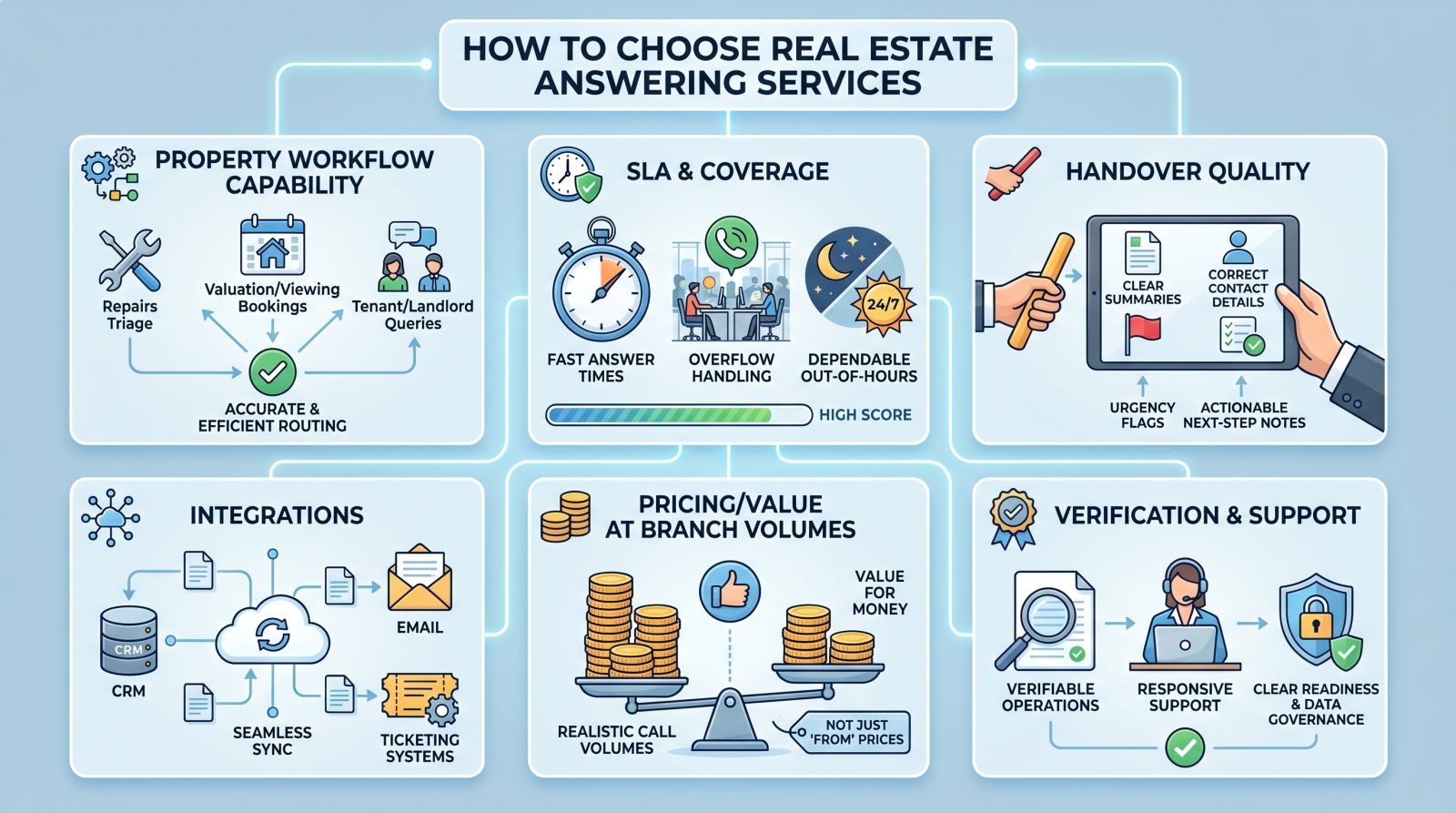
For each provider, we scored the service against each of the criteria below from 0–10, then applied the percentage weights shown. The weighted results were then added together to produce a final score out of 10.
Property workflow capability (30%)
We prioritised whether the service can handle real estate-specific calls properly — repairs triage, valuation/viewing bookings, and tenant/landlord queries — without missing key details or misrouting urgency.
SLA & coverage (20%)
We scored reliability under pressure: fast answer times, overflow handling during peak hours, and dependable out-of-hours/weekend coverage.
Handover quality (15%)
We scored how well calls are handed over to negotiators or property managers: clear summaries, correct contact details, urgency flags, and next-step notes your team can act on immediately.
Integrations (15%)
We scored whether the service connects to property CRMs, email, or ticketing systems so enquiries and repair requests do not require manual retyping.
Pricing/value at branch volumes (10%)
We scored value for money at realistic call volumes, not just headline “from” prices.
Verification & support (10%)
We scored whether the provider has verifiable operations, responsive support, and clear readiness for the call-handling and data-governance expectations of the markets it serves.
Best Real Estate Answering Service: How We Shortlisted
We were deliberately strict when building this shortlist. The goal was to protect you from choosing a generic call centre that can answer the phone, but cannot support property workflows, emergency escalation, or accountable handovers.
Because many of the providers reviewed in this draft are evidenced through UK registrations and UK-facing proof points, you will still see UK-specific references in the shortlist. But the screening logic itself is broader and can be applied in any market.
This is how we screened them.
To protect you from choosing a provider that cannot support real estate operations properly, these were the core parameters we evaluated:
Verifiable operating footprint (non-negotiable)
The provider must show a real business presence and an independently checkable verification source, such as a company registry, legal page, or equivalent corporate record.
Property-sector proof (required)
The provider must demonstrate real estate experience with either a property case study/testimonial or a dedicated estate agency, lettings, brokerage, or property management service page.
Out-of-hours + emergency handling (must be explicit)
“24/7 answering” is not enough. The provider must document an escalation process: what counts as urgent, who gets contacted, and how quickly.
Transparent pricing (model-ready)
Pricing must be presented in a clear billing model, support realistic call volumes, and make overage or after-hours costs visible enough for you to estimate monthly spend.
If a provider cannot evidence these points, we do not shortlist them.
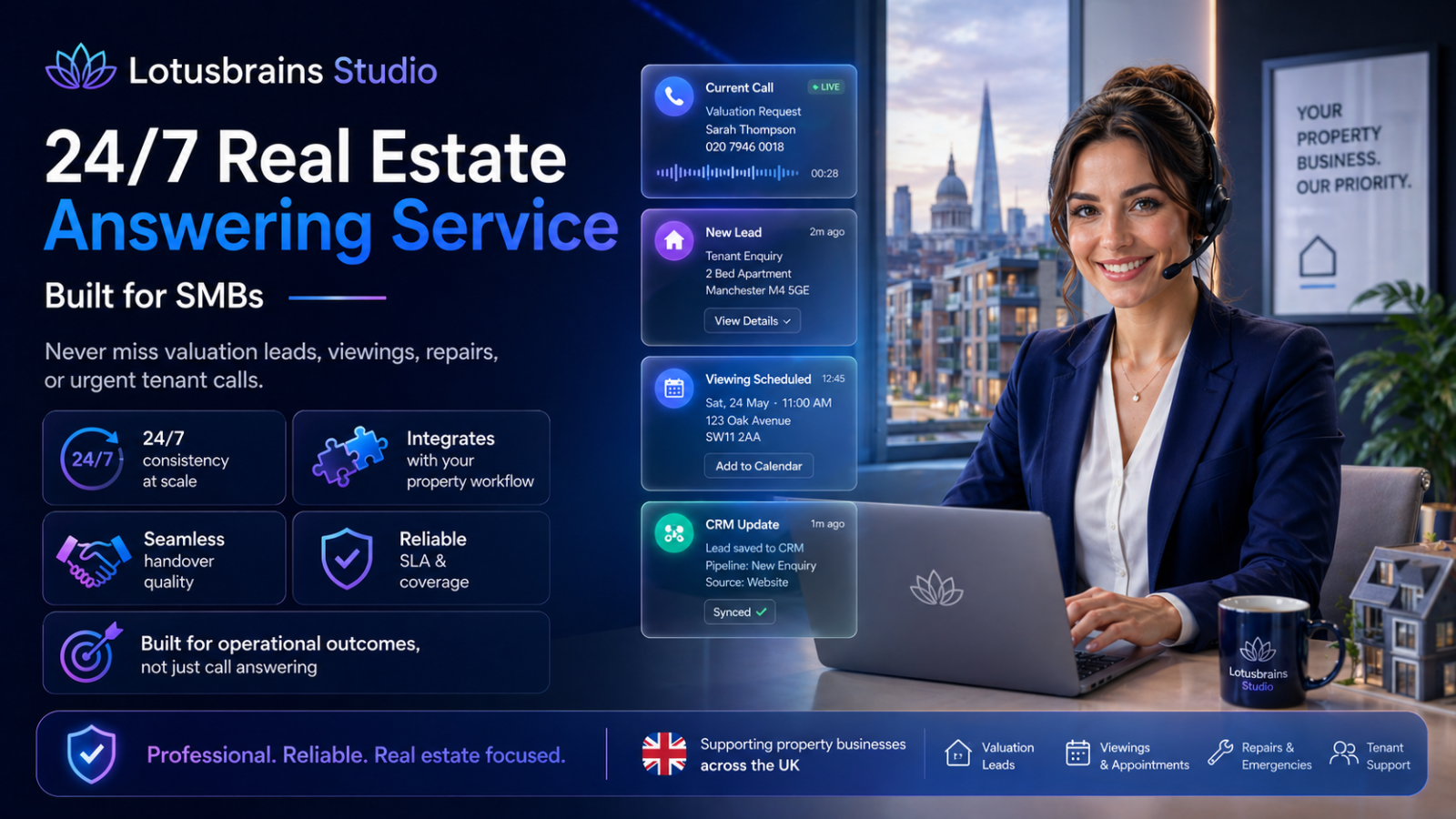
1. Lotusbrains Studio — Best AI-Led Real Estate Answering Service for SMBs
Verdict: Best for estate agencies, property managers, and real estate businesses desiring a tailored answering service built around lead qualification, structured enquiry capture, and workflow automation, rather than a generic message-taking service.
It is 2026, and indeed, many businesses searching for the best real estate answering service are not simply looking for someone to pick up the phone. From what we have seen, many are seeking to solve a deeper operational problem: missed valuation leads, inconsistent call handling, poor follow-up, and too much valuable staff time being swallowed by repetitive first-line conversations.
We understand you want more than a generic tired human PA on the phone, you want an infrastructure that can handle those calls for your real estate opportunities, and intelligently squeeze in extra opportunities for you to make an extra upsell, independently update your CRMs, and optimise the caller’s customer journey accordingly.
That is exactly where we take a different approach.
At Lotusbrains Studio, we do not view real estate answering as a basic receptionist function. We build AI-led answering systems designed around how a real estate business actually operates. These agents, built around your unique real estate business processes, excellently manage how enquiries are qualified, how urgent issues are triaged, going as far as handling how leads are routed and followed up after the call ends.
You would be hard-pressed to find a traditional or human PAs real estate answering service that does this like us, without paying your arm, your leg, and even a loved one...lol!
Now, having a real estate answering service that is extensively aligned with your backend systems matters. This is because, from what we have seen over the last 6 years in building intelligent solutions for real estate businesses, the real cost of poor call handling often emerges after the conversation ends.
If the answering service is not fully aligned with your CRM and wider workflows, valuation leads may not be captured properly, viewings can be delayed, tenant issues can be mishandled, and important enquiries can fail to reach the right person or process in time.
We don’t need to remind you that this is hard cash being left on the table.
Where many traditional answering services focus mainly on answering politely and relaying a note, at Lotusbrains Studio, we build systems that can do far more at the first point of contact.
Our AI-driven real estate answering workflows can handle calls, qualify leads, capture structured details, route calls based on intent, trigger follow-up actions in your CRMs and sales pipelines automatically, and support a more consistent handover process from first ring to next step.
In practical terms, that means agencies can often operate with faster response times, cleaner enquiry handling, and less dependence on manual admin than they would with a conventional human-only PA model.
Here is what we do so well.
Built for operational outcomes, not just call answering
Our real estate clients trust us to build cutting-edge AI answering systems that help them move calls forward properly. That can include identifying whether the caller is a buyer, seller, landlord, tenant, or contractor, capturing the right details early, and helping direct the conversation into the right commercial or operational path.
Tailored real estate workflows
You need more than a tired PA (who handles calls for a million other businesses) answering your calls robotically or mindlessly. Your callers would not readily forgive you for that.
And this is just what we do well. Building real estate answering services that are unique to your business. We do not force agencies into a one-size-fits-all call script.
We build around the client’s actual workflows and what makes your real estate brand stand out: from your personality and SOPs. This could mean customising valuation intake, viewing requests, repairs triage, branch routing, landlord enquiries, or lead qualification.
That makes the system more commercially useful than a generic answering service that sounds polished but sits outside how the business really runs.
Deeper automation than a typical answering service
We are especially strong where call handling needs to connect into your wider real estate business. Our deployments can integrate with CRMs, calendars, webhooks, email workflows, booking flows, internal alerts, and custom automations, so the answering layer becomes an active part of the operation rather than a disconnected front desk.
24/7 consistency at scale
Your traditional human real estate answering tire — INEVITABLY. Our AI agents don’t!
This is one of the clearest areas where AI-led answering can outperform a human PA model. A human receptionist may bring warmth, but humans also vary by shift, fatigue, workload, and training depth.
AI can answer instantly around the clock, follow the same playbook every time, and capture structured information without skipping fields when call volume rises.
Natural conversation quality
Property calls break down quickly if the system feels robotic or rigid. We place strong emphasis on making conversations feel smooth, helpful, and natural, so callers feel guided rather than trapped in a phone tree. That matters in real estate, where reassurance, clarity, and pacing all influence caller confidence.
Commercially efficient for growing agencies
For many real estate businesses, the real value is not just saving admin time. It is gaining a more scalable front-line answering system for lead capture, triage, and follow-up without relying entirely on a fully human answering layer for every first-touch call. We would only escalate to a human system for edge cases.
Where AI answering can be better than a human PA
A traditional human answering service can still work well in some situations, especially where relationship continuity or emotional sensitivity matters. But in many real estate workflows, AI can be the better first-line tool.
For example, AI is often stronger when the job requires:
- instant pickup, including evenings and weekends
- structured capture of lead or property details
- consistent qualification questions
- repeatable triage logic
- fast escalation based on rules
- workflow automation after the call
That is why we believe AI-led real estate answering is particularly well suited to valuation enquiries, viewing requests, overflow calls, tenant repair triage, and routine front-line property questions. Humans still matter for edge cases, distressed callers, sensitive complaints, or complex commercial conversations. But for predictable Tier 1 call handling, AI often gives businesses a stronger operational layer.
Watch-outs
Not a plug-and-play answering service
We are best suited to businesses that want a tailored real estate answering setup, not a basic off-the-shelf receptionist service with minimal customisation.
Best results require business input
The strongest outcomes happen when a client is willing to share how they handle enquiries, qualify leads, route calls, and define urgency. That discovery work helps us build a much sharper and more useful system.
Pricing depends on scope
Our pricing is flexible, but it depends on the complexity of the build, the integrations required, and the depth of the automation involved.
Pricing snapshot
From:
Custom pricingModel:
Bespoke setup plus ongoing support and usage depending on scopeNotes:
Best suited to real estate businesses focused on conversion, operational efficiency, and long-term ROI rather than simple low-cost message takingIntegrations and setup
Integrates with:
CRMs, calendars, webhooks, automation platforms, and custom business workflowsSetup time:
Varies by project scope, but built around the client’s real operational requirementsKeeps your number?
Yes, depending on the telephony setup and routing requirementsReal Estate Answering Service Case study: How we helped Neon Luxuries reduce average response time from 6 hours to 30 minutes and double closing rates
We are particularly proud of the answering services (AI phone agents) we built for Neon Luxuries, an upscale real estate firm.
Before working with us, the business was spending a significant amount of time dealing with inbound enquiries and calls, many of which were repetitive, low-quality, or not commercially urgent. As is often the case in real estate, responsiveness mattered. But if you have been in real estate long enough, you will agree with us that not every caller deserves the same level of immediate human attention.
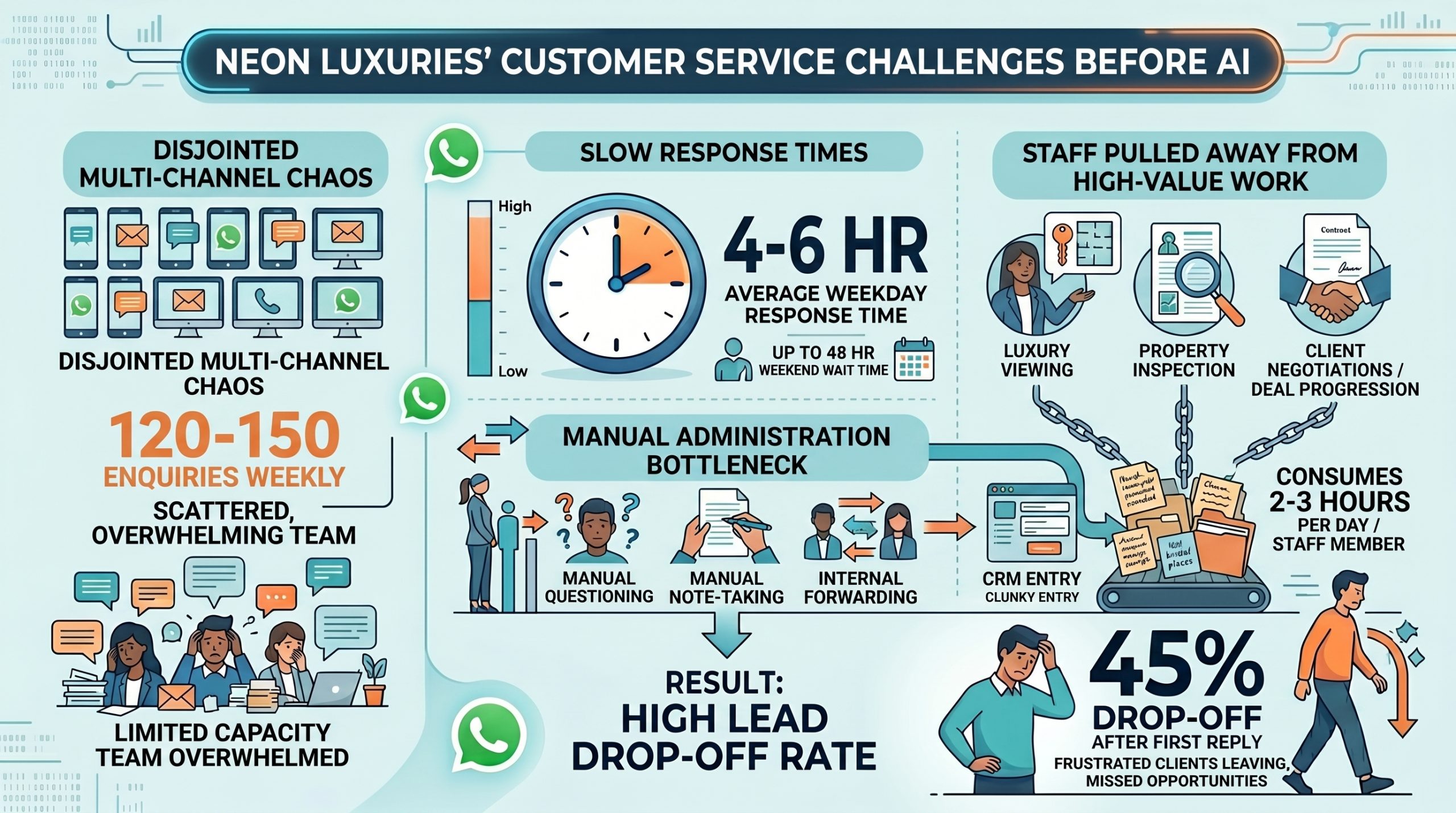
That created an obvious inefficiency. Skilled team members were being pulled into repetitive first-line call handling when their time was better spent on inspections, tours, and serious prospects.
We built an AI-powered real estate answering workflow tailored to their enquiry flow, so calls could be answered faster, qualified more intelligently, and captured in a much more structured way from the outset.
The system was designed to identify caller intent, urgency, and suitability early, while syncing with their CRM and wider workflow. In practical terms, it gave Neon Luxuries a more responsive front-line answering layer without forcing the team to spend the same amount of human effort on every inbound call.
Results delivered:
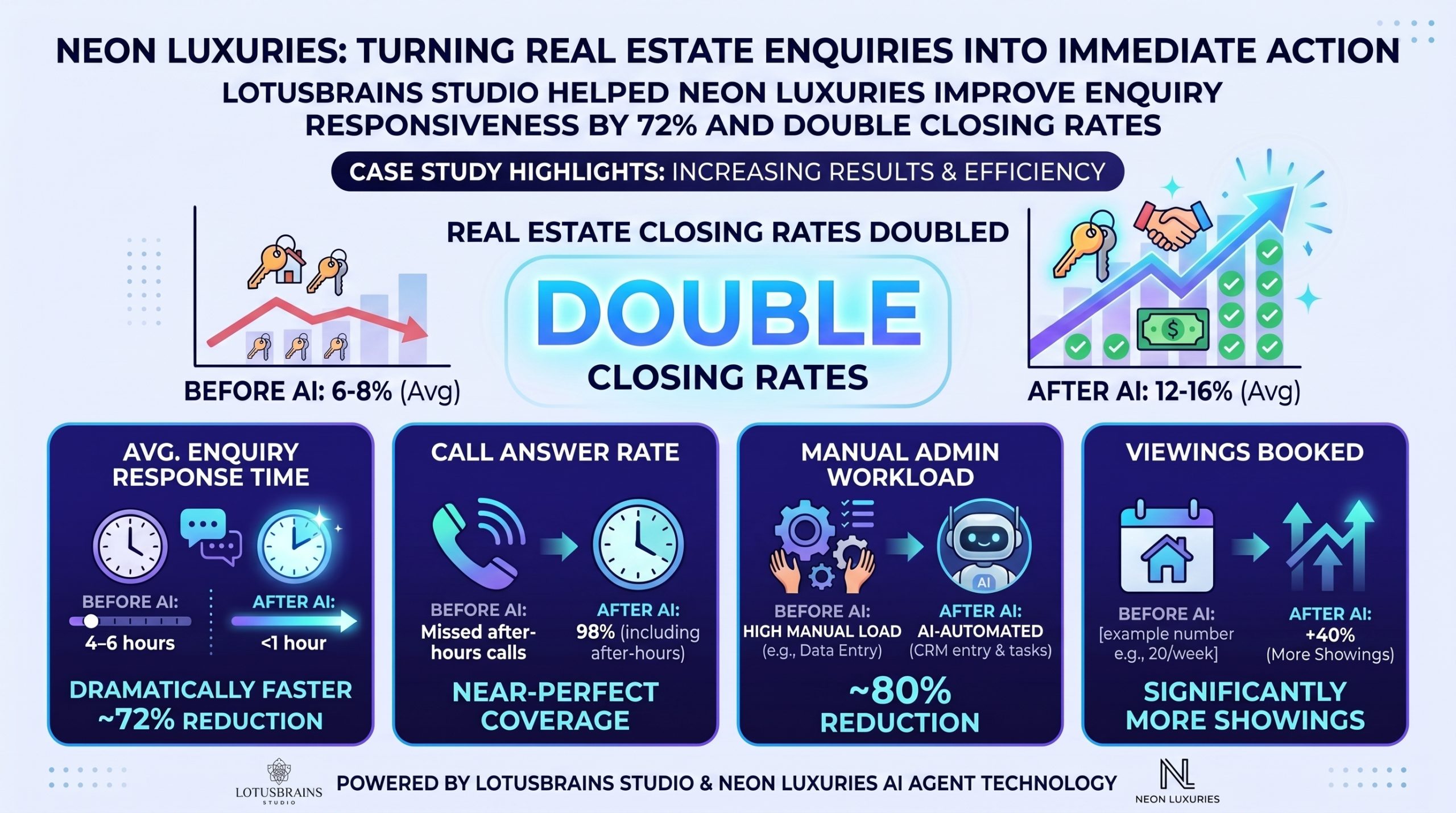
- 72% improvement in enquiry responsiveness
- Remarkable increase in closing rates over 3 months
- Stronger lead filtering, allowing the team to focus on high-value prospects only
- The business now operates with 50% of the team size previously needed for that process
- The effective output of a single employee tripled due to automation of repetitive administration and lead qualification
The result was a more responsive, scalable, and commercially effective operation. Instead of being tied up in repetitive backend work, the Neon Luxuries team could spend more time on high-value activities and serious buyer conversations.
Choose us if you want a real estate answering service built around how your business actually works — especially if lead qualification, structured enquiry capture, intelligent routing, and workflow automation matter to you.
We are a particularly strong fit for estate agencies and property businesses where inbound calls directly affect revenue, responsiveness, and operational efficiency.
Skip us if you only want the cheapest plug-and-play answering service with minimal customisation.
2. Moneypenny
Moneypenny is one of the largest answering services globally and has carved out a strong niche in estate agency call handling. Unlike generic AI phone agent services, it offers property-specific training and CRM integrations.
Verdict: Best for multi-branch estate agencies requiring native CRM integration and strong brand representation.

Property strengths:
CRM integration:
Native two-way sync with Reapit, Alto, and Street.co.uk, so leads can appear as live enquiries
Property-specific training:
PAs trained on valuation qualification scripts
Hybrid AI + human:
Offers Moneypenny AI for Tier 1 capture with human escalation
Watch-outs:
- Premium pricing may be high for single-branch independents
- Setup requires detailed script customisation
Workflow tests:
After-hours maintenance emergency:
Verified. Captures address, severity, immediate safety context, and escalates to the duty line with full handover detail
Book a valuation:
Verified. Captures name, postcode, timeline, current listing status, and pushes the enquiry into the CRM flow
Pricing:
From £120/month (100 calls)
Case Study
Monopoly Buy Sell Rent has partnered with Moneypenny for over a decade to ensure every call is handled professionally. The combination of Moneypenny’s telephone answering service and AI voice agent reportedly improved efficiency and consistency across their franchise operation.
3. The Call Answering Company
The Call Answering Company provides a high-touch, boutique service with a clear focus on professional triage and estate agency workflows.
Verdict: Best for independent agencies needing a seamless, in-house-style extension for property management.

Property strengths:
Specialist triage:
Agents are trained to distinguish between urgent maintenance issues, such as flooding, and routine repairs
Lead capture:
Strong valuation-intake scripting
Direct patching:
Emergency calls are warm-transferred immediately to your property managers
Watch-outs:
- Higher cost per call than volume providers
- Requires precise script onboarding
Workflow tests:
After-hours maintenance emergency:
Verified. Uses an emergency playbook to verify address, urgency, and access details before alerting the duty property manager
Booking a viewing:
Excellent. Captures buyer status and preferred dates with high accuracy
Pricing:
From £55/month
Case Study: Envirotec Limited
During the pandemic, Envirotec Limited shifted to remote work, leaving phone calls answered by whoever was available. This inconsistent approach was far from ideal.
After trials with other providers, Envirotec chose The Call Answering Company for its personal, professional service and family business ethos.
The solution maintained Envirotec's four-ring policy, ensured consistent call handling, and introduced a triage process that directs calls to the correct person—saving employee time and improving caller experience.
Critically, capturing caller information has helped Envirotec continue growing without missing a single opportunity.
"Capturing the caller's information has been invaluable in ensuring no opportunity is missed." – Rudy Krook, Head of Commercial
4. Face for Business
Face for Business (FFB) is a lead-centric provider with a clear focus on high-street estate agents, emphasising lead quality over pure message-taking volume.
Verdict: Best for independent high-street agencies needing a professional front-of-house layer to qualify valuation leads.

Property strengths:
Dedicated lead PA model:
Assigned lead PA plus a small property-specialist pod of 3–5 people
Proactive bill optimisation:
Monthly volume reviews help prevent overage shock
Negotiator-ready messaging:
PAs are trained to ask contextual questions, such as whether the caller also has a property to buy
Watch-outs:
- Setup is more involved than plug-and-play services
- Core strength is daytime overflow rather than always-on emergency triage
Workflow tests:
Urgent tenant repair call:
Supported, but not the core proposition. The service can triage the issue, message the team, or make a warm transfer to an on-call contact where instructed
Book a viewing:
Verified. Handles appointment scheduling and listing lead capture well
Alternative for agencies wanting always-on AI-led coverage:
Where Face for Business is strongest as a human-led front-of-house service, we offer a different model at Lotusbrains Studio: AI-led real estate answering built for 24/7 call capture, deeper workflow customisation, and structured escalation. That can be a better fit for agencies that want round-the-clock responsiveness without the cost profile of fully human answering.
Pricing:
From £49/month
Case Study: Lancasters Estate Agents
Lancasters Estate Agents struggled with juggling weekend viewings and phone calls, especially with fewer staff in the office. Directors Katy and Ben Washington found that calls were diverting to them on days off, leaving no real break.
After trying multiple services, they chose Face For Business for its reactive, brand-aligned approach.
The weekend answering service ensures every call is answered, no leads are missed, and staff no longer juggle calls alongside viewings. This has freed up man hours, improved customer service, and given the team genuine time off.
"It's given us more man hours to do what we're passionate about." – Katy Washington
5. Pocket Receptionist
Pocket Receptionist is the tech-first alternative for solo agents, micro-agencies, and small property managers, prioritising mobile agility over dedicated teams.
Verdict: Best for solo agents or small property managers who want a big-business feel on a lean budget.

Property strengths:
Real-time app alerts:
Instant push notifications mimic an internal CRM experience
Cost transparency:
Monthly cost calculator helps model 30- and 100-call scenarios
Scalability:
Users and simultaneous call limits can be adjusted through the portal
Watch-outs:
- Generic receptionist pool rather than a dedicated property pod
- Lacks deep native sync with property CRMs, relying more on email, SMS, and app alerts
Workflow tests:
After-hours viewing enquiry:
Verified. Captures property reference, preferred times, and callback details, then returns a structured message to the team
Maintenance issue after hours:
Limited. Better suited to structured message capture and app notification than true emergency triage
Alternative for teams wanting deeper automation:
At Lotusbrains Studio, we offer a different model: AI-led real estate answering built for 24/7 structured capture, deeper workflow customisation, and lower running costs at scale than fully human coverage. That can be a better fit where simple message capture is not enough.
Pricing:
From £70/month
Property Case Study:
DPS Estates says Pocket Receptionist’s real estate answering service has been great from the start and has improved their business at a fraction of the price of alternatives
6. Answer4u
Answer4u is a high-capacity call centre specialising in structured data capture and large-scale lettings support – making it more optimised for real estate businesses.
Verdict: Best for large property management groups or social housing providers.

Property strengths:
Technical triage:
Proven ability to handle high volumes of repair calls during surge periods, such as storms or winter demand
Custom scripting:
Highly granular decision-tree scripting for maintenance workflows
Watch-outs:
- Can feel more call-centre-like than boutique for small luxury agencies
Workflow tests:
After-hours maintenance emergency:
Verified. Uses the e-monitor platform to create a full audit trail of emergency dispatches
Viewing enquiry:
Functional. Reliable on data capture, though less sales-led than more boutique providers
Pricing:
From £100/month
Case Study: South Derbyshire District Council
With just three days before Christmas Eve, South Derbyshire District Council urgently needed an out-of-hours telephone answering service to support tenants facing emergency property issues.
Answer4u rapidly onboarded a bespoke triage solution, translating the council’s internal processes into structured call scripts and integrating them with CRM and rota systems.
The result was seamless. The service went live on time, generating $250,000 in after-hours bookings within six months while automating 68% of all reservation calls. Tenants received consistent, professional support outside office hours, and the council gained a trusted, scalable partner for handling seasonal demand.
While Answer4u delivers high-volume triage for large housing providers via human PAs, a monthly cost of £100 can be overwhelming. We offer something different at Lotusbrains Studio: AI-driven real estate answering that combines 24/7 availability with genuine brand warmth.
Why real estate businesses are considering us:
- 24/7 coverage for a fraction of the cost – No human shift overhead, yet every call answered instantly.
- Fluid customisation – Your tone, scripts, and qualification rules adapt without lengthy onboarding.
- Sales-led, not just service-led – Our AI schedules viewings and answers property questions, acting as an extension of your team.
For agencies wanting reliable, round-the-clock support without the call-centre feel, we believe our AI-native approach is a compelling next step.
7. Virtually There
Virtually There provides affordable, professional lead capture for solo agents and small property start-ups.
Verdict: Best for growing agencies needing to maintain a robust brand persona – typified in high-quality call handling – without high retainer costs.

Property strengths:
Lead capture:
Efficient intake of valuation leads with immediate email and SMS notification
Trial offer:
Often provides a low-risk starting point for new property managers
Light operational fit:
Email, SMS, and diary sync make it workable for lean teams handling straightforward enquiries
Watch-outs:
- Best suited to basic lead qualification rather than deeper triage
- Less suited to multi-branch operations or more complex routing setups
Workflow tests:
Valuation lead after hours:
Good fit. Built around quick capture and immediate notification
Viewing enquiry:
Supported. More suitable for straightforward follow-up scheduling than complex routing
Pricing:
From £15/month (flat fee / PAYG)
Property proof:
The likes of Nick Stopard Service from Boardwalk Property Co have a positive appraisal of Virtually There’s real estate answering services.
8. MyRuby
MyRuby focuses on a dedicated-receptionist model, in which a small, assigned pod of PAs handles your agency’s calls to build brand familiarity.
Verdict: Best for boutique agencies and surveyors who value continuity and rapport.
Property strengths:
PA continuity:
Callers speak with the same two to three receptionists, creating the feel of an in-house team
Professional tone:
Highly polished delivery suited to high-end residential or commercial portfolios
Watch-outs:
- Not a true 24/7 service; coverage is typically standard or extended business hours
- Higher cost profile than simpler overflow services
Workflow tests:
Viewing enquiry:
Strong fit. PAs are trained to present the value of the viewing and keep the handover polished
Urgent repair during covered hours:
Verified. Follows pre-agreed escalation rules, but always-on emergency coverage is not the core proposition
Pricing:
From £145/month (25-70 calls)
Alternative for teams wanting always-on coverage:
At Lotusbrains Studio, we take a different route: AI-led first-line answering that runs 24/7, follows custom property playbooks, and escalates to humans only when the workflow or caller requires it. That can suit agencies that want continuity and customisation without the cost profile of a dedicated human pod across all hours.
Case Study: ProAuction Limited
ProAuction Limited, a leading auction house, turned to MyRuby to manage high-volume enquiries during busy sale periods without overwhelming their in-house team.
MyRuby screens every caller, identifying whether they are existing clients, new prospects, or general enquiries. Nearly 80% of calls are efficiently directed to auction sale particulars, allowing the core team to focus on high-value tasks.
Using bespoke on-screen forms, MyRuby PAs capture industry-specific lead data, which is then emailed instantly to the correct contact. This ensures no opportunity is missed and follow-ups are seamless.
The office phone lines are programmed to automatically divert to MyRuby when engaged or when staff are out at property viewings. This guarantees every caller receives prompt, professional assistance, improving both client experience and operational efficiency.
9. Message Direct
Message Direct focuses on operational efficiency for lettings portfolios, with particular strength in contractor coordination and maintenance workflows.
Verdict: Best for lettings-heavy portfolios requiring sophisticated contractor routing and repairs management.
Property strengths:
Contractor database:
Approved contractor lists can be maintained by speciality, allowing calls to be routed appropriately
Ticketing integration:
Creates tickets in property management software such as Fixflo and Arthur
Escalation hierarchy:
Supports multi-tier routing from tenant to property manager to duty manager to director
Watch-outs:
- Less focused on sales or valuation lead capture
- Setup requires detailed contractor mapping
Workflow tests:
After-hours maintenance emergency:
Verified. Identifies the correct emergency contractor from the database and patches the call with full context
Viewing enquiry:
Basic capability. Better suited to repairs and contractor workflows than sales-led enquiry handling
Pricing:
From £0.64/day
Property proof:
All Property Claims says the service ensures calls are answered when the team cannot get to them, gathers the required information, and sends it back promptly
10. Ansacom
Ansacom is a boutique, award-winning service that aims to feel invisible to the caller, acting as a true extension of the agency.
Verdict: Best for luxury high-street agents where brand tone and white-glove service matter most.

Property strengths:
Terminology training:
Agents are taught estate-agency language such as “STC”, “Under Offer”, and “Exchange”
High-conversion front-of-house handling:
Strong emphasis on turning casual daytime enquiries into booked viewings
Branded call experience:
Well suited to agencies that care deeply about how the conversation feels to the caller
Watch-outs:
- Not a volume-discount option; you are paying for conversation quality rather than low-cost scale
- Less obviously suited to cost-sensitive, high-volume overflow handling
Workflow fit:
Valuation and viewing calls:
Strong fit for polished front-of-house handling and brand-sensitive conversations
Best use case:
Agencies that prioritise caller experience and terminology fluency over low-cost volume processing
Pricing:
£0.75 to £0.95 per minute
Property proof:
South Coast Estates says the service feels like having a receptionist in the office without the overheads and praises the team’s knowledge and brand representation.
Best Real Estate Answering Service By Business Scenario
Selecting the right provider in 2026 is less about finding “a voice” and more about matching a service to your actual business need.
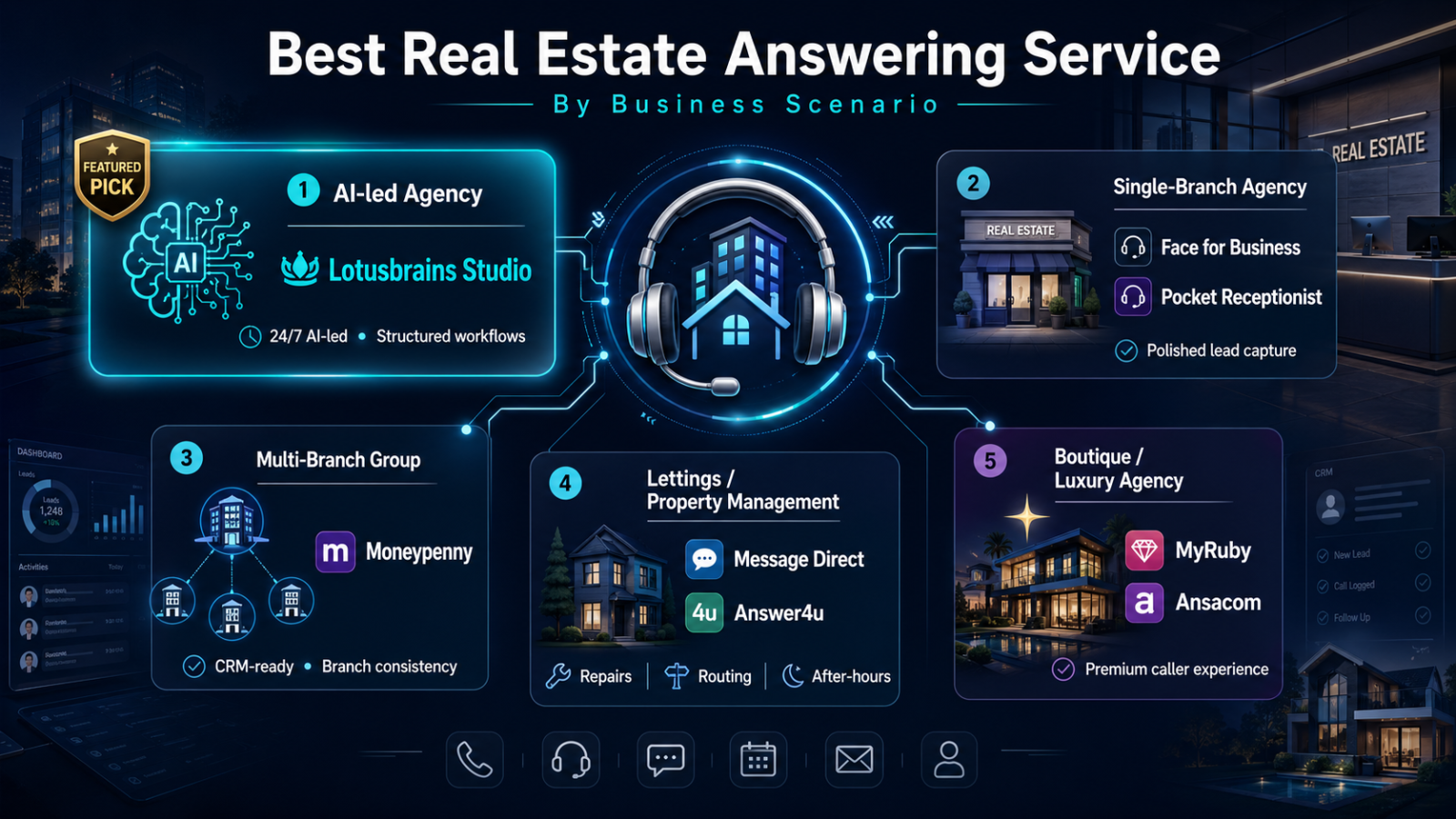
The agency that wants AI-led real estate answering rather than a traditional PA model
This is where we would look closely at Lotusbrains Studio. We built our service for agencies that want 24/7 first-line answering, structured valuation and tenant-enquiry capture, deeper workflow customisation, and consistent escalation rules without relying entirely on a human PA layer.
The single-branch estate agency
Prioritise Face for Business if your biggest concern is lead quality and a polished front-of-house feel for local sellers. Consider Pocket Receptionist if you want a leaner, lower-friction setup focused on fast call capture and notifications.
The multi-branch group
Moneypenny is the strongest fit here. Its CRM integrations, structured workflows, and branch-ready handling make it better suited to larger operations where consistency across locations matters.
The lettings-heavy / property-management team
Prioritise Message Direct or Answer4u. These providers are more operationally aligned with contractor routing, repairs logging, and after-hours maintenance handling than the more sales-led options in this list.
The boutique or luxury agency
MyRuby and Ansacom are better suited where caller experience, tone, and continuity matter more than low-cost scale.
Real Estate Answering Agencies: Red Flags To Watch For
There are red flags you should watch out for when dealing with real estate answering services.
When evaluating a provider’s website, demo, or contract, these red flags should be immediate dealbreakers that you should not settle for.
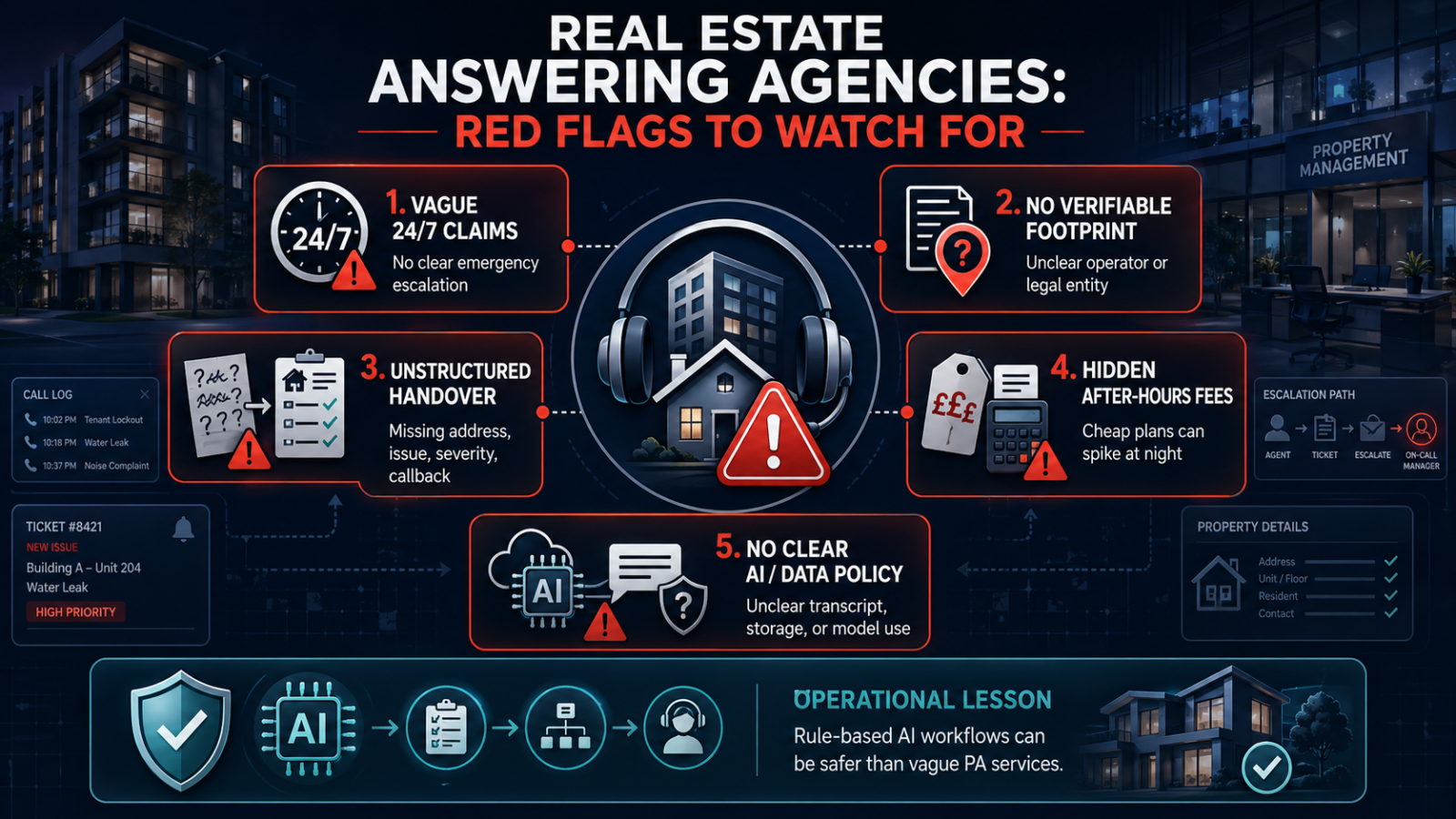
Vague out-of-hours claims
If they say “24/7” but cannot explain their emergency escalation logic, they may simply be taking a message that sits in an inbox until morning. For property businesses, that is not real emergency cover.
No verifiable operating footprint
If you cannot verify where the business operates from, who owns it, or what legal entity is behind it, treat that as a trust and data-governance risk.
Unstructured handover
Avoid providers that only offer generic call notes or email paging. Without structured fields such as property address, property reference, issue type, severity, and callback details, your team loses time chasing basic information.
Hidden after-hours surcharges
Many services look affordable at low daytime volumes, then become expensive once evenings, weekends, or longer calls enter the picture. Always model your realistic monthly usage, not just the cheapest advertised plan.
No clear AI or data policy
If the provider uses AI, ask how audio and transcripts are handled, where data goes, and whether customer conversations are used to train shared models. If they cannot answer clearly, move on.
Quiet operational lesson: In some cases, a well-designed AI-led answering workflow is actually safer than a vague human PA service, because the AI can be forced to follow a playbook, log every step, and escalate by rule rather than memory.
Real Estate Answering Services: FAQs
Q1: Real Estate answering pricing: AI vs human, which is cheaper?
Start with your real call pattern, not the provider’s entry plan.
At low volumes, a traditional human answering service may look fine on paper. But as call volume rises, especially across evenings, weekends, or longer tenant conversations, human PA pricing can become expensive quickly through per-call, per-minute, or after-hours billing.
That is one of the reasons AI-led answering is becoming more attractive in real estate. For predictable first-line workflows, AI can often deliver 24/7 coverage, structured capture, and faster escalation at a lower ongoing cost than a fully human PA model.
Ask the vendor:
How does pricing behave at my real call volumes, including overflow, after-hours, and longer calls? Can I set spending alerts or usage caps?
Q2: What should I check before recording property calls?
Do not treat call recording as a default admin feature. Treat it as a data-governance issue.
You need clarity on:
- whether callers are notified appropriately
- how long recordings are stored
- who can access them
- how recordings can be exported, deleted, or retrieved when needed
- whether transcripts are also being generated and stored
If AI is involved, go one step further: ask whether transcripts or call data are used for model training, what the retention policy is, and what controls exist around access and deletion.
Ask the vendor:
Can you show me your retention, access, deletion, and transcript-handling policy in writing?
Q3: How should an answering service handle urgent repair or habitability complaints?
Your answering service should not improvise here.
Whether the issue is a leak, no heating, flooding, mould, access failure, or another urgent repair, the provider should follow a clear playbook:
- capture the full address and contact details
- identify the nature and severity of the issue
- log the exact time reported
- gather any access or safety details
- escalate according to a pre-set priority path
This is an area where AI can outperform a human PA operationally. A properly configured AI agent will not forget required questions, will not skip fields under pressure, and can log and escalate instantly.
Humans are still valuable when the caller is distressed or the situation is unusual. But for first-line triage itself, AI is often the more consistent tool.
Q4: Will leads or tenant enquiries appear directly in our CRM?
It depends on the integration model.
In practice, there are usually three levels:
- basic handover: email or message summary only
- semi-automated handover: structured data passed through forms, middleware, or workflow tools
- direct integration: the lead or issue appears inside the CRM or workflow system automatically
If your agency cares about speed and operational tidiness, this matters more than most providers admit. A service that “answers professionally” but still leaves your team retyping every enquiry is not really solving the workflow problem.
At Lotusbrains Studio, we take this seriously because we see real estate answering as an operations problem, not just a receptionist problem. The real win is not merely picking up the call; it is getting clean, structured information into the next step of your workflow fast.
Ask the vendor:
Exactly what happens after the call ends? Where does the data go, and what does my team still need to do manually?
Q5: What is the safer way to trial a new answering service: number porting or call forwarding?
If you are testing a provider for the first time, call forwarding is usually the safer starting point.
It lets you assess pickup speed, script quality, note quality, and escalation handling without immediately moving your core number into someone else’s phone system.
Once the service has proven itself operationally, you can decide whether a full port makes sense.
This is particularly useful for AI-led answering, because AI can often be trialled behind a forwarding rule very quickly. That gives you a low-risk way to test real performance before making a deeper telecom decision.
Q6: Can AI handle urgent maintenance calls as well as a human?
For first-line triage, often yes — and in many cases, more consistently.
A human PA may bring warmth and reassurance, but they can also miss fields, vary in how they ask questions, or handle urgency differently from one shift to the next.
A well-configured AI agent does not get tired, does not forget the playbook, and can ask the same critical questions every time. That makes it especially strong for urgent but structured real estate workflows.
Where humans still win is emotional judgment:
- distressed tenants
- angry landlords
- sensitive complaints
- unusual situations that do not fit the script
Conclusion
The most credible position in 2026 is not human answering versus AI answering. It is choosing the right operating layer for the right type of call.
Traditional human answering services still make sense where tone, reassurance, or relationship continuity matter most. That is why providers like MyRuby, Ansacom, and Face for Business can work well for agencies that value a polished front-of-house experience.
But for predictable, high-volume, rules-based real estate calls, AI often gives agencies a stronger first-line setup than a human PA.
Why? Because AI agents for real estate answering can:
- answer instantly, 24/7
- follow the same playbook every time
- capture structured data without fatigue or missed fields
- route or escalate calls immediately based on your rules
- become more cost-efficient than fully human answering as volume rises
- support deeper workflow customisation than many off-the-shelf PA services
That does not mean AI replaces humans everywhere. It means AI is often the better Tier 1 layer for valuation intake, viewing requests, tenant repair triage, overflow call handling, and routine landlord or buyer enquiries.
Humans still matter for distressed callers, sensitive complaints, negotiation-heavy conversations, and edge cases that need judgment rather than process.
That is exactly why we believe Lotusbrains Studio is a compelling option for modern real estate businesses. We do not position ourselves as a generic message-taking service.
We build AI-led real estate answering systems designed to handle first-line calls properly: capturing structured details, following custom property playbooks, escalating when rules trigger, and giving agencies round-the-clock responsiveness without the cost profile of a fully human answering layer.
So the real question is not, “Do I want a human answering service or AI?”
It is, “Which model gives my agency the best mix of responsiveness, control, consistency, and cost at the workflows that matter most?”
For many agencies now, that answer will increasingly involve AI.
That is why the strongest model is often AI first, human escalation when needed.
At Lotusbrains Studio, that is exactly how we think about it. We use AI where consistency, speed, and structured capture matter most, then route to humans where empathy or judgment genuinely adds value.