
We regularly tell business owners, answering calls is no longer just about customer service. It now directly affects how much money you keep and how customers see your brand.
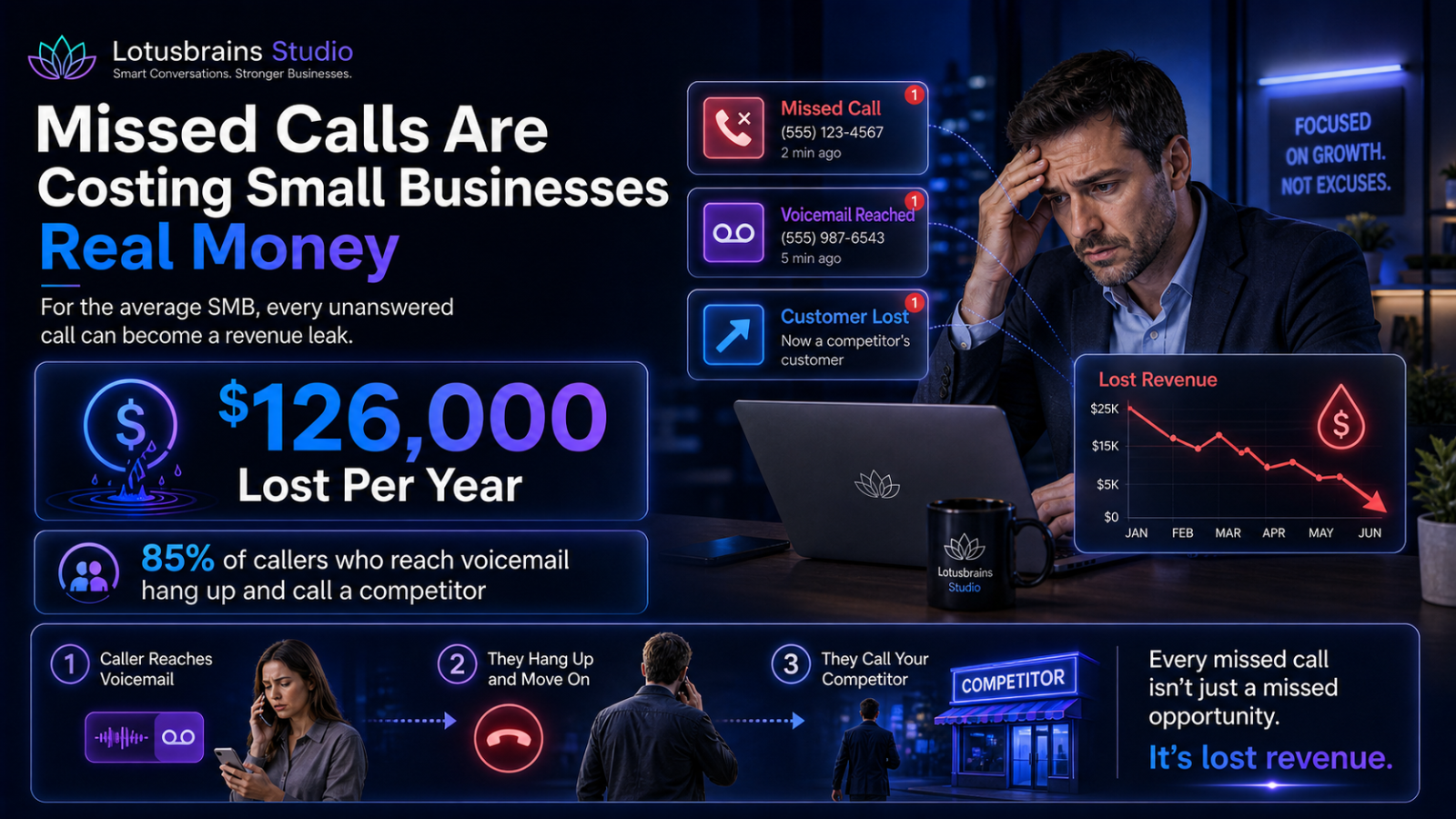
For the average small business, a missed call is not just a blinking light on a desk phone; it is a quantifiable revenue leak. Recent data indicate that SMBs lose approximately $126,000 annually due to unanswered calls: 85% of callers who reach voicemail simply hang up and dial a competitor.
If you are running a small business, relying on voicemail is no longer a viable strategy. One increasingly viable response is to deploy an AI autonomous agent that can dynamically respond to customer questions and needs.
Indeed, the market has split into three distinct paths. First, there are outsourced answering services, where human receptionists handle calls on your behalf. Second, there is call centre software (CCaaS/VoIP), which empowers your internal team to manage high call volumes on a unified platform. Finally, a third path has emerged: AI voice agents, which offer the 24/7 responsiveness of a call centre at a fraction of the cost. This guide evaluates the top 10 providers across these categories to help you choose the right architecture for your growth.
Call Center For Small Business: How to Choose The Best Provider
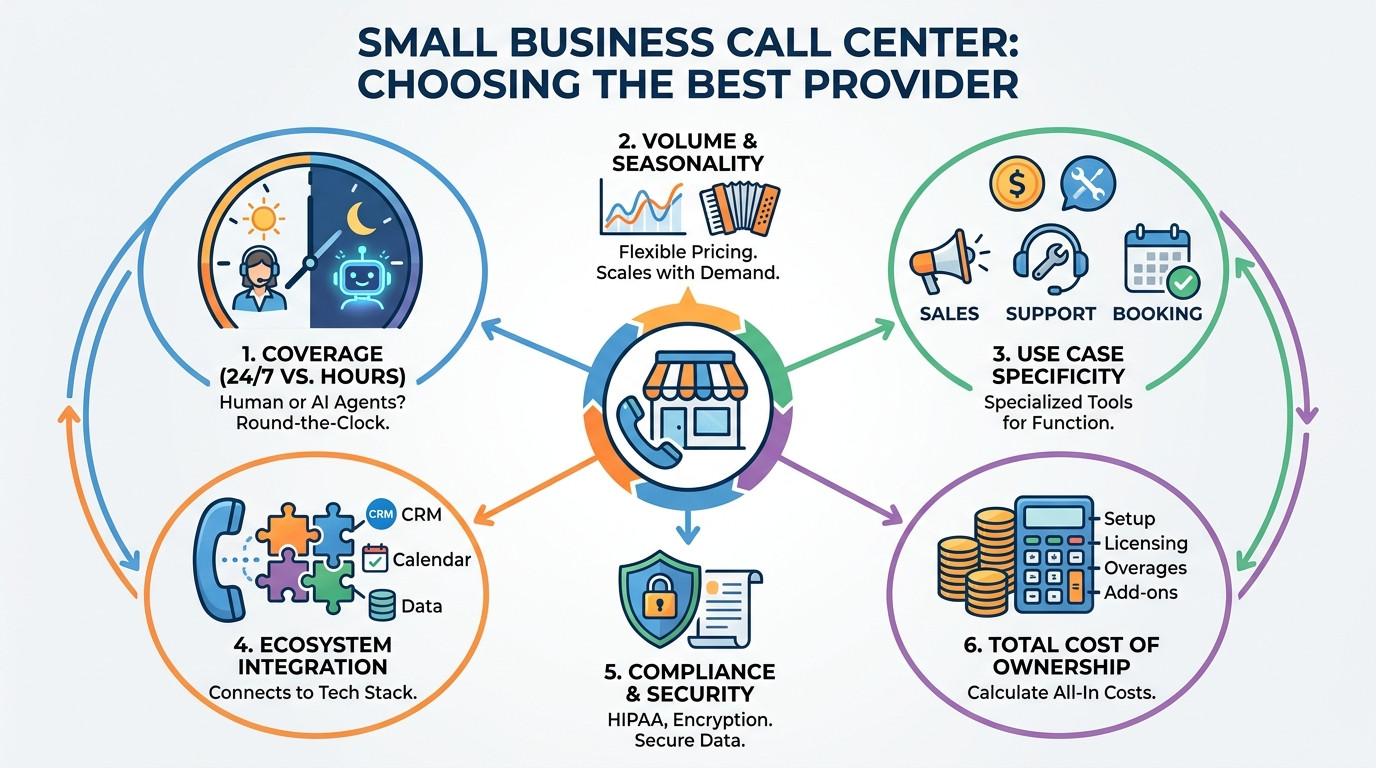
Selecting the right call centre for a small business requires balancing operational needs with economic reality. Before committing to a contract, evaluate these six critical buying factors:
1. Lotusbrains Studio: Best Call Center For Small Business
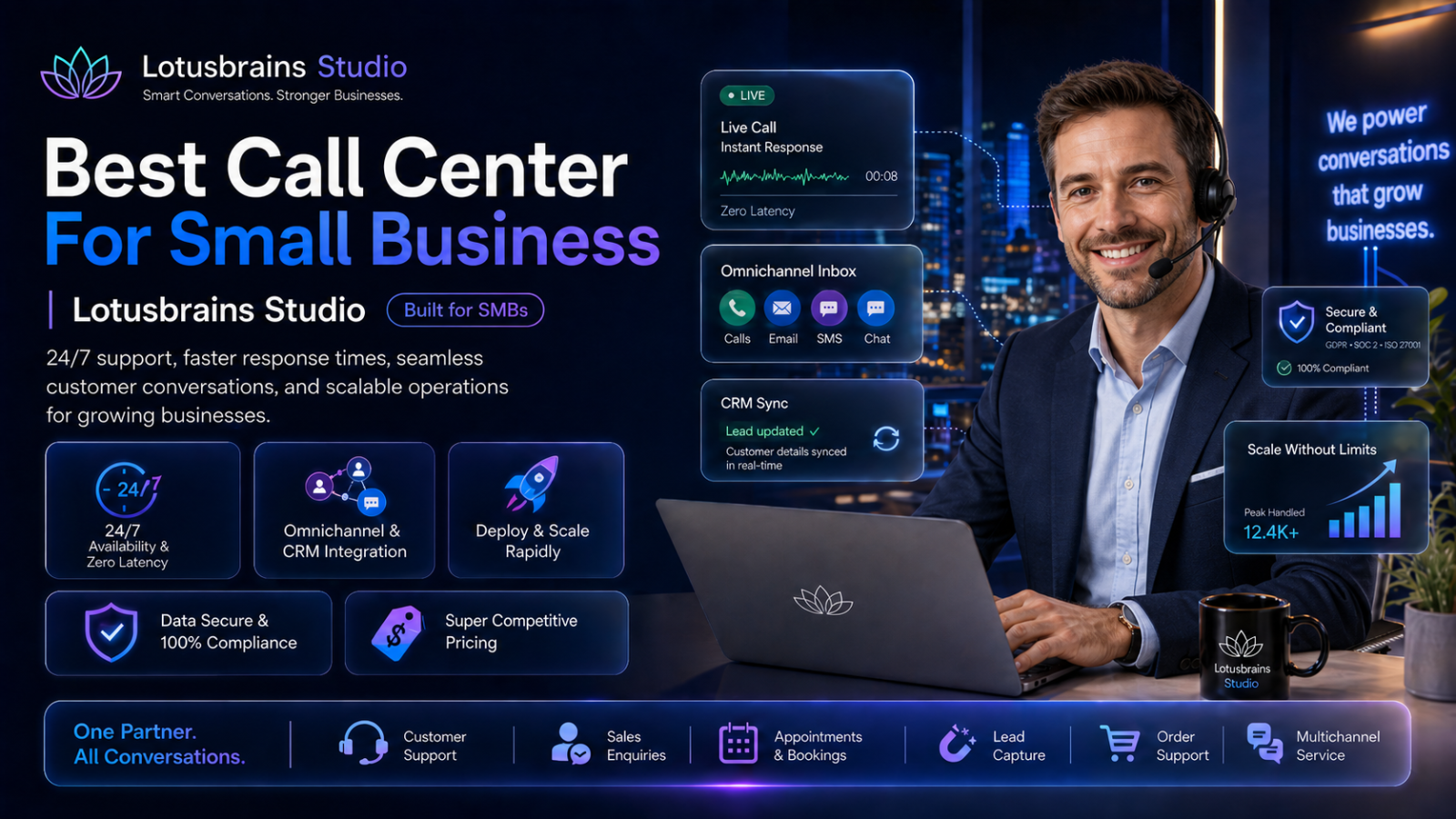
Lotusbrains Studio is an AI voice agent call centre that handles inbound and outbound calls, qualification, booking, and support.
We're not a traditional outsourced team of human agents, but an autonomous, intelligent system powered by AI phone agents designed to eliminate the friction of legacy call centres. Rather than hiring a generic SaaS tool, we build custom AI voice agents tailored to your specific workflows and business communication needs.
Who it's designed for:
It's built for SMBs that need a call centre to reliably book appointments, qualify leads, resolve common questions, and capture caller details with consistent handling and smart routing, without the massive overhead of hiring staff or paying high per-minute rates for human answering services.
Standout Strengths:
- 24/7 Availability by Default: Unlike human teams that require shift scheduling or after-hours surcharges, our AI call center voice agents are active every time and every day, ensuring no missed revenue during nights or weekends
- Zero Latency: Using specialized orchestration (via Retell or Vapi AI), we achieve sub-500ms latency, making the conversation feel naturally human.
- Automation Depth: We go beyond simple message taking: our system can log calls, tag intent, create tickets, update CRMs, send SMS follow-ups, and collect consent instantly.
- Speed to Deploy and Scale: You can add new scenarios, handle peak traffic spikes, or provide new numbers immediately without the week-long recruiting and training cycles required by human centres.
- RAG Architecture: The agent is connected to a knowledge base graph via Retrival-Augmented Generation (RAG). This ensures it answers pricing and procedure questions accurately without hallucinating false information.
Pricing
We operate on a custom implementation model that is typically volume- or performance-based and often significantly cheaper than human alternatives. It offers high-volume handling (i.e., can handle 100 or 1000 concurrent calls instantly), which any human receptionist cannot handle, and it's still cheaper compared to a human receptionist
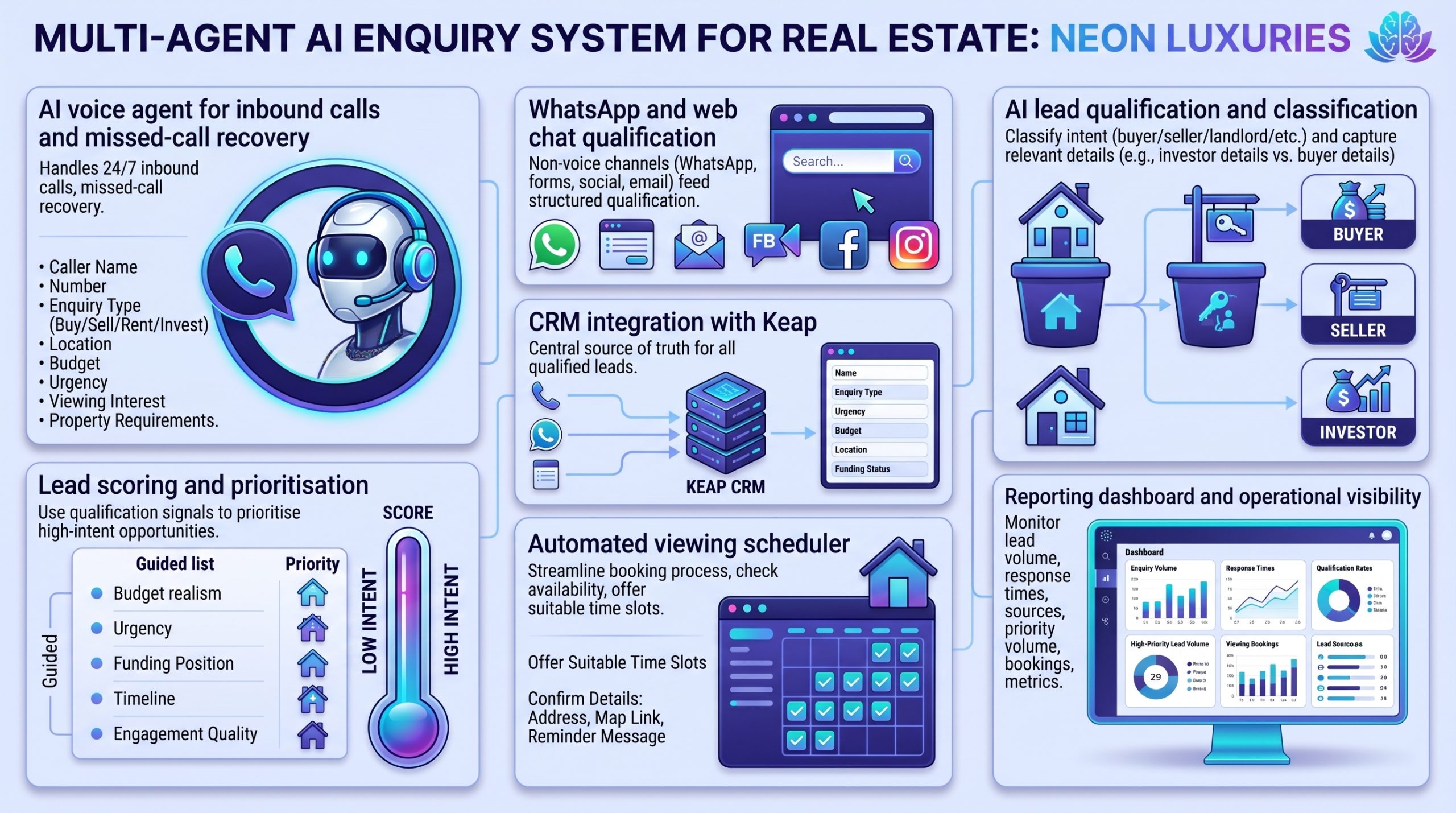
One of the clearest examples of where our AI call handling model works exceptionally well is Neon Luxuries, a real estate business focused on property sales, lettings, and investment opportunities.
Like many growing property businesses needing call centers, Neon Luxuries faced a familiar operational problem: incoming enquiries were valuable, varied, and highly time-sensitive, but handling them manually or via outsourced call centers created friction.
Buyers, sellers, landlords, and investors were all coming in through the pipeline, and the team had to spend significant time sorting through who was serious, what they needed, how urgent their enquiry was, and what should happen next. In a sector where speed and responsiveness directly shape conversion, that manual process was creating pressure and leaving too much room for delay.
What made this engagement a strong fit for us was that Neon Luxuries did not need a generic answering call center or answering tool. They genuinely needed a system that reflected how their business actually operates.
First, we took the time to understand their workflow, map how enquiries came in, identify where the bottlenecks were, and build an intelligent AI call handling agent around those real operational needs.
The result was a system that could engage, handle calls excellently, process leads faster, qualify them more intelligently, and capture the right information early, including intent, urgency, and suitability, with almost no human intervention.
Instead of relying on slow manual back-and-forth, as a human PA in a call centre would just to establish who was serious and who needed immediate attention, Neon Luxuries could handle enquiries in a far more structured, responsive, and consistent way from the outset via these internalised AI phone agents.
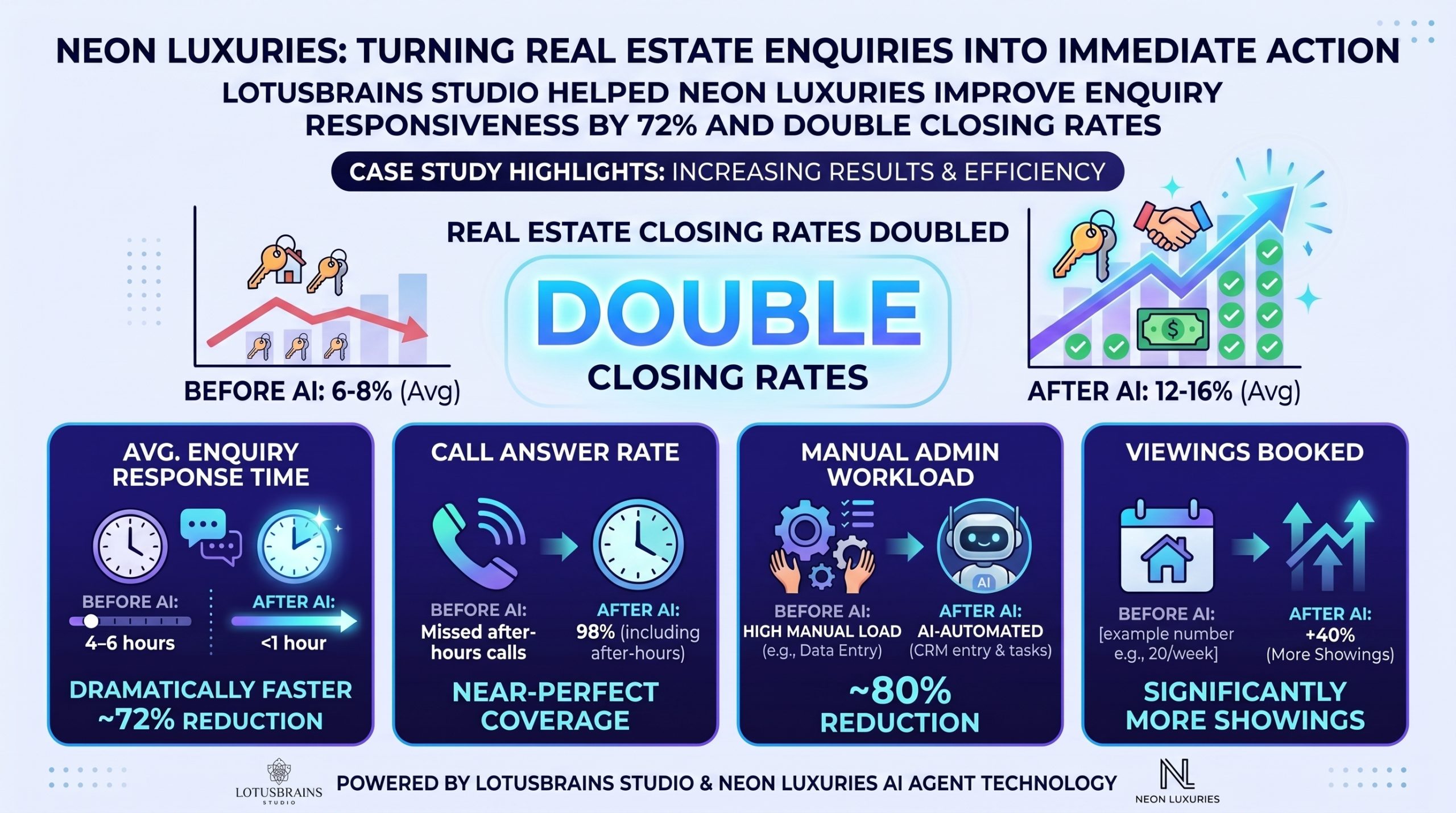
The business impact was significant. After implementation, enquiry responsiveness improved by 72%, despite operating with only half the team size that had previously managed the process.
Even more notably, the effective output of a single employee tripled, because so many repetitive tasks like call handling and lead qualification were handled automatically by the AI call center system.
The business also reported that closing rates doubled over a three-month period, driven in part by the system’s ability to filter out poor-quality leads and leave the team with more serious, higher-value opportunities.
For us, this is exactly where AI voice and intake automation can outperform traditional call centre models for small businesses. It is not just about answering the phone faster. It is about qualifying demand properly, removing repetitive admin, improving responsiveness at scale, and allowing human staff to focus on the highest-value conversations.
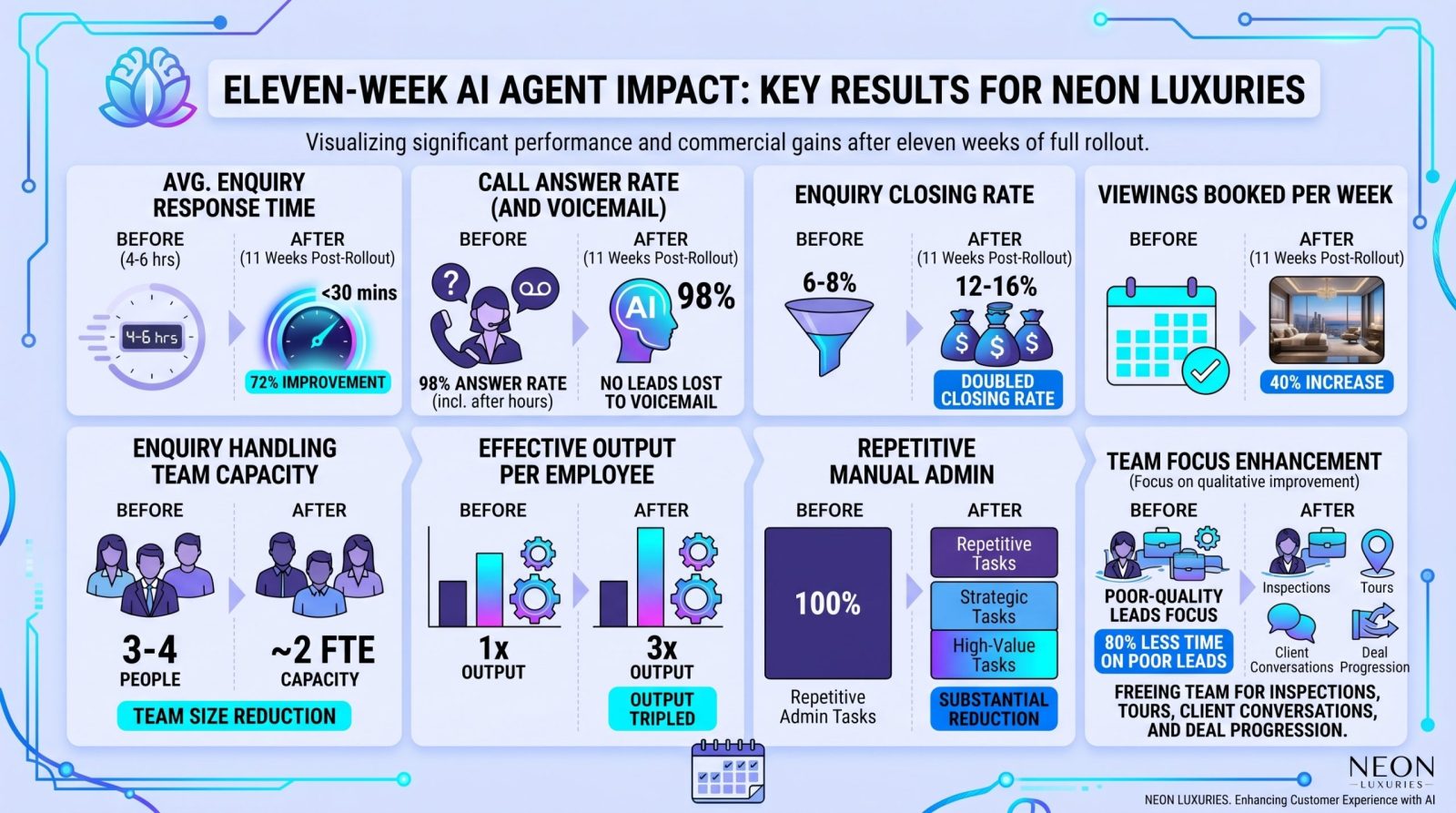
In Neon Luxuries’ case, that meant more efficiency, better lead handling, a stronger client experience, and more output without increasing headcount.
2. Ruby - Best Call Center for Premium brand voice and receptionist experience
Ruby is a premium outsourced virtual receptionist service known for its highly trained agents, who act as a seamless extension of your team.
Who it’s designed for:
It is designed for businesses such as law firms, boutique consultancies, and healthcare practices that require strong interpersonal client engagement, rapport, and close brand alignment.
Standout strengths:
- Premium brand voice: Receptionists are trained to sound like in-house staff, offering a level of service that builds rapport and trust.
- Native integrations: Strong integrations with legal and professional tools, including Clio, Rocket Matter, and MyCase, help streamline intake.
- Mobile app: Ruby offers a robust app that lets you toggle availability and view call activity in real time.
Pricing snapshot:
Ruby uses a minute-bundled pricing model. Plans for 2026 include 50 minutes for ~$250 (~£200)/month ($5/min) and 200 minutes for ~$720 (~£575)/month ($3.60/min).
Best-fit scenarios:
- Choose this if your brand values premium, meticulous service and prioritises experience over budget.
- Choose this if your firm prioritises depth and call quality over high call volume.
Limitations for SMBs:
- Rounding tactics: Calls are rounded up to the nearest 30-second or minute increment, which can inflate billable usage by 20-30%.
- High overage costs: Exceeding your bundle results in increased per-minute overage fees.
Where AI voice agents can outperform this:
Ruby is a premium human service, but minute bundles become expensive as volume grows. An AI voice agent can handle routine calls and overflow 24/7 at a lower cost, scaling during spikes without the need to hire more receptionists. That allows Ruby to be reserved for VIP or more relationship-driven interactions, while AI handles the rest.
Bottom line:
Ruby is a strong option for human empathy and brand-sensitive call handling, but its premium pricing makes it harder to scale for high-volume operations.
3. AnswerConnect - Best for: 24/7 live answering and UK options
AnswerConnect is a 24/7 live answering service that uses a distributed workforce to provide resilient, round-the-clock coverage for businesses in the UK.

Who it’s designed for:
It is primarily designed for service-based businesses, such as real estate and IT firms, that need guaranteed 24/7 responsiveness.
Standout strengths:
- 24/7 coverage: Round-the-clock answering is available on all plans, rather than being treated as an expensive add-on.
- Resilience: The distributed workforce model helps maintain service continuity during local power outages or weather disruption.
- UK focus: Strong UK presence and specific pricing bundles make it relevant for UK businesses.
Pricing snapshot:
UK plans start at £195/month for 150 minutes, plus a £49.99 setup fee on some tiers, and rise to £375/month for 350 minutes. Overages are charged at £1.75 per additional minute.
Best-fit scenarios:
- Choose this if you are a UK-based business that needs professional representation.
- Choose this if your business runs 24/7 and cannot afford to miss urgent or emergency calls.
Limitations for SMBs:
- Setup fees: The £49.99 setup fee on lower tiers creates friction at the start.
- Per-minute rounding: Billing is rounded up, so all interactions are subject to a one-minute minimum billing unit.
Where AI voice agents can outperform this:
AI offers more predictable handling during spikes and more structured data capture into your CRM. While AnswerConnect relies on humans to take notes, AI phone agents can log call outcomes instantly and more consistently. These AI-driven call center agents can also reduce the wait times that can occur with human pools during peak periods.
Bottom line:
AnswerConnect is a reliable option for 24/7 human coverage, particularly for UK businesses, but it lacks the instant data integration that AI voice systems can offer.
4. PATLive - Best for: Flexible, pay-as-you-go US receptionists
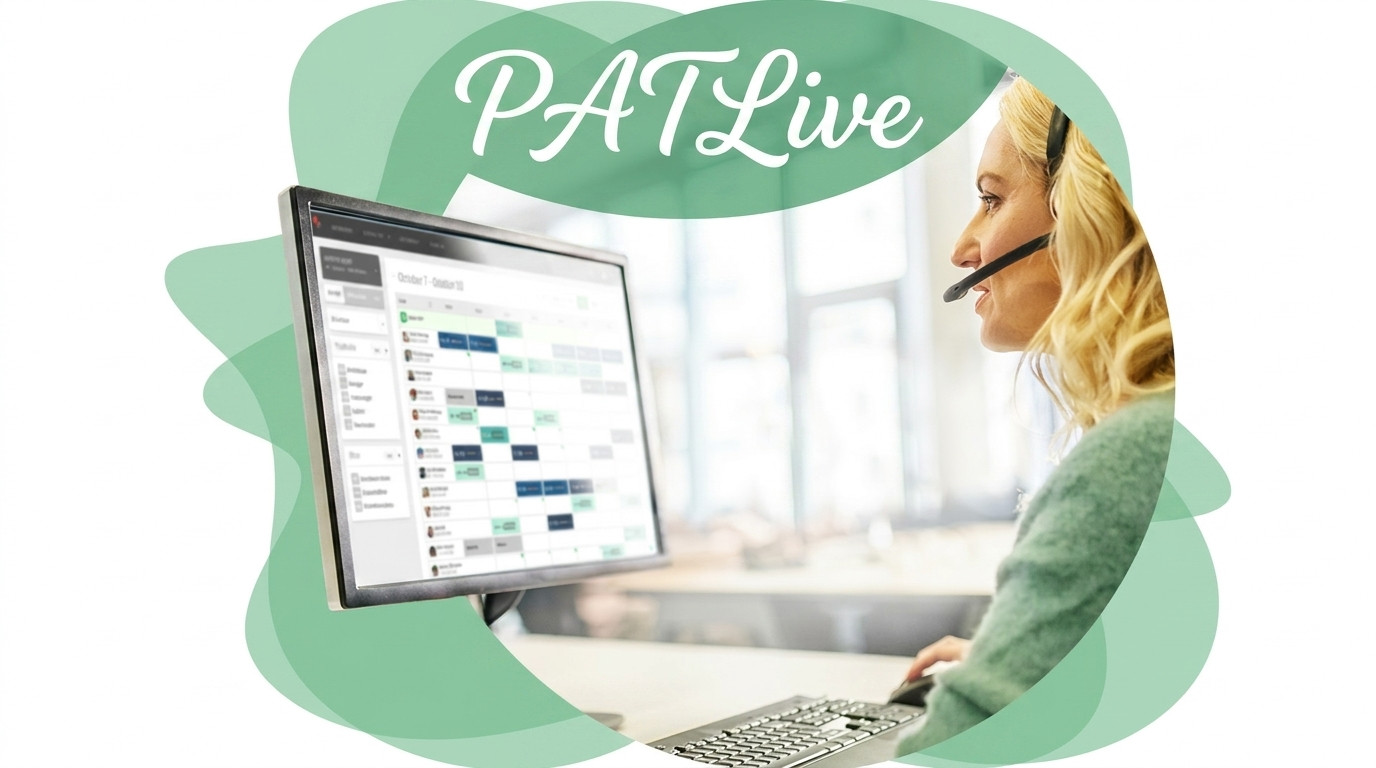
PATLive is a live answering service known for its proprietary scripting platform and contract-free flexibility.
Its scripting platform allows small businesses to build a detailed flowchart or logic tree for receptionists to follow. However, the service is largely based in the United States.
Who it’s designed for:
It is best suited to seasonal businesses or those with fluctuating call volumes that need complex scripting without being locked into long-term contracts.
Standout strengths:
- No contracts: Services are month-to-month, allowing easy cancellation or plan changes.
- Flexibility: It handles variable call volume without committed headcount, focusing on real-time service needs rather than a fixed number of calls.
Pricing snapshot:
PATLive offers a basic pay-as-you-go plan at $75 (~£60)/month ($2.60/min). Standard plans include 200 minutes for $460 (~£360)/month ($2.30/min).
Best-fit scenarios:
- Choose this for dynamic intake processes that require situational awareness and thoughtful responses.
- Choose this if your call volume varies widely from month to month.
Limitations for SMBs:
- High per-minute rate: The pay-as-you-go rate of $2.60/min is steep for casual usage.
- Cost accumulation: For simple calls, paying $2+ per minute adds up quickly compared with software or AI.
Where AI voice agents can outperform this:
Per-minute live answering adds up fast. AI voice agents can reduce the cost per solution for FAQs, booking, and simple lead qualification to cents rather than dollars.
That allows human answering spend to be focused on more complex dispatch or service scenarios that genuinely require human judgment.
Bottom line:
PATLive is a strong choice for complex, variable-volume human answering, provided you are willing to pay a premium for the flexibility it offers.
5. Smith.ai - Best for: Lead qualification and workflow automation
Smith.ai is an outsourced answering service that differentiates itself with a per-call pricing model and a heavy focus on AI-assisted human workflows.
Who it’s designed for:
It is well-suited to law firms, marketing agencies, and businesses that prioritise rapid engagement and filtering out non-ideal prospects, where this has a direct effect on return on investment.
Standout strengths:
- Per-call pricing: You pay per call, not per minute. This gives agents more room to handle each call thoroughly rather than rushing to reduce billed time.
- Spam blocking: They block spam and wrong numbers for free, so you do not pay for noise.
- CRM integration: Strong integrations with platforms such as HubSpot and Salesforce help ensure accurate lead logging.
Pricing snapshot:
Plans start at $300 (~£240)/month for 30 calls ($11.50 per call) and scale to $810 (~£640)/month for 90 calls ($10.50/call). Overages are approximately $10-$11.50 per call.
Best-fit scenarios:
- Choose this if you have long, high-value intake calls, such as legal discovery, where per-minute billing would destroy your budget.
- Choose this if you need robust spam filtering included.
Limitations for SMBs:
- Overage spikes: At around $11.50 per overage call, an unexpectedly successful marketing campaign can result in a significant bill.
- Short-call inefficiency: You pay the full per-call rate even for a 30-second interaction, which is inefficient for quick queries.
Where AI voice agents can outperform this:
Smith.ai is strong for qualification, but per-call pricing can spike when there are lots of short calls. AI handles high-frequency, quick questions cheaply and consistently, without triggering a $10 fee.
This can make AI a more efficient first layer for repetitive enquiries, while human handling is reserved for higher-priority prospects who benefit most from a personalised interaction.
Bottom line:
Smith.ai offers one of the smarter human-answering workflows, but its per-call model requires careful volume management to avoid billing shock.
6. Moneypenny (VoiceNation) - Best for: Bilingual support and brand continuity
Now incorporating VoiceNation, Moneypenny is a global outsourced communications provider offering dedicated receptionists and 24/7 bilingual answering.
Who it’s designed for:
It targets businesses that need a strong brand presence, particularly those serving Spanish-speaking populations or operating across the US and UK.
Standout strengths:
- Bilingual coverage: Strong capabilities in handling English and Spanish calls seamlessly.
- Dedicated receptionist: Unlike pool-based services, this model uses dedicated agents who learn your business more intimately.
- 24/7 availability: Full round-the-clock availability helps you capture leads across time zones.
Pricing snapshot:
Pricing typically starts from £165/month but varies based on volume and required features. 24/7 coverage is often an add-on costing an additional £80-£125/month. Setup fees can also be high for more complex setups.
Best-fit scenarios:
- Choose this if you need a dedicated agent who can learn your business closely.
- Choose this if you require seamless bilingual switching.
Limitations for SMBs:
- Hidden costs: Setup fees and add-ons for 24/7 coverage can significantly increase the advertised base rate.
- Contract terms: Some plans may require longer commitments than month-to-month competitors.
Where AI voice agents can outperform this:
Moneypenny’s bilingual coverage is strong, but AI can deliver multilingual capabilities at scale instantly. An AI voice agent can switch between languages in milliseconds and provide instant summaries and automated CRM updates, whereas human bilingual agents are a finite and more expensive resource.
Bottom line:
Moneypenny provides a polished, dedicated human experience for bilingual needs, assuming you can absorb the higher setup and operating costs.
7. RingCentral - Best for: All-in-one enterprise communication
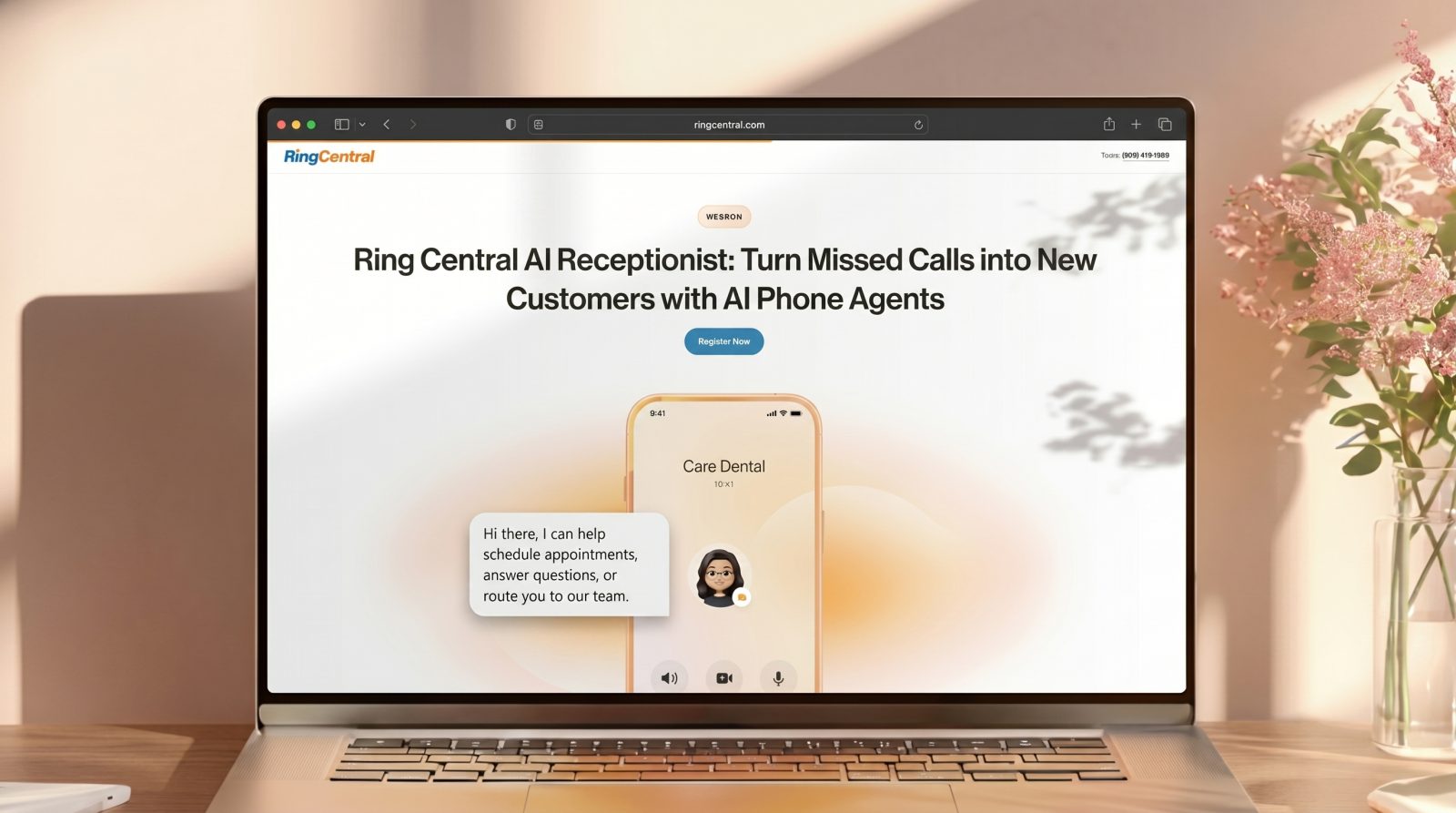
RingCentral is a cloud-based communications system (RingCX) that combines voice, video, team messaging, and contact centre features into a single platform.
Who it’s designed for:
It is built for growing teams and for businesses that want to structure their call-answering system more systematically, with enterprise-grade routing and reliability.
Standout strengths:
- UK carrier status: Industry-leading reliability makes it a safe choice for mission-critical phone lines, with reliable UK number porting.
- Omnichannel: Manages voice, SMS, fax, and video in one app.
- Analytics: Deep reporting tools help track agent performance and call volume.
Pricing snapshot:
Core VoIP plans start at £20-£30 per user per month. The contact centre solution starts at around £65 per agent per month.
Best-fit scenarios:
- Choose this if you have an internal sales or support team that needs powerful routing software.
- Choose this if you need to bundle your phone system with video conferencing.
Limitations for SMBs:
- Complexity: The admin portal is dense and can feel overwhelming for non-technical small-business owners.
- Implementation costs: Advanced contact centre features often require expensive implementation packages.
Where AI voice agents can outperform this:
Software still requires staffing. RingCentral gives your team the tools, but AI voice agents can act as the frontline layer that answers 24/7. Instead of hiring more staff to manage inbound calls, you can use AI to answer and route only qualified or escalated calls to your human team.
Bottom line:
RingCentral equips your team with industry-leading communication tools, but it is still a software-only solution. You are paying for the platform, while remaining responsible for staffing and managing the people who handle inbound calls.
8. Nextiva - Best for: Unified customer experience and support
Nextiva is a cloud communications platform that blends business phone service with customer experience management (CXM) tools.

Who it’s designed for:
It serves SMBs seeking a holistic view of customer interactions by combining voice, video, and collaboration in a single interface.
Standout strengths:
- Service quality: Consistently rated highly for customer support and ease of use.
- Unified platform: Threaded conversations allow you to see texts, calls, and emails from a customer in one view.
- Reliability: Carrier-grade network reliability helps ensure calls do not drop.
Pricing snapshot:
Plans typically range from $15 to $75 per user per month (£12-£60), depending on the feature set.
Best-fit scenarios:
- Choose this if you want a unified interface for smoother client oversight.
- Choose this if you prioritise strong support from your vendor.
Limitations for SMBs:
- Contract length: Best pricing is often tied to longer-term contracts of one to three years.
- Per-user cost: Costs scale linearly with headcount, making it expensive to add seasonal staff.
Where AI voice agents can outperform this:
Nextiva solves the telephony layer, while AI can resolve routine queries such as qualification, booking, and FAQs without adding headcount. That separation between call volume and labour cost is one of AI’s main advantages over software-only platforms.
Bottom line:
Nextiva is one of the most user-friendly software platforms for internal teams, but, like RingCentral, it still depends on human staff to operate.
9. Freshdesk Contact Centre - Best for: Ticketing and helpdesk integration
Freshdesk Contact Centre (formerly Freshcaller) is a VoIP solution built directly into the Freshworks ecosystem, bridging the gap between phone calls and support tickets.
Who it’s designed for:
It is ideal for support teams already using Freshdesk and wanting to convert phone calls into tickets automatically.
Standout strengths:
- Ticket integration: Every call automatically creates a ticket, helping ensure no issue falls through the cracks.
- Freemium model: Offers a free entry-level tier, with charges applying mainly to usage, which lowers the barrier to entry.
- Number management: Easily buy local and toll-free numbers in over 90 countries.
Pricing snapshot:
Paid plans start at £12 per agent per month (Growth) and range up to £60 per agent per month (Enterprise), plus per-minute call charges.
Best-fit scenarios:
- Choose this if your primary workflow revolves around ticketing.
- Choose this if you are a startup looking for a low fixed-cost entry point.
Limitations for SMBs:
- Call quality: Some users report more variable call quality than with carrier-grade rivals such as RingCentral.
- Add-on costs: Advanced features and AI minutes can add up quickly.
Where AI voice agents can outperform this:
Freshdesk works well when humans are answering, but AI voice agents can auto-create tickets, tag intent, and summarise calls instantly. That reduces first-response time and helps ensure the ticket is already structured before a human even reviews it.
Bottom line:
Freshdesk is a logical choice for support teams, offering one of the tightest integrations between voice and ticketing workflows.
10. Aircall - Best for: CRM integrations and sales coaching
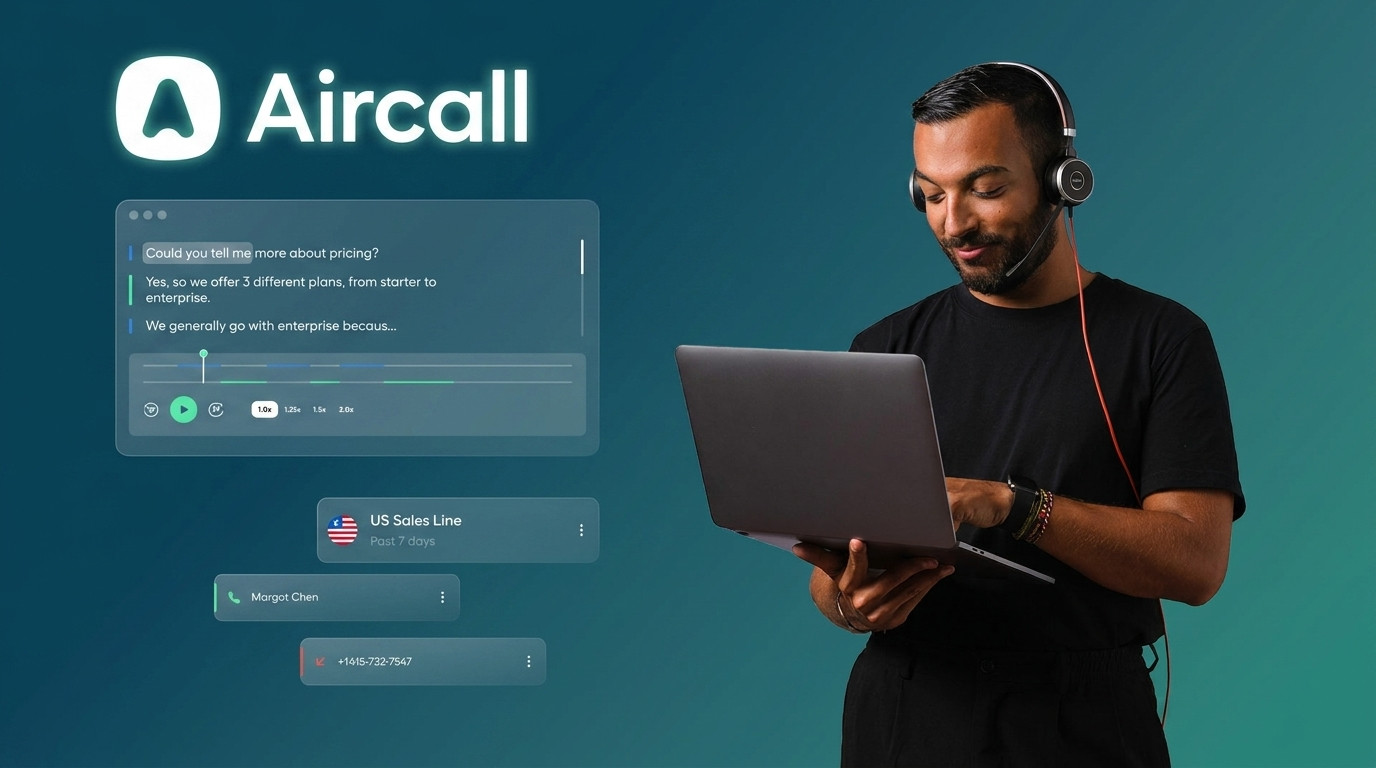
Aircall is a modern, voice-first communication platform that integrates seamlessly with popular CRM and helpdesk tools.
Who it’s designed for:
It is built for modern sales and support teams that live inside HubSpot, Salesforce, or Pipedrive and need a phone system that works smoothly with them.
Standout strengths:
- App marketplace: More than 100 one-click integrations make it one of the most connected phone systems in this comparison.
- Coaching tools: Features such as call whispering and real-time analytics help managers train sales reps.
- Fast setup: Can be deployed quickly without hardware.
Pricing snapshot:
Plans generally start at $30-$40 per month (Essentials) and $50-$70 per month (Professional), usually with a three-user minimum.
Best-fit scenarios:
- Choose this if your business runs on HubSpot or Salesforce.
- Choose this if you have a remote sales team that needs monitoring and coaching.
Limitations for SMBs:
- Minimum seats: The three-user minimum can be a hurdle for solopreneurs.
- Cost: It is pricier per seat than basic VoIP competitors.
Where AI voice agents can outperform this:
Aircall helps manage human reps, while AI can reduce the number of repetitive calls those reps need to handle. By placing AI at the first layer of interaction, businesses can reserve their paid human licences for higher-value conversations rather than basic qualification or repetitive enquiries.
Bottom line:
Aircall is a strong choice for teams that work deeply inside their CRM and want a smooth voice workflow around that environment.