How We Helped Riona Atelier Turn WhatsApp Into an AI Shopping Concierge and Increased Conversion Rate from 28% to 42%
Riona Atelier, a premium fashion accessories brand known for handcrafted beaded bags, had a customer experience problem that many growing ecommerce brands eventually face.
We helped them implement an AI shopping concierge for WhatsApp: a guided, inventory-aware, brand-aligned customer experience that could recommend products, answer questions, qualify buying intent, capture customisation requests, and hand over to the team when needed.
Results at a glance
Within five months, WhatsApp became faster, more consistent, and more commercially effective.
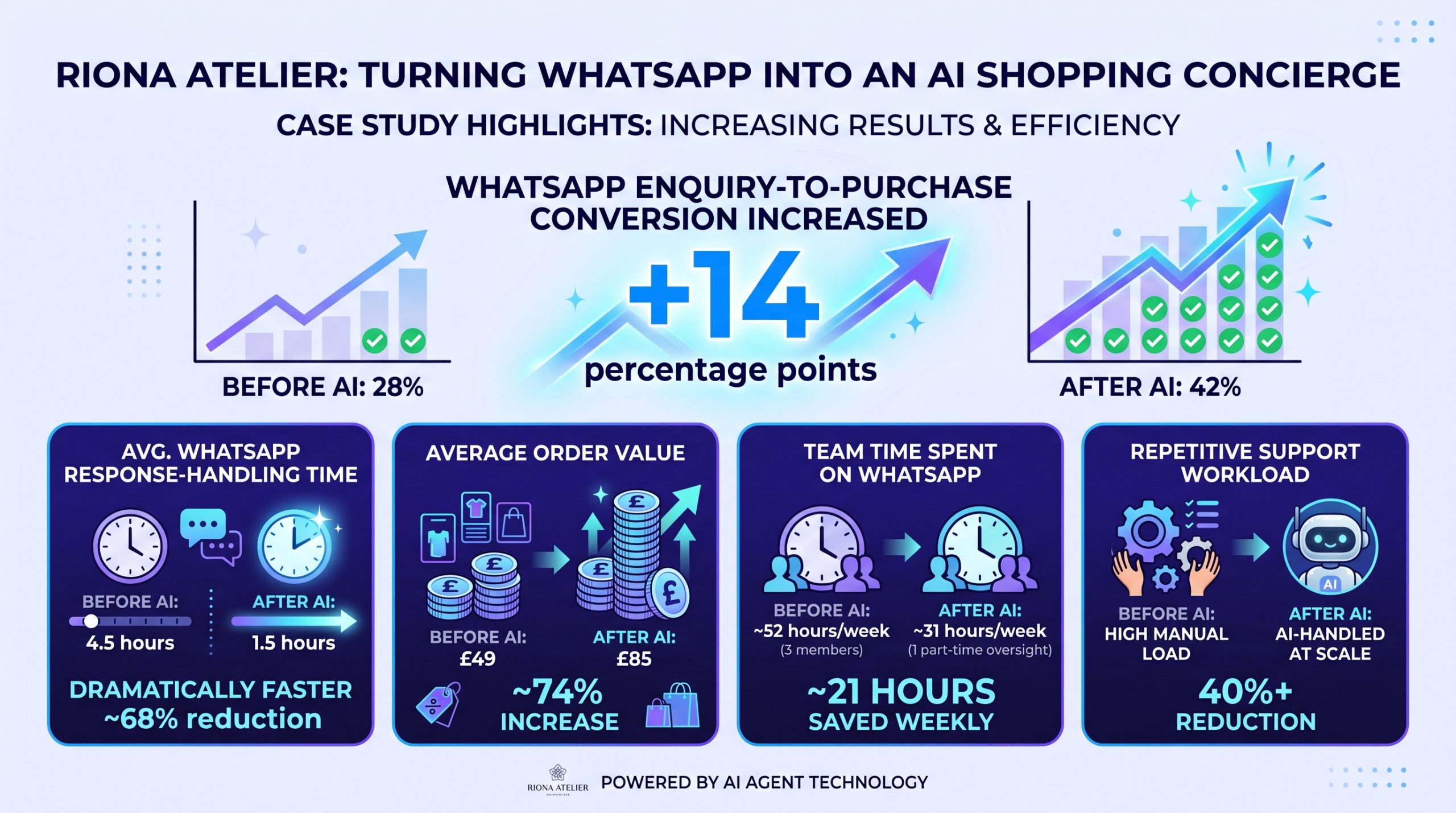
WhatsApp conversion
28% → 42%
+14 percentage points from enquiry to purchase.Response-handling time
4.5 hrs → 1.5 hrs
Around 68% faster average handling time.Weekly WhatsApp workload
52 hrs → 31 hrs
Roughly 21 hours saved every week.Average order value
£49 → £85
About 74% increase through stronger matching.About Riona Atelier
A premium accessories brand where personal styling guidance directly influenced sales.
Riona Atelier specialises in handcrafted beaded bags and occasion-wear accessories, including evening and bridal bags, day-to-night crossbody bags, customised accessories, and limited-edition seasonal collections.
Their ideal customer is a style-conscious woman aged 25–50 who values craftsmanship, individuality, and a personal shopping experience. Many customers are buying for a specific occasion: a wedding, birthday, anniversary, formal event, or memorable personal treat.
The stronger the guidance, the more likely a customer was to buy. But as the brand grew, delivering that level of guidance manually through WhatsApp became increasingly difficult.
The challenge
The problem: WhatsApp had become both a sales engine and an operational bottleneck
Before working with us, WhatsApp was one of Riona Atelier’s most valuable sales channels.
Customers discovered the brand through social media, referrals, or the website, clicked through to WhatsApp, and started conversations such as:
These were not low-value support messages. They were buying signals.
But every message triggered a manual process.
A team member had to reply, understand the customer’s occasion, check what they liked, confirm stock, search for product photos, explain sizing, compare options, advise on colours, answer delivery questions, and sometimes check whether customisation was possible.
Once the customer was ready to buy, the team then had to guide them toward payment, confirm the order, and make sure the details were passed through correctly.
On paper, this looked like good customer service.
In practice, it was becoming unsustainable.
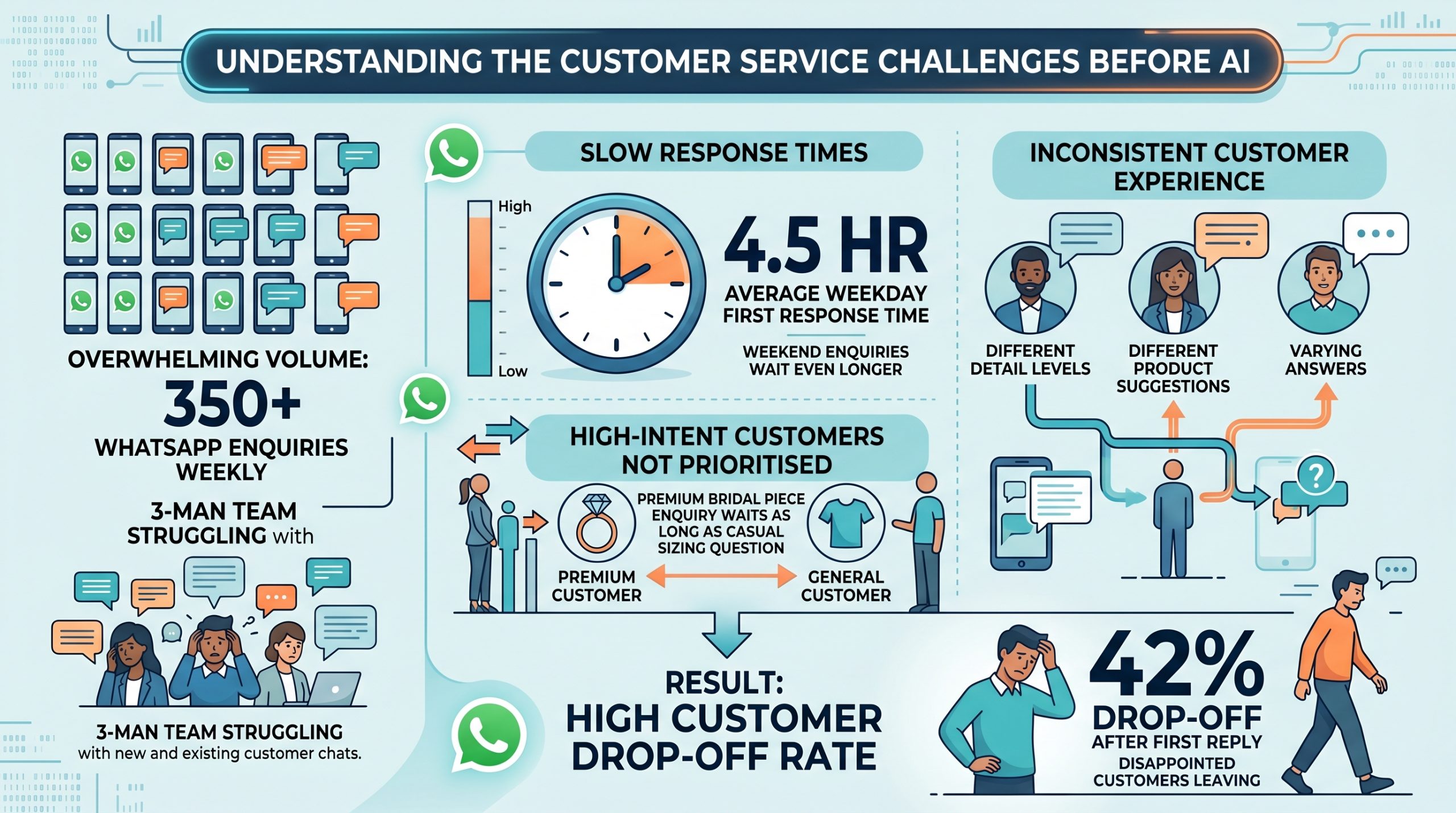
The team was handling around 350 WhatsApp enquiries per week, with three people involved across customer support and order handling. Around 65% of all customer messages fell into repeatable question categories.
Common questions included:
The answer context did not dramatically change, but the team still had to type responses manually.
That created three major problems.
First, response times were too slow. The average first response-handling time was around 4.5 hours during weekdays, and weekend enquiries often waited much longer.
Second, the customer experience became inconsistent. Depending on who replied, customers could receive different levels of detail, different product suggestions, or slightly different answers to the same question.
Third, high-intent customers were not always prioritised. Someone enquiring about a premium bridal piece could wait just as long as someone asking a casual sizing question.
For a premium brand, that mattered.
When customers are shopping for an occasion, timing and confidence are everything. If they do not get help quickly, they often move on.
Riona Atelier did not simply need faster replies. They needed a smarter way to guide customers toward the right product without losing the personal, premium feel of the brand.
“WhatsApp was one of our most important customer channels, but it was becoming too time-heavy to manage manually. We needed a smarter way to give customers a personal shopping experience without tying the team to WhatsApp all day.”
The solution
The Solution: An AI shopping concierge built around guided selling, inventory awareness, and brand experience
We designed and implemented a WhatsApp AI shopping concierge that acted almost like a digital personal stylist for Riona Atelier.
Instead of waiting for a team member to manually respond, customers could immediately enter a guided conversation.
The AI system could ask intelligent questions, understand what the customer was shopping for, recommend suitable products, answer approved FAQs, capture custom requests, and hand over to the team when a conversation needed human judgment.
Without exposing the proprietary implementation blueprint, the solution included several core layers.
The complete WhatsApp AI concierge connected customer intent, product context, operational rules, human handoff, and reporting into one managed workflow.
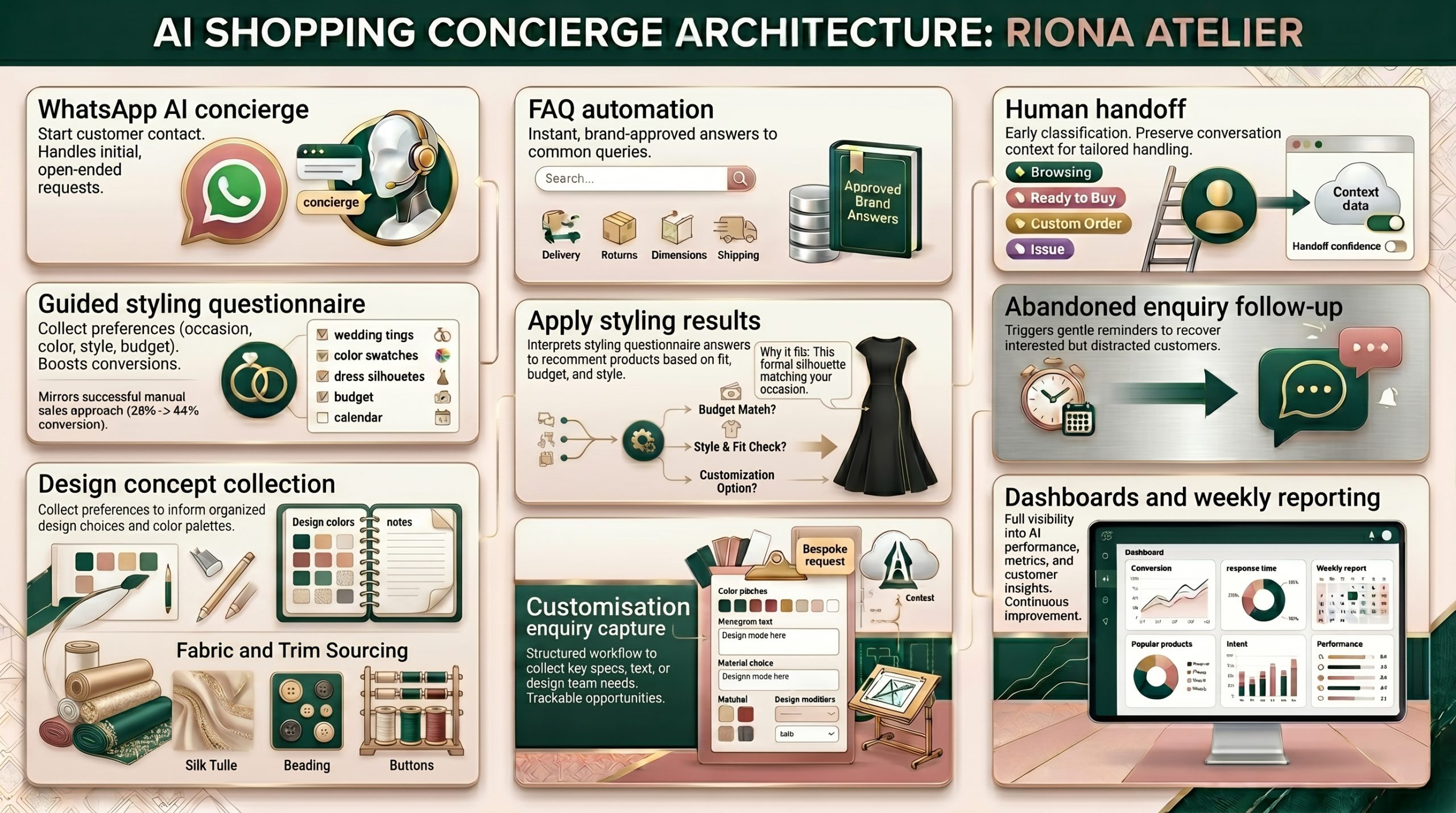
WhatsApp AI concierge
The first layer was a WhatsApp AI concierge. This gave customers an instant starting point when they messaged the brand.
The concierge was designed to feel warm, helpful, and stylistically aligned with Riona Atelier. It did not force customers into rigid buttons. It could respond naturally and guide them through product discovery.
Instead of treating those messages as vague enquiries, the AI turned them into useful buying context.
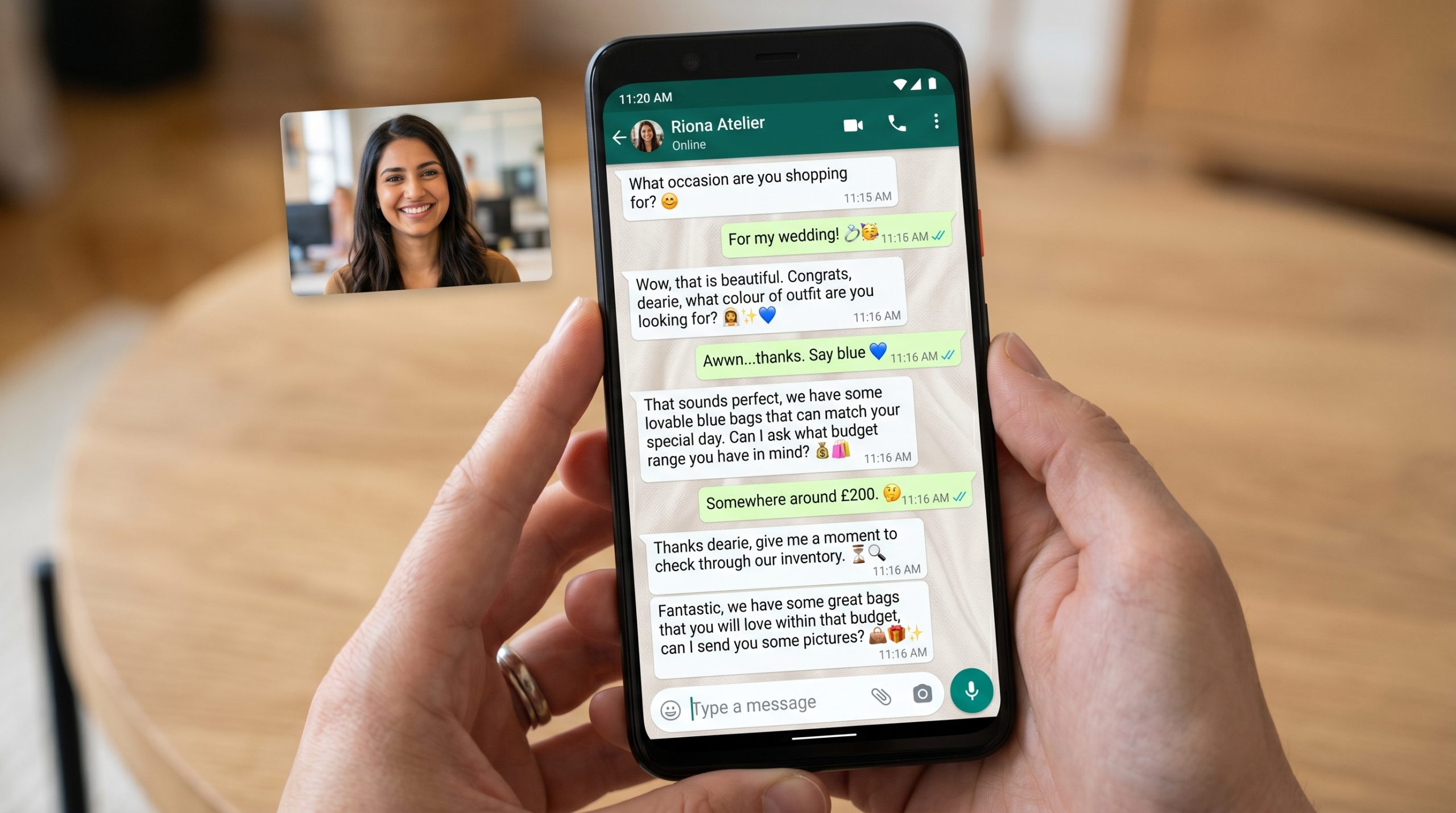
Guided styling questionnaire
Before recommending products, the AI asked natural follow-up questions that helped narrow the buying context.
- occasion
- outfit colour
- preferred bag style
- budget
- delivery deadline
- customisation or monogramming needs
This mattered because Riona Atelier already knew that while the overall enquiry-to-purchase conversion rate was around 28%, conversations with multiple photos and personalised recommendations converted at around 44%.
Inventory-aware product recommendations
The AI was connected to WooCommerce product data, including names, descriptions, prices, SKUs, stock status, images, variations, and key product details.
It also used richer styling attributes such as occasion, colour family, style, size, customisation availability, delivery timeline, price tier, matching accessory options, and gift-wrapping availability.
If someone asked for a medium-sized blue bag for a wedding under £150, the system could narrow recommendations using both style fit and availability.
For one-off pieces, samples, limited editions, and custom prototypes, we used a hybrid inventory layer via Google Sheets.
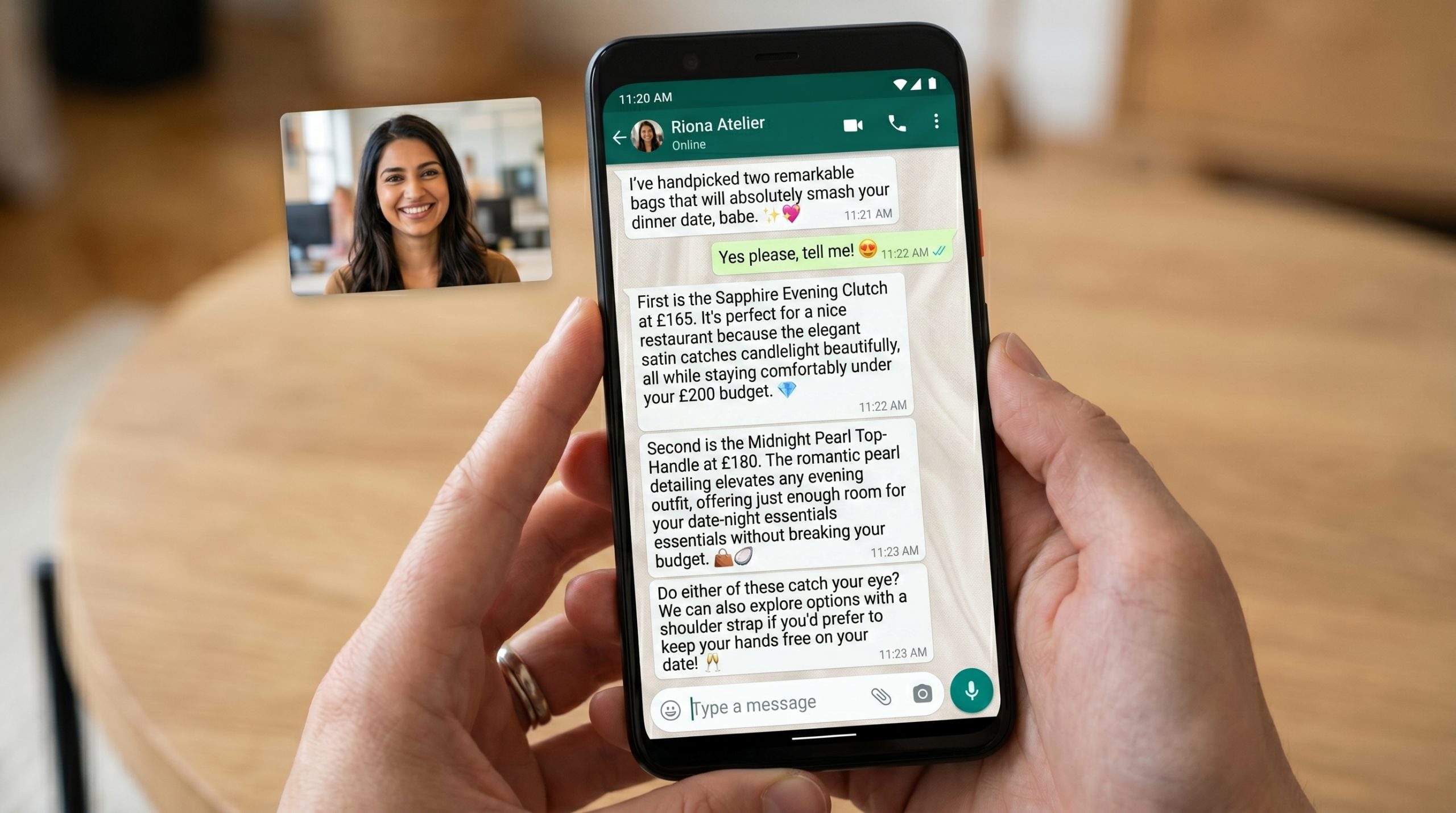
Dynamic product suggestion logic
The AI did not simply list products. It explained why a product made sense for that customer.
"This piece works well for a wedding because it has a more formal silhouette, sits within your budget, and the gold detailing would complement your black dress beautifully."
This made the recommendation feel more like a stylist's suggestion than a product search result.
FAQ automation using approved answers
We mapped the most common WhatsApp questions and created approved answer categories so the AI could respond consistently.
- delivery timelines
- returns
- dimensions
- international shipping
- custom colours
- stock availability
- pricing
- hardware options
- urgent orders
- matching accessories
Intent tagging and customer prioritisation
The AI automation tagged conversations into useful categories, including browsing, ready to buy, custom order enquiry, delivery or logistics question, complaint or issue, and human-needed conversation.
That meant a ready-to-buy customer, a custom order enquiry, and a frustrated customer no longer had to sit in the same unstructured WhatsApp queue.
What had previously been invisible became operational intelligence.
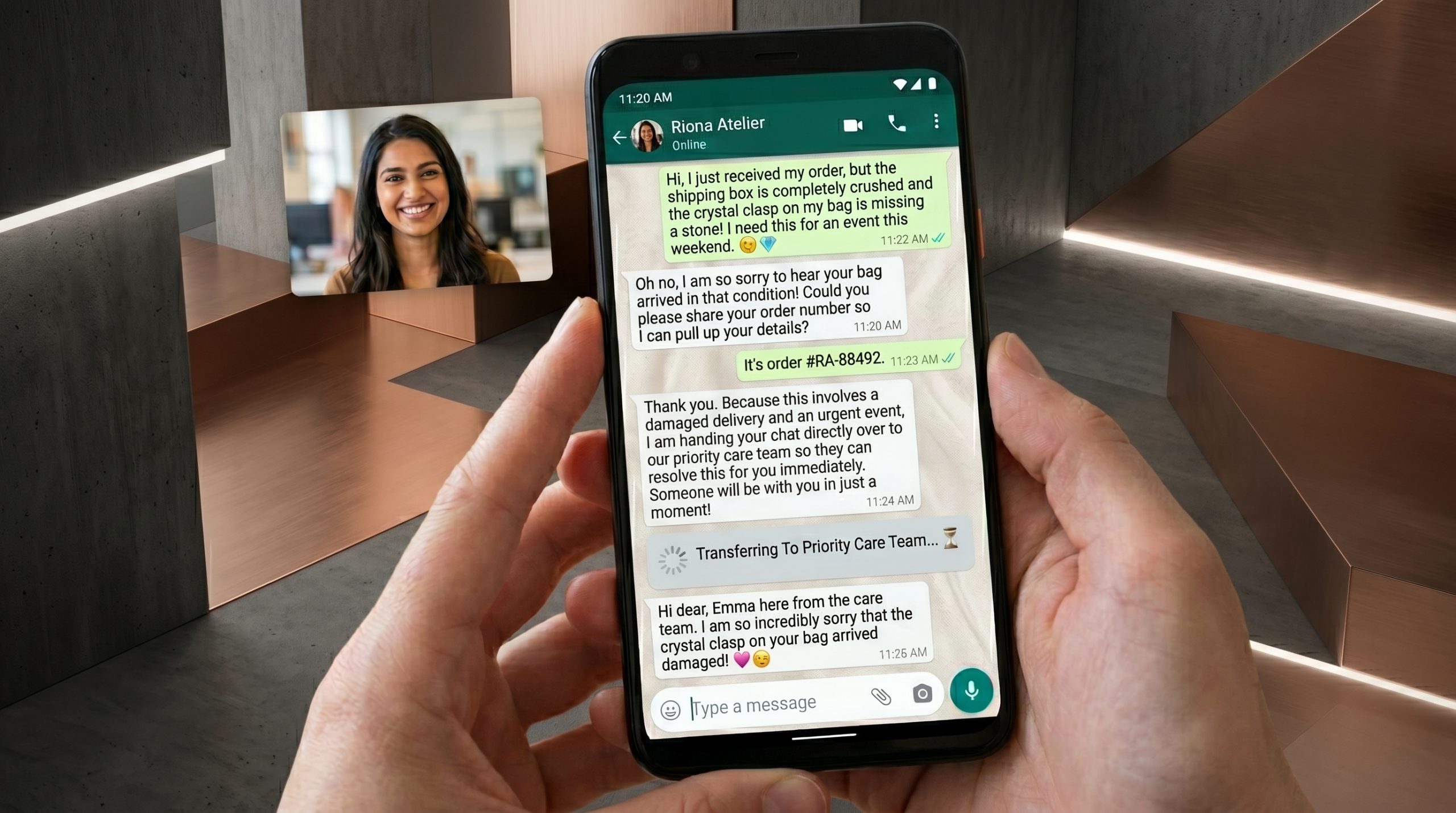
Human handoff with context preserved
We were careful not to over-automate.
If a conversation involved a complex custom order, damaged delivery, sensitive complaint, or unusual request, the AI moved the customer to a human team member.
The handoff was designed with clear rules, confidence limits, and preserved context, so the customer did not need to repeat themselves.
Abandoned enquiry follow-up
If a customer stopped responding after key buying moments, the system could send gentle reminders.
These were not pushy sales messages. They were designed to recover customers who were interested but distracted.
Customisation enquiry capture
Customisation requests used to get buried in WhatsApp threads. The AI collected key details such as colour, monogram text, size, material, deadline, and special request notes.
Those details were converted into a structured record for the team to review and fulfil.
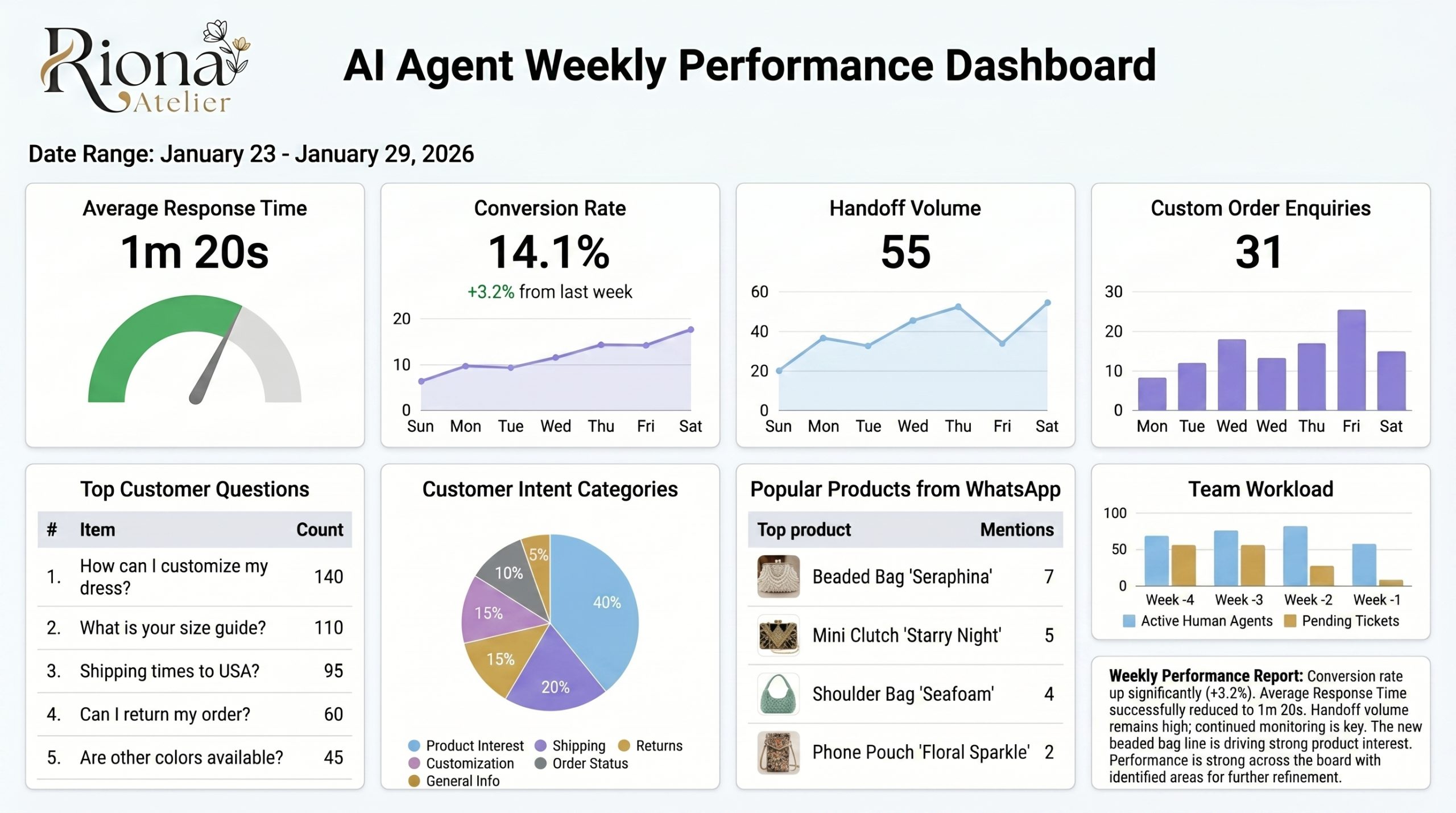
Dashboard and weekly reporting
The final layer was visibility.
The dashboard allowed Riona Atelier to monitor response-handling time, conversion rate, top asked questions, handoff volume, customer intent categories, popular products from WhatsApp, team workload, and custom order enquiries.
Each week, the system produced a performance report. This meant the AI concierge was not a set-and-forget tool. It became a measurable sales and operations asset.
Implementation timeline
How the implementation unfolded
The full implementation took 8 weeks.
We moved from customer journey discovery through product data preparation, build, internal testing, controlled launch, full rollout, team training, and optimisation.
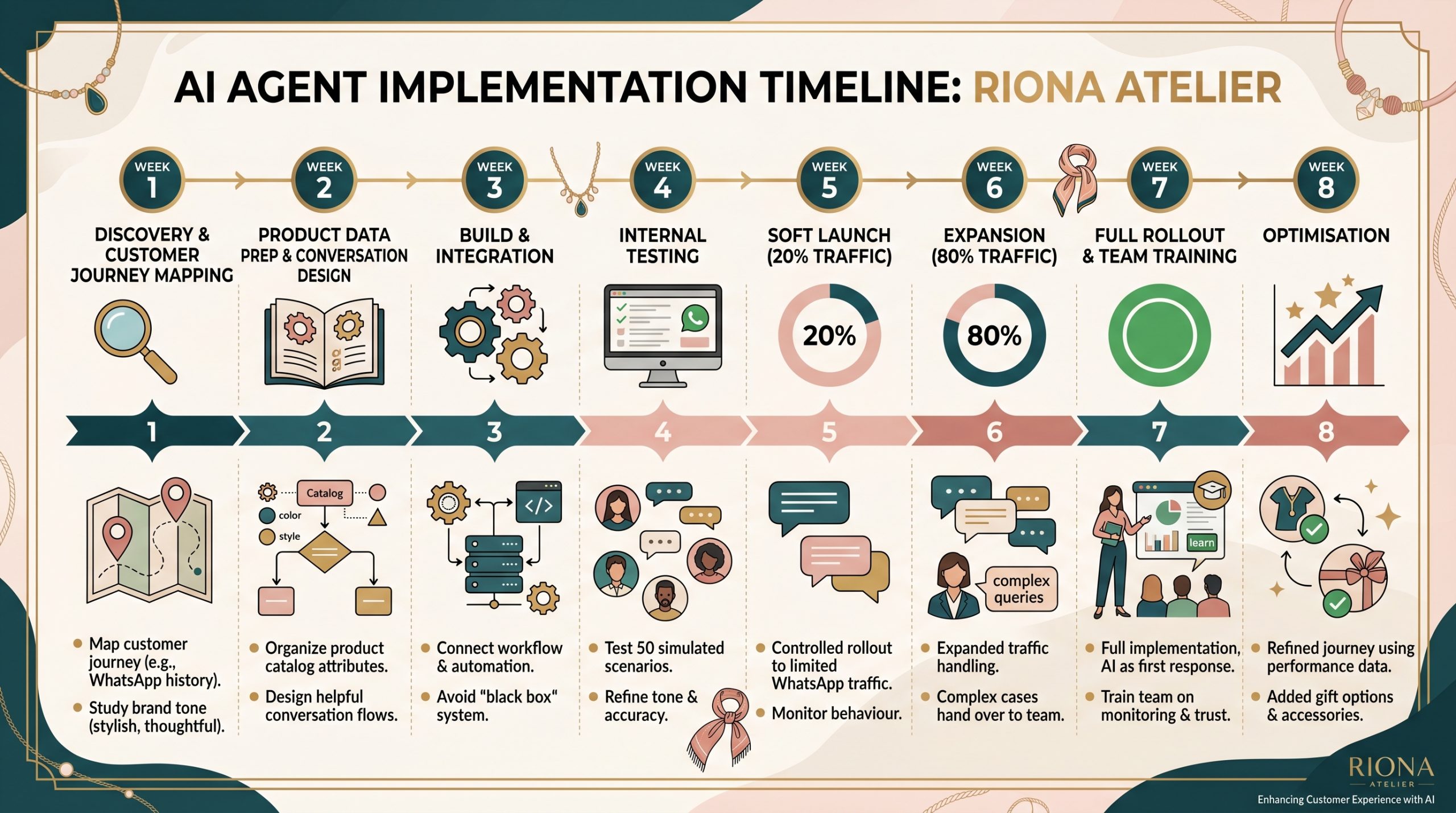
Week 1: Discovery and customer journey mapping
We started by mapping Riona Atelier's customer journey in detail.
This included reviewing WhatsApp history, identifying the most common question types, understanding where customers dropped off, and documenting how the team manually recommended products.
We also studied the brand's tone so the AI could feel warm, stylish, thoughtful, and aligned with a premium handcrafted accessories brand.
Week 2: Product data preparation and conversation design
Next, we worked on the product structure. The AI system could only recommend intelligently if the catalogue was organised intelligently.
We helped define the product attributes needed for guided selling: occasion, colour family, style, size, price tier, delivery timeline, customisation availability, and more.
At the same time, we designed the guided conversation flow so the concierge could be helpful without interrogating the customer.
Week 3: Build and integration
In week three, we connected the core workflow.
This included the WhatsApp automation layer, the AI conversation engine, the product catalogue connection, the inventory logic, and the workflow automations around tagging, routing, and escalation.
We deliberately avoided building a black-box system. Riona Atelier needed something the team could understand, review, and manage as the business grew.
Week 4: Internal testing
Before launch, the concierge was tested against 50 simulated customer scenarios.
These included straightforward product enquiries, vague styling requests, urgent delivery questions, custom order requests, low-stock scenarios, budget uncertainty, and frustrated customer messages.
The goal was not just to make the AI answer. The goal was to make it answer in a way that felt commercially sensible and brand-safe.
Week 5: Soft launch to 20% of WhatsApp traffic
Once internal testing was complete, we rolled the system out to a controlled portion of WhatsApp traffic.
Only around 20% of incoming conversations were handled by the AI first.
This gave the team room to monitor behaviour, identify edge cases, and build confidence before wider rollout.
Week 6: Expansion to 80% of traffic
After refining the system based on early live data, we expanded the rollout.
At this stage, the AI handled the majority of WhatsApp enquiries, while complex custom orders and sensitive conversations continued to hand over to the team.
The team was no longer buried under repetitive questions, but they still had control where it mattered.
Week 7: Full rollout and team training
By week seven, the AI concierge became the first response layer for all WhatsApp enquiries.
We trained the team on how to monitor conversations, use the dashboard, review handoffs, and update key information.
This step was important because AI adoption is not just about the system. It is also about helping the team trust and use it properly.
Week 8: Optimisation
In the final implementation week, we used early performance data to refine the journey.
We adjusted question order, improved product matching logic, and added two additional attributes: matching accessories and gift-wrapping options.
By the end of week eight, the system was fully live, stable, and integrated into Riona Atelier's day-to-day customer experience.
Results
The outcome after five months
Five months after full rollout, the results were clear.
Riona Atelier's average WhatsApp response-handling time improved from 4.5 hours to 1.5 hours, an improvement of around 68%.
Their WhatsApp enquiry-to-purchase conversion rate increased from 28% to 42%.
The five-month impact covered response speed, conversion, average order value, workload, order processing, customer drop-off, and team focus.
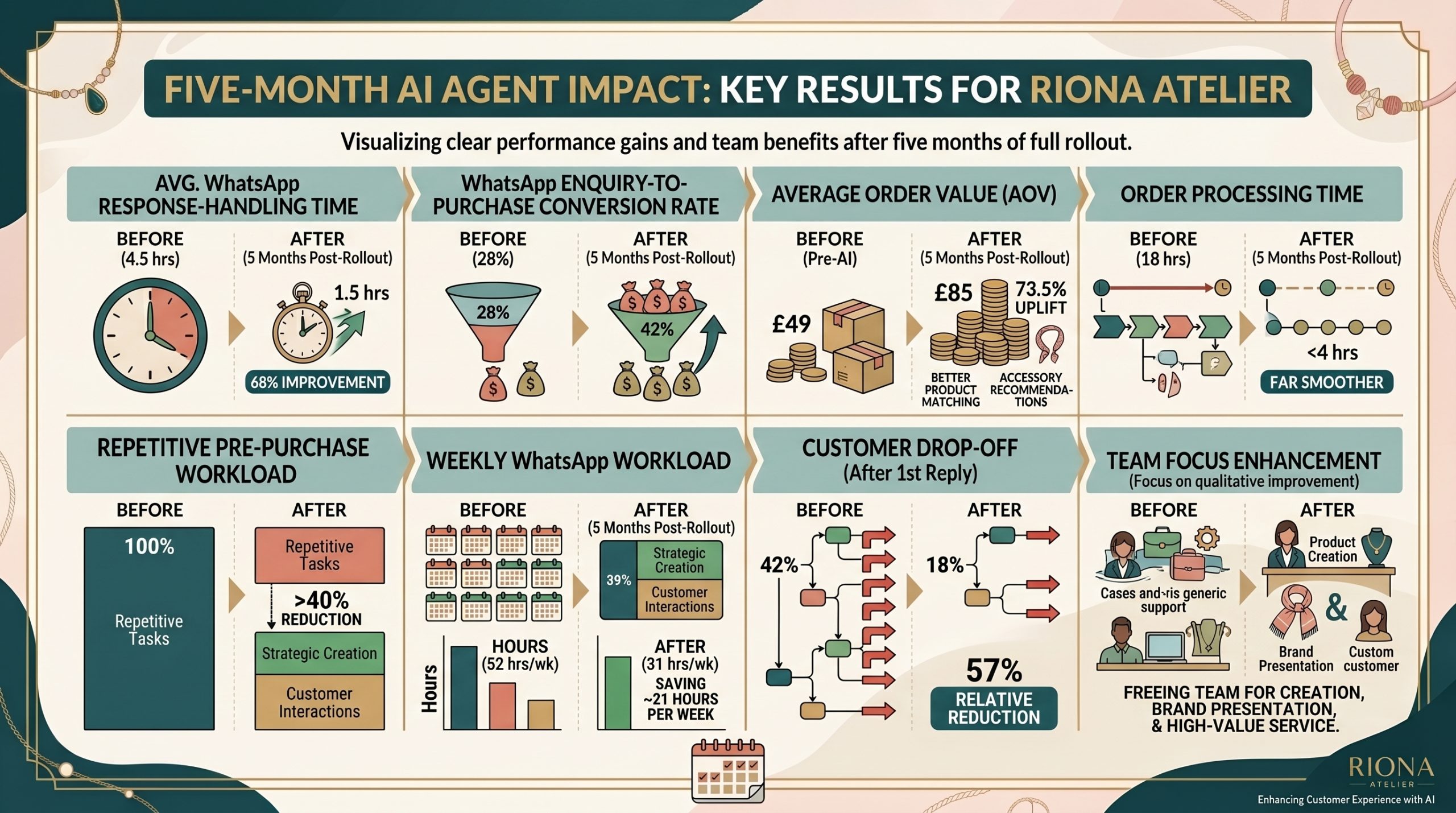
Around 68% faster average WhatsApp response-handling time.
WhatsApp enquiry-to-purchase conversion increased by 14 percentage points.
Repetitive pre-purchase support workload reduced at scale.
Roughly 21 hours saved every week on WhatsApp handling.
Approximately 73.5% uplift, helped by better matching and relevant accessory recommendations.
The buying journey became far smoother after the handoff and order details were structured.
Drop-off after first reply fell by a relative reduction of around 57%.
The channel could be managed with one part-time oversight role for monitoring, handoffs, and exceptions.
Custom order enquiries also became fully trackable, rather than being buried inside message threads.
That gave the team far better control over bespoke requests and future product opportunities.
"What Lotusbrains Studio did for us was not just automate our replies. They helped us turn WhatsApp into a lucrative inbound sales channel for us while spoiling our customers with an enjoyable shopping experience."
Why the numbers improved
The numbers improved because the customer journey improved.
Customers were often waiting for answers, receiving inconsistent guidance, or being shown products without enough context.
They were guided faster and more intelligently, with clearer product fit, availability, comparison, and purchase momentum.
The team was no longer overwhelmed by repetitive pre-purchase questions, creating a more consistent and scalable sales journey.
The business did not just become faster. It became more consistent, more responsive, more organised, and more scalable.
Not replacing the brand experience - strengthening it.