
AI voice agent pricing is a topic coming up more often in our discussions with business owners and executives. They are rightly keen to know how much per minute they can expect to pay for AI voice agents and the total cost of ownership (TCO) of these agents – and how that compares to the traditional cost of having human agents manage calls.
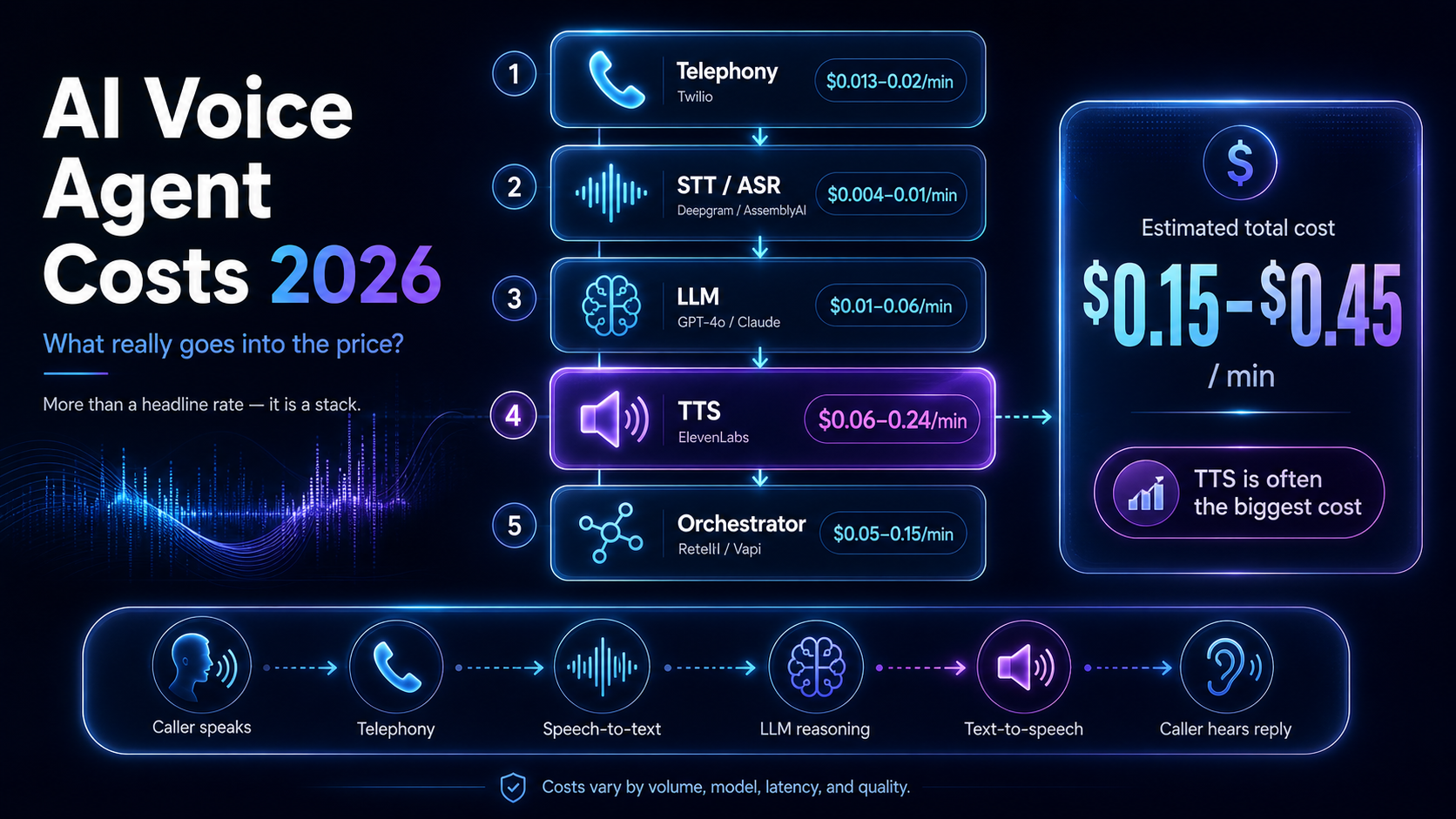
By total cost of ownership (TCO), we mean the final price you pay for an AI voice agent you pay after adding up every single fee, not just the advertised rate.
This article details all you need to know about AI voice agent costs in 2026. Our experts break down AI voice agent pricing per month, spanning what notable providers like Vapi, Retell, and Synthflow charge for their agents.
We dive deeper into retell AI pricing per minute voice agent, Vapi AI pricing per minute voice agent, Synthflow AI pricing per minute voice agent – as well as what managed done-for-you AI voice agent providers charge.
This write-up analyzes the contracts, hidden stack costs (like transcription and voice synthesis), and approximate prices of the top 10 providers to give you a transparent look at what you will actually pay per month.
What you will get from this article
- We expose the true cost per minute after you add essential layers like STT (Speech-to-Text), LLM (Large Language Model) inference, and telephony (phone line) fee.
- Volume-Based Forecasts: See exactly what 1000, 5000, and 100000 minutes cost across different vendors.
- Hidden Fee Exposure: We highlight hidden fees such as failed call taxes, compliance surcharges, and concurrency limits (limit on how many calls can happen at once).
AI Voice Agent Pricing: What determines the cost?
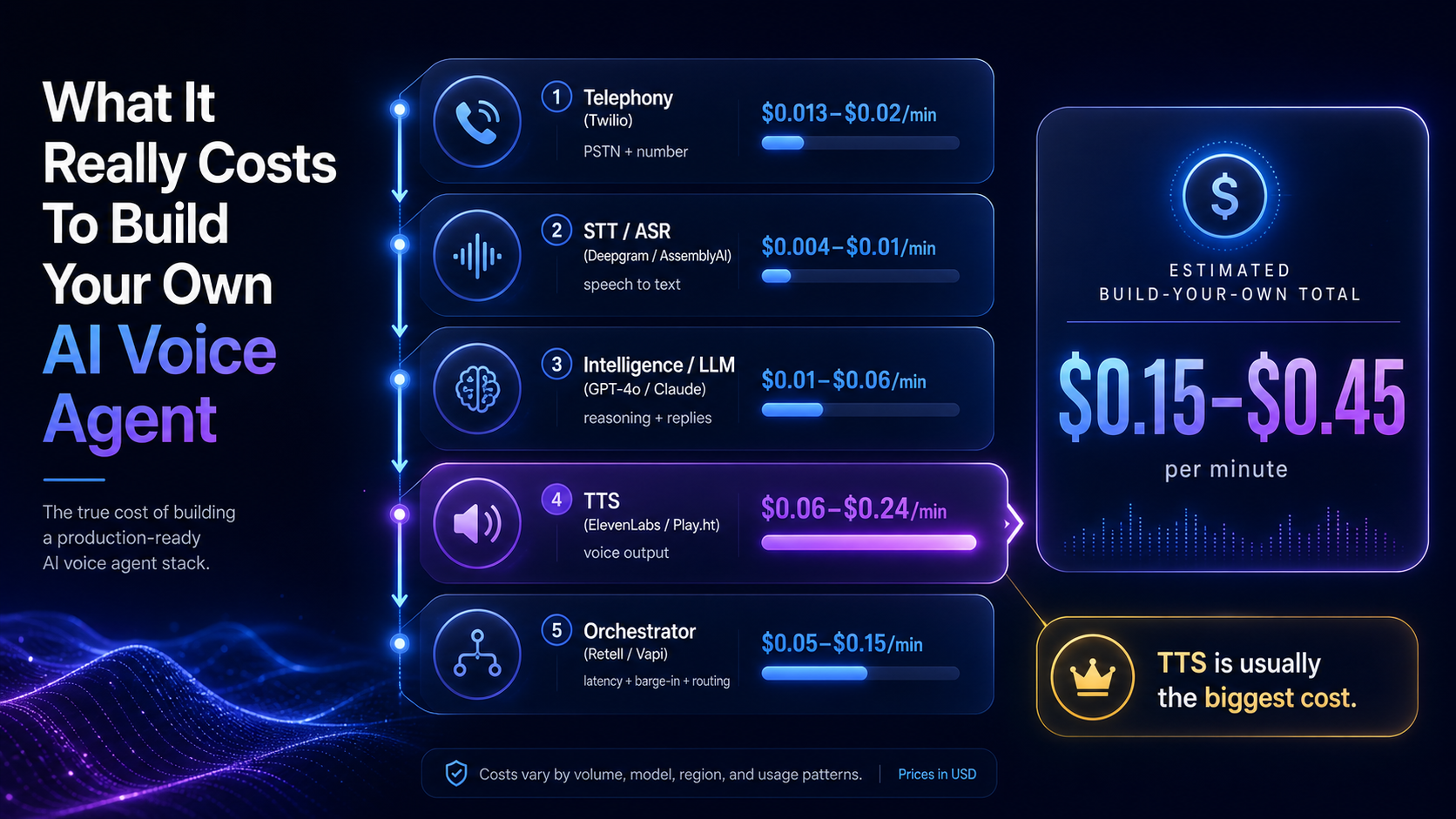
AI voice agent pricing varies dramatically depending on what exactly you are paying for. The most important cost drivers are below.
Minutes consumed
Minutes remain the most visible pricing variable, but the rate attached to those minutes varies widely by platform and what is bundled.
Retell’s calculator shows one example at $0.11 per minute, comprising $0.055 for Retell voice infrastructure, $0.04 for the LLM, and $0.015 for text-to-speech. That already shows why a single headline rate rarely tells the whole story.
Telephony and number costs
Telephony is a core determinant of AI voice agent pricing. At Lotusbrains Studio, we strive to keep these costs minimal when building AI voice agents for our clients by choosing relatively affordable providers like Twilio.
On Twilio voice AI agent pricing per minute, local outbound calls are $0.0158 per minute, local inbound calls come at $0.01 per minute, and a standard local number goes for $1.15 per month.
Twilio also charges $0.0025 per minute for recording and $0.0500 per minute for transcription. Often, this varies by country.
So if you take Retell’s example $ 0.11-per-minute stack and add Twilio’s outbound rate, you are already at around $0.1258 per minute before transcription, recording, CRM logic, or compliance tooling.
Subscriptions, bundles, and overages
Many vendors do not rely solely on pay-as-you-go usage. Instead, they combine usage billing with subscriptions, bundles, or plan fees.
Bland AI, for example, combines monthly subscription pricing with minute-based usage. On aircall AI voice agent pricing, this provider also uses usage tiers rather than a single flat universal rate.
Aircall’s AI voice agent includes 50 free minutes per month, then offers bundles at $175 for 500 minutes and $725 for 2,500 minutes. You can expect pay-as-you-go usage to start at $0.39 per minute.
How about Bland AI pricing voice agent per minute?
Bland AI combines a monthly plan with usage-based billing: the Start plan is free at $0.14 per connected minute, while the Build plan is $299/month at $0.12 per minute.
Knowing what goes into an AI voice agent pricing matters because some platforms look cheap until you exceed your allowance or need extra features that sit outside the base plan.
Concurrency charges
Some providers also charge based on the number of simultaneous calls your system can handle.
Vapi, for example, includes 10 concurrent calls, then charges $10 per additional line per month.
Synthflow also lists extra concurrency at $20 per additional concurrent call. That means your bill can rise not just because of total usage, but because of peak demand.
Speech recognition, voice, and model costs
Buyers often underestimate the extent to which the underlying AI components affect cost.
Deepgram lists Nova-3 Monolingual at $0.0077 per minute and Nova-3 Multilingual at $0.0092 per minute.
But for us, we have enjoyed more success with the likes of ElevenLabs, whose low-latency text-to-speech can be as low as $0.05 per minute on its Business plan.
OpenAI prices models differently again, using tokens rather than minutes, with GPT-5.4 mini priced at $0.75 per million input tokens and $4.50 per million output tokens, while GPT-realtime-1.5 audio pricing is higher.
So when a vendor says “bring your own model”, that can materially change your real monthly cost.
Integration depth
The deeper the integration, the higher the likely cost. We have had businesses come to us for ready basic voice agents that basically handle customer inquiries on calls and book appointments on calendars.
There is not much significant engineering that goes into this, and a couple of hundred dollars should suffice for this. However, AI voice agent pricing increases when you want your AI voice agents to do more on the back of such calls.
This could include logging transcripts, updating your CRM, triggering workflows, qualifying leads, intelligently transferring calls, and syncing outcomes across multiple systems.
Integration depth is often where extra monthly fees or custom development costs begin to appear as you transition from basic AI phone agents to a multi-agent AI setup that blends with your full infrastructure.
Feature complexity
Feature complexity also changes the economics significantly.
A simple receptionist-style agent is much cheaper than one with multilingual support. For context, we had a client for whom we originally built an AI voice agent, for whom the voice model was costing around $0.05 per minute.
But by the time they requested we upgrade the agent to multilingual support, the cost shot up to $0.01 per minute, and in some cases, varying up to $0.020. Further feature complexities like advanced lead qualification, sentiment detection, real-time routing logic, or agent-to-human handoff with context preservation can increase cost.
Support, analytics, and maintenance
Not every vendor includes the same level of service around the product.
Some charge mainly for the software and leave the rest to you. Others include implementation help, performance monitoring, reporting, support, and ongoing optimization within a broader enterprise contract.
That is why two providers with similar-looking usage rates can still have very different total cost profiles. You may ask us which is the safer path: one-off or ongoing support?
In truth, it depends on your specific business needs. We have built and handed off basic AI voice agents (that simply answer calls) to clients who have an engineering team that we guided on maintenance.
But this creates technical overhead for your team. If you don’t have such internal engineering facilities and aren't a technical founder, you would be safer with a plan that includes ongoing support.
AI voice agents are improving rapidly. An ongoing support program enables you to leverage the latest advancements in conversational AI without the headache of manual updates.
Believe us when we say the technology is changing at a fast and furious pace. Some of the voice agents we built in 2024 are nowhere near as powerful as those we are building in 2026 – simply because of the technological breakthroughs of recent months.
Instead of your agent becoming outdated in a few months, a dedicated partner ensures it continually evolves—learning from real customer interactions, adopting new features, and optimizing for better results while you focus entirely on running your business.
2. PolyAI - Best for Enterprise Brand Safety
Graded Score:
Pricing Snapshot:
Pricing model: Managed Service Contract (Custom Quote).
Starting Headline Cost: Custom (Typically starts around ~£120,000 annually).
Best value when you have high call volumes (50k+ min/month) and brand reputation is critical (e.g., banking, hospitality).
What you actually pay (Pricing breakdown):
- Base Usage: Structured as a flat managed service fee plus a variable rate per minute or per call session.
- Included allowances: Includes implementation, custom voice design, and dedicated linguist support.
-
Typical add-ons that change the bill:
- Telephony: Usually bundled, but complex routing may incur carrier fees.
- STT/TTS/LLM: STT (Speech-to-Text) is the technology that transcribes audio to text. TTS (Text-to-Speech) turns text back into audio. LLM (Large Language Model) is the AI brain. With PolyAI, these are bundled into the managed rate.
- Extras: Continuous improvement, detailed analytics, and multi-language support are standard inclusions in the retainer.
Example monthly totals:
Pricing Model Explanation: PolyAI does not sell minutes in a vending machine style. Contracts are typically annual engagements.
Budget Expectation: Baseline expenditure for managed services and platform start at £10,000/month, amortised over the term.
What to ask sales: What is the guaranteed containment rate, and do we pay for calls that escalate to a human?
Best value verdict:
A compelling value proposition for scaling down a 50+ person seat contact center(help desk), while upholding top-tier brand safety protocol.
Watch-outs:Note the significant upfront requirement: this solution is not viable for pilot programs with an investment floor below £50k.
This solution is optimised for mid-market and enterprise-level firms: not recommended for organizations with annual revenue below £10M or those seeking instantaneous deployment.
Bottom line:
For those seeking a fully autonomous alternative to human staffing, this is a premier choice , as the premium pricing covers performance insurance and service-level assurance.
3. Replicant - Best for Contact Center Automation
Graded Score

Pricing snapshot
Pricing Model: Outcome-based/Usage-based
Starting headline cost: Custom Quote (Scale-dependent)
Best value when: Optimised for those seeking outcome-based billing instead of paying for agent talk time.
What you actually pay (Pricing breakdown)
- Base Usage: Operational costs are tied to performance-verified outcomes rather than raw volume.
- Included allowances: The subscription includes access to the Natural Language Understanding (NLU) processing layer, a real-time analytical dashboard, and standard integrations.
-
Typical add-ons that change the bill
- Telephony: Integrates with your existing CCaaS (Contact Centre as service), like Genesys or NICE; telephony costs may remain with your carrier
- STT/TTS/LLM: Bundled.
- Extras: Replicant offers a 100% risk-free guarantee, refunding the implementation fee if key Performance Indicators (KPIs) aren’t met.
Example monthly totals:
Pricing Model Explanation: Replicant targets the enterprise contact center. Pricing is engineered to be lower than your current Business Process Outsourcing (BPO) cost per minute (roughly £0.70-£0.80/min).
Budget Expectation: A typical enterprise-level engagement requires a six-figure annual commitment.
What to ask sales: Does the resolution fee apply if the user eventually transfers to a human?
Best value verdict:
A compelling provider for sectors with seasonal surges, as it replaces fixed labor overhead with a scalable, performance-based structure.
Watch-outs: The onboarding could take a while. But on the upside, this avoids the bottlenecks associated with legacy telephony stacks.
Not ideal if you are a developer wanting to tweak prompt engineering daily.
Bottom Line:
If you want minimal financial risk on deployment, this is a strong pick because their money-back guarantee aligns their incentives with your success
4. Cognigy - Best for enterprise Orchestration
Grade Score:
Pricing Snapshot
Pricing model: Per billable conversation (Subscription)
Starting headline cost: ~£2,000/month (Basic Tier)
Best value when: You have complex, multi-turn workflows involving backend API integrations (e.g., flight changes, banking).
What you actually pay (Pricing breakdown):
- Base Usage: Charged per conversation.
- Included allowance: Basic tiers include ~5000 to 10,000 conversations
-
Typical add-ons that change the bill:
- Telephony: Cognigy voice gateway is often a separate line item or setup fee.
- STT/TTS/LLM: Can be BYO (Bring Your Own) or integrated. If BYO, you pay separate fees for the underlying cognitive services (Azure, Google, OpenAI).
- Extras: Enterprise support SLAs (Service Level Agreements) and on-premises deployment options incur additional costs.
Example monthly totals
Pricing Model Explanation: You pay a platform fee (~£2k+) plus volume steps.
Budget Expectation: Mid-market deployments typically range from £4,000 to £12,000/month, depending on the complexity of the conversation.
What to ask sales: Are Voice Gateway minutes charged separately from the conversion license fee?
Best value verdict
Strong value if you are an enterprise IT team building complex, long-running transactions
Watch-outs: Users may encounter session termination if a complex inquiry exceeds the 50-turn dialogue limit.
Not ideal for short, simple calls (e.g., appointment reminders).
Bottom line:
If you want deep backend integration and long-context memory, this is a strong pick because the conversation pricing model doesn’t punish you for long call durations.
5. Yellow.ai (VoiceX) - Best for Customer Support Automation
Graded Score:
Pricing snapshot:
Pricing model: Resolution-based (free-tier available)
Starting headline cost: £0.79 per resolution.
Best value when: You want to automate support tickets and only pay when the AI actually solves the problem.
What you actually pay (pricing breakdown):
- Base usage: ~£0.79 per resolution after the free allowance (500 sessions/month on the free tier).
- Included allowance: Free tier includes 1 agent and 500 sessions. Enterprise offers unlimited agents.
-
Typical add-ons that change the bill:
- Telephony: Enterprise plans may require custom SIP trunking setups
- STT/TTS/LLM: 15+ LLMs included in the architecture.
- Extras: Resolution definition is key to ensuring it aligns with your internal metrics.
Example monthly totals:
Pricing Model Explanation: Unlike minute-based billing, you aren’t stressed about call length.
Budget Expectation: 1,000 resolved calls ~ £790. 10,000 resolved calls ~£7,900.
What to ask sales: How do we define a resolution technically?, is it a closed ticket or a specific intent matched?
Best value verdict:
Strong value if you focus on CSAT and ticket deflection. CSAT (Customer Satisfaction) simply measures how happy your callers are with their support experience. Because you only pay when the AI successfully resolves an issue, this pricing model directly aligns your costs with keeping customers happy and reducing your human team's workload.
Watch-outs: If your resolution rate is low, the ROI drops (though you pay less).
Not ideal if you need purely conversational, non-goal-oriented agents (e.g., companion bots)
Bottom line:
If you want a predictable ROI, this is a strong pick because you stop paying for failed attempts and only pay for successful support outcomes.
1. Retell AI - Best for Developers & High-Volume Sales
Graded Score: 92/100
Retell ai pricing per minute voice agent (Pricing Snapshot):
Pricing model: Pay-as-you-go (per minute)
Starting headline cost: ~£0.06/min ($0.07) for typical
Best value when: We think Retell ai pricing voice agent has some of the best competitive rates. Retell is exceptionally optimized for AI voice agents where latency is critical, and where a <800ms (i.e., accelerated processing) response threshold ensures a natural conversational flow.
What you actually pay (pricing breakdown):
- Base usage: ~£0.06/min (billed per minute).
- Included allowances: £7.3 ($10) trial credit, 20 concurrent calls on free tier.
-
Typical add-ons that change the bill:
- Telephony: Twilio/provider pass-through (~£0.012/min)
- STT/TTS/LLM: Costs are driven by your AI model selection, typically ranging from £0.10 to £0.24/min, depending on whether you use expensive voices (like ElevenLabs) or cheaper ones (like Deepgram).
- Extras: Knowledge base (~£6/mon), Verified phone numbers (~£2/mon).
Example monthly totals:
1,000 minutes/month ~£80 ($110).
5,000 minutes/month ~£410 ($550)
10,000 minutes/month ~£820 ($1100)
Best value verdict:
Strong choice if your dev or engineering team is building a custom, high-speed voice agent or bot and does not want to expend overwhelming time stitching up the underlying infrastructure.
Watch-outs: Note that the platform or base fee is just the starting point; you will be charged an additional fee for underlying AI components and inference.
If you are keener on customization and want extensive granular control over the underlying architecture, Retell may be a little strangulating for you.
Bottom line:
If you want the lowest latency for natural voice agents with quicker builds (and you are willing to sacrifice extreme customization), this is a strong pick because the minimal platform fee investment buys you the best orchestration engine on the market.
2. Vapi - Best Engineering Teams (Bring-Your-Own (BYO) Stack)
Graded Score:
Vapi AI voice Agent Pricing Snapshot:
Pricing model: Usage-based (Hosting fee)
Starting headline cost: ~£0.04/min ($0.05)
Best value when: Best suited for teams with high technical literacy who want to plug in their existing enterprise to a bespoke voice infrastructure (e.g., OpenAI or Elevelabs).
What you actually pay (Pricing breakdown);
- Base usage: ~£0.04/min (Platform fee only).
- Included allowances: £7.3 ($10) trial credit.
-
Typical add-ons that change the bill
- Telephony: ~£8/month per concurrent line + usage (~£0.01+/min).
- STT/TTS/LLM: 100% client-side. You pay OpenAI/Deepgram/ElevenLabs directly. Users must provide their own API key for either OpenAI or ElevenLabs.
- Extras: HIPAA Compliance is a ~£800/month add-on ($1,000)
Example monthly totals:
1,000 minutes/month ~£260 ($330)
5,000 minutes/month ~£1,300 ($1,650)
10,000 minutes/month ~£3,400 ($4,300).
Best value verdict:
For us at Lotusbrains Studio, Vapi is our go-to orchestrator for AI voice agents when we want way more control over the agent build. Vapi is an ideal fit for an organization already operating at scale, allowing you to further capitalise on your existing AI ecosystem and build way more powerful AI voice agents that readily blend with your existing tech stack.
Watch-outs: The regulatory cost burden is significant. The high technological burden can be too high for small-scale startups.
Not ideal if you don't want to manage 5 different API bills (Vapi, Twilio, OpenAI, Deepgram, ElevenLabs).
Bottom Line:
If you want granular control over every part of your stack, this is a strong pick because it allows you to bring your own components for maximum flexibility.
3. Synthflow - Best for Agencies & SMBs
Grade Score:
Synthflow AI Voice Agent Pricing snapshot
Pricing model: Monthly Subscription (Bundled Minutes)
Starting Headline Cost: ~£23/month (starter) to ~£300/month (Pro)
Best value when: An ideal infrastructure for marketing agencies looking to provide automated voice support to their SMB (Small and Medium Business) client base.
What you actually pay (pricing breakdown):
- Base Usage: Pro plan (~£300/month) includes 2,000 minutes. Growth (~£720/mon) includes 4,000 minutes.
- Included allowances: No-code builder, Twilio connectivity (bundled), basic voices.
-
Typical add-ons that change the bill:
- Overage: ~£0.11($0.15)/min for starter, ~£0.09/min on Growth/Enterprise Tier.
- Extra: Agency plan (~£920($1250)/mo) allows white-labeling the entire platform (branding it as your own).
Example monthly totals
1,000 minutes/month ~£300 (Covered by pro plan).
5,000 minutes/month ~£600 (Growth plan).
10,000 minutes/month ~£1,500 (Agency plan).
Best value verdict:
Ideal for platforms that need a ready-made business model that is architected for instant market deployment.
Watch-outs: You pay for the bundle even if you don't use the minutes (breakage).
Not ideal if your priority is speed (extreme latency optimization (<500ms)).
Bottom line:
If you want predictable monthly billing without engineering, this is a strong pick because the bundled pricing removes the cost fluctuations typical of a complex AI stack.
4. Aircall AI Voice AGent - Best for Current Aircall Users
Graded Score:
Aircall AI voice agent pricing per minute snapshot
Pricing model: Per-minute add-on
Starting headline cost: ~£0.39/minute ($0.49)
Best value when: Best if you already have Aircall seats; for a small addition to your existing monthly spend, you get a ready-made AI receptionist.
What you actually pay (pricing breakdown):
- Base usage: ~£0.39/min for pay-as-you-go.
- Included allowances: 50 free minutes per account per month.
-
Typical add-ons that change the bill:
- Seats: You must have active Aircall licenses (minimum of 3 seats = ~£70-£120/month base).
- Bundles: Volume bundles can reduce the rate by up to 40%
Example monthly totals:
1,000 minutes/month ~£390 + seat costs (~£120).
5,000 minutes/month ~£1,950 + seat costs.
10,000 minutes/month ~£3,900 + seat costs.
Best value verdict:
Strong value if you need zero setup time and deep HubSpot/Salesforce integration.
Watch-outs: At £0.39/min, it is twice as expensive as custom API builds.
Not ideal if you have high-volume outbound campaigns
Bottom line:
If you want convenience over cost efficiency, this is a strong pick because it plugs directly into your existing phone system.
5. Bland AI - Best for Enterprise Scale & Speed
Grade Score:
Bland AI pricing per minute voice agent (Pricing Snapshot):
Pricing model: Subscription + Usage
Starting headline cost: ~£224($299)/month (Build Plan) + usage
Best value when: You are scaling an enterprise operation needing 5,000+ calls/day
What you actually pay (Pricing breakdown)
-
Base usage:
- Build (~£224($299)/mon): Usage rate ~£0.10/min ($0.12)
- Scale (~£370($499)/mon): Usage rate ~£0.09/min ($0.11)
- Included allowances: Platform access, voice cloning, and high concurrency limits.
-
Typical add-ons that change the bill:
- Transfers: ~£0.03/min surcharge for transferring calls.
- Failed Calls: ~£0.012 fee for outbound calls under 10 seconds (e.g voicemails/hangups).
Example monthly totals
1,000 minutes/month £340 (£240 sub + £100 usage).
5,000 minutes/month £850 (£400 scale sub + £450 usage)
10,000 minutes/month £1,200 (£400 scale sub + £900 usqage).
Best value verdict:
Strong value if you need dedicated infrastructure and custom-trained models
Watch-outs: The failed call tax can add up quickly on cold outbound campaigns with a low answer rate.
Not ideal if you are a non-commercial user (the monthly subscription floor is high).
Bottom line:
If you want enterprise-grade reliability and custom infrastructure, this is a strong pick because it scales without performance degradation, even at the highest levels of traffic.
Closing
Choosing the right AI voice agent pricing model comes down to volume vs. engineering effort.
- Low Volume / Agency: Use Synthflow for predictable bundles.
- High Volume / Dev Team: Use Retell or Bland for granular API control
- Enterprise Support: Go with PolyAI or Yellow.ai to guarantee outcomes
Conclusion: Why Lotusbrains Studio Is the Best Value in AI Voice Agents
After analysing dozens of providers, from self-serve APIs to enterprise managed AI voice agent services, one truth is clear: most AI voice agent providers either bury costs in complex stacks or lock you into rigid, overpriced contracts.
We believe Lotusbrains Studio occupies the smarter middle ground.
Consider the DIY route. Vapi may advertise $0.05/min, but once you add Twilio ($0.014/min), Deepgram ($0.008/min), ElevenLabs ($0.05/min), and LLM costs ($0.01/min), you are at $0.25–0.33/min—before your engineering team touches a single dashboard. You then manage five separate invoices and debug latency at 2 AM.
We do the opposite.
Our fully managed model delivers $0.13–0.19 per minute all-in. This way, you don’t have to worry about telephony, STT, LLM, TTS, and orchestration included.
No hidden fees. No surprise "failed-call taxes." No paying for minutes you do not use.
For technical teams who already have enterprise agreements with OpenAI or ElevenLabs, our component-based pricing lets you bring your own models while we handle orchestration, telephony, and ongoing optimisation.
You get control without the chaos.
The honest watch-out: We are not a $50/month plug-and-play toy. Quality onboarding requires a proper discovery session. But if you value outcomes over tinkering, we believe you will find no better partner.